

For investors aiming to create a portfolio that produces steady passive income, a methodical screening process is important. One useful method involves selecting for firms that provide an appealing dividend now and also have the fundamental financial soundness to maintain and raise those payments. This method frequently centers on three main elements: a high dividend score, which assesses the yield, growth, and security of the payment; good profitability, confirming the firm earns sufficiently to cover the payout; and firm financial condition, showing it can endure economic challenges without threatening the dividend. Using these filters together, investors can sort through the market to find stocks where the dividend is not merely a leftover from the past, but a secure part of a sound business.
An Examination of Eli Lilly & Co (NYSE:LLY)
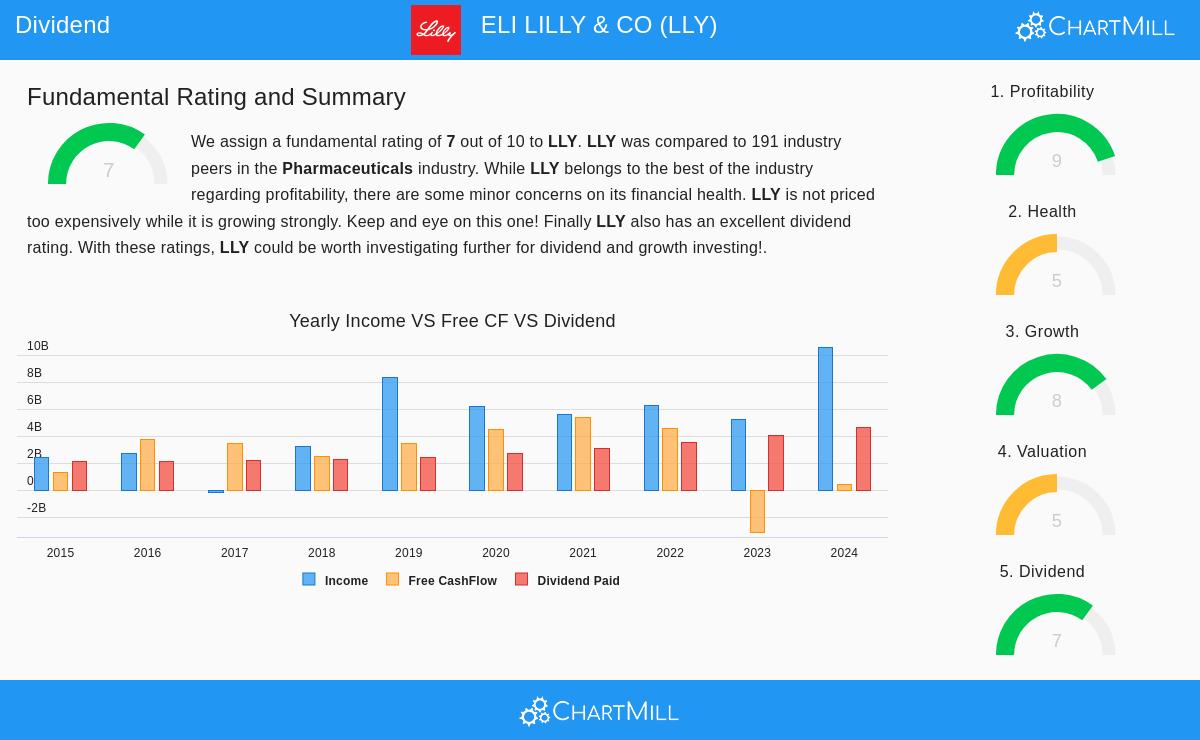
Eli Lilly & Co (NYSE:LLY) appears as a notable candidate from this type of screening method. As a worldwide pharmaceutical frontrunner with a strong pipeline containing treatments for diabetes and obesity, Lilly’s fundamental picture makes a firm argument for dividend-oriented investors, especially those who value growth together with income.
Dividend Profile: Steadiness and Increase
The heart of any dividend investment case rests on the payment itself. Lilly’s dividend profile performs favorably on the important measures of steadiness and increase potential, which are critical for a lasting income method.
- History of Steadiness: The firm has distributed a dividend for at least ten straight years and has not cut it in that time. This extended, uninterrupted record is a sign of corporate dedication to giving capital back to shareholders and offers a degree of predictability that income investors appreciate.
- Notable Dividend Increase: Possibly more notable than the steadiness is the speed of increase. Lilly’s dividend has risen at a yearly rate near 15.6% over the last five years. An increasing dividend helps counter inflation and raises an investor’s actual yield on the first cost over time.
- Secure Payout Ratio: Security is where idea meets reality. Lilly distributes about 28% of its net income as dividends. This is a cautious ratio, leaving most earnings to be put back into research, development, and other expansion projects. It shows the present dividend is easily supported and not endangered by a small earnings shift. Also, the firm’s earnings are rising quicker than its dividend, strengthening the security of future raises.
While its present dividend yield is moderate compared to the wider S&P 500, it is similar to others in its field. For a method that mixes yield with growth and safety, this exchange can be suitable, as the main return source is frequently the compounding result of dividend increase over a long ownership time.
Supported by Firm Profitability
A lasting dividend must be paid for by a profitable company. This is why selecting for good profitability is a required filter; a firm cannot generously share profits it does not make. Lilly performs very well here, having exceptional margins and returns on capital that clearly aid its capability to fund shareholder returns.
The firm’s profitability measures are excellent, with an operating margin above 44% and a return on invested capital (ROIC) close to 29%. These numbers are much higher than field averages and show a very efficient business with pricing strength and a winning product list. High profitability supplies the cash needed to pay for the dividend, invest in future expansion, and keep a firm balance sheet—all without stressing the firm’s means.
Satisfactory Financial Condition with Points
The third element of the screening method—financial condition—makes sure the firm is not over-borrowed and can handle its duties through economic periods. Lilly’s health score shows a mostly firm but varied image. On the good side, the firm has a very strong Altman-Z score, a main sign of financial soundness and low failure risk. However, investors should note a somewhat high debt-to-equity ratio, which points to a considerable use of debt financing.
This is balanced by the firm’s strong cash generation. While the debt amount is high, the very high profitability and cash flow give the ability to manage this debt without difficulty. For dividend investors, the important point is that the firm’s main activities are creating more than enough value to cover its interest costs and dividend payments, though it is an area to watch over time.
Increase at a Fair Price
An extra aspect for dividend investors is the firm’s growth path, as it supports future dividend raises. Lilly is in a strong growth period, with revenue climbing over 45% in the past year and earnings per share growing by more than double. More significantly, this speed is anticipated to persist, with firm analyst predictions for both revenue and earnings growth in the next years.
Price is always a factor. While Lilly’s price-to-earnings ratio is high plainly, it is seen as more fair compared to its field competitors and when including its exceptional growth speed and profitability. The market is valuing continued achievement, which, if it happens, would support the higher price and supply the earnings growth to power more dividend rises.
Summary
Eli Lilly & Co stands as a possible match for a dividend growth method that emphasizes safety and security together with yield. It satisfies a strict screen built on a firm dividend score—aided by a steady history, strong growth, and a secure payout—supported by first-class profitability and satisfactory financial condition. The firm’s rapid growth picture adds a notable aspect, indicating the ability for major dividend raises ahead. As with all investments, this assessment is based on past results and future projections, which are not certainties.
For investors wanting to examine other firms that meet similar standards of high dividend quality, firm profitability, and financial condition, you can see the complete results of the screening method here.
Disclaimer: This article is for informational purposes only and does not constitute financial advice, a recommendation, or an offer to buy or sell any security. All investments involve risk, including the potential loss of principal. Investors should conduct their own research and consult with a qualified financial advisor before making any investment decisions. The fundamental analysis report for LLY referenced in this article can be found here.