

For investors aiming to construct a portfolio centered on steady passive income, a methodical selection process is necessary. One useful approach includes searching for companies that provide a notable dividend and also have the fundamental financial soundness to maintain and increase those payments. This frequently requires examining more than the stated yield to assess the company's earnings, balance sheet, and the durability of its dividend. A stock that performs favorably in these areas can be a more durable choice for long-term dividend investment.
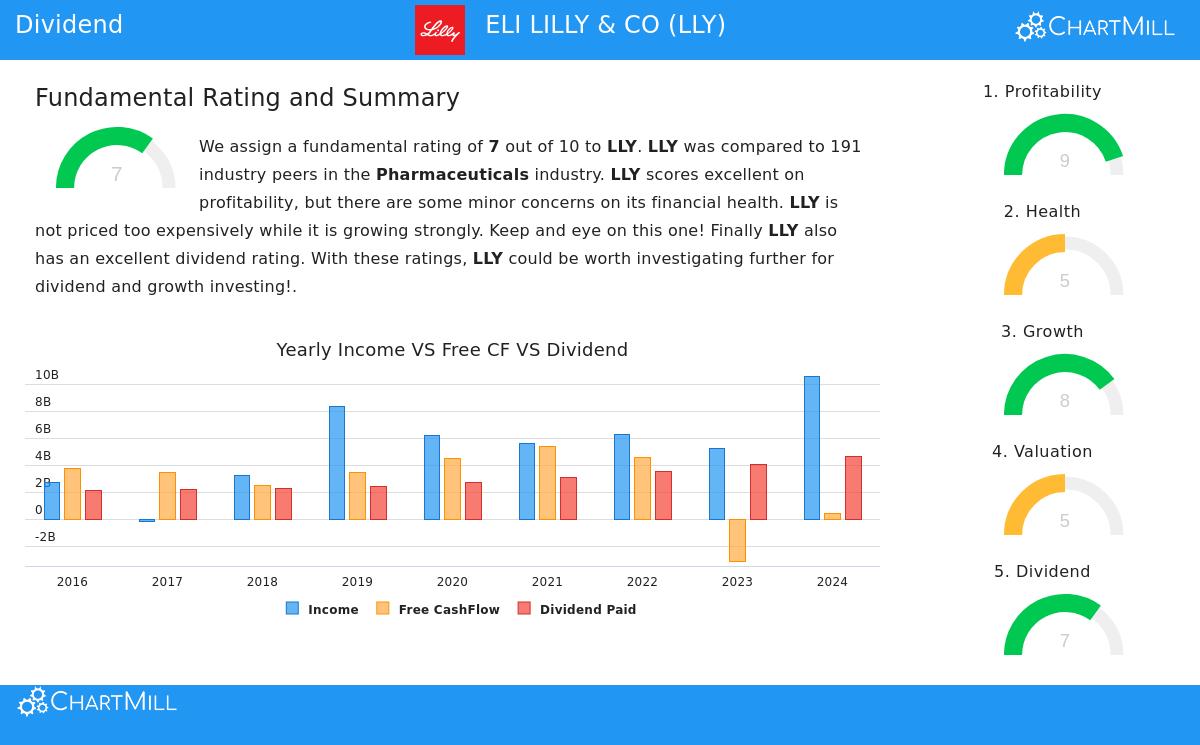
ELI LILLY & CO (NYSE:LLY) results from such a selection process, presenting a strong case for income-oriented investors. The company’s fundamental report displays a balanced assessment, with specific advantages in areas important for dividend durability.
A Focus on Dividend Quality
The center of the selection method emphasizes a high ChartMill Dividend Rating, which combines various important measures into one number. For Eli Lilly, this rating is a good 7 out of 10, signaling a sound overall dividend standing. This number rests on several foundations:
- Steady and Increasing Payout: The company has a flawless history, having paid and raised its dividend for a minimum of ten straight years. This steadiness is a sign of dividend dependability. Also, the dividend is rising at a notable yearly rate of about 15.6% over the last five years.
- Manageable Payout Ratio: Possibly most important for durability, Eli Lilly’s payout ratio is at a very comfortable 28.3%. This indicates under one-third of its profits are paid as dividends, leaving substantial funds to put back into the business, handle debt, and manage economic challenges without threatening the shareholder payment. This low ratio is a main protection against dividend reductions.
- Context on Yield: The present dividend yield is near 0.67%. Although this is under the wider S&P 500 average, it is useful to frame this number. The yield seems lower partially because the company’s stock price has experienced considerable gains from solid business results. Compared to its pharmaceutical industry peers, Eli Lilly’s yield is in fact strong, placing above almost 90% of similar companies.
The Foundation: Profitability and Financial Health
A high dividend yield holds little worth if the company cannot support it. This is why the selection approach also requires satisfactory scores in profitability and financial health, areas where Eli Lilly performs very well and displays some variation, in turn.
Profitability is a notable advantage, with a ChartMill Profitability Rating of 9. The company produces outstanding returns on its capital, greatly exceeding industry norms. Important margins, like Gross, Operating, and Profit Margin, are all in the highest group of the pharmaceuticals sector. This strong profitability is the source that finances the dividend and its increase, directly connected to the durability of the income.
Financial Health gets an average score of 5, pointing to a sound but not perfect situation. The examination shows a combination:
- On the favorable side, the company’s Altman-Z score is very good, indicating no short-term bankruptcy concern, and it stacks up well against industry peers on multiple debt measures.
- The selection filter seeks "satisfactory" health, and points to observe involve a somewhat high Debt-to-Equity ratio and liquidity ratios (Current and Quick Ratio) that are under many industry rivals. These elements are watched but are offset by the company's strong cash flow production, which supplies the ability to handle its debts.
Growth Supporting the Dividend Idea
Importantly, Eli Lilly is not a static income selection. It shows solid growth, with revenue and earnings per share rising at double-digit speeds both in the past and in projections for future years. This growth path is important for the dividend investment thesis, as it implies the company can keep raising its payment without pressuring its finances. The fundamental report states that earnings are rising quicker than the dividend, further supporting the payout's durability.
Valuation Considerations
From a valuation viewpoint, standard measures like the Price-to-Earnings ratio seem high, showing the market’s higher price for the company’s growth outlook and leading product group. However, when growth is considered through measures like the PEG ratio, the valuation seems more acceptable. For a dividend investor concentrated on long-term income steadiness and growth, paying a higher price for a company of this caliber can be acceptable, though it remains a point to note.
Reviewing Additional Possibilities
Eli Lilly & Co. offers an example of how a high-caliber dividend stock manages yield, growth, and financial soundness. Investors curious about locating other companies that fit similar standards of solid dividend ratings along with satisfactory profitability and health can inspect the predefined screen applied in this study.
You can review the current results of this "Best Dividend" screen and adjust the filters to your own criteria here.
For a complete breakdown of all the fundamental factors behind Eli Lilly’s ratings, you can view the full ChartMill Fundamental Analysis Report for LLY.
Disclaimer: This article is for informational purposes only and does not constitute financial advice, a recommendation, or an offer or solicitation to buy or sell any securities. The information presented is based on data provided and should not be the sole basis for any investment decision. Investing involves risk, including the potential loss of principal. Always conduct your own due diligence and consider consulting with a qualified financial advisor before making any investment decisions.