

For investors looking for a disciplined, long-term market method, few strategies are as significant as Peter Lynch’s. The famous manager of Fidelity’s Magellan Fund supported putting money into familiar companies, concentrating on businesses with durable growth, good financial condition, and fair prices. His method, often called Growth at a Reasonable Price (GARP), stays clear of speculative manias by finding companies increasing earnings consistently without getting too expensive. A stock filter using Lynch’s ideas searches for a particular mix of earnings power, balance sheet soundness, and price.
One business that recently appeared using this filter is MICRON TECHNOLOGY INC (NASDAQ:MU), a top maker of memory and storage products. The semiconductor company, whose goods are essential for data centers, AI uses, and consumer electronics, seems to match several important Lynch standards, making it a prospect deserving of more study for investors focused on GARP.
Matching Peter Lynch's Main Standards
Peter Lynch’s plan stresses lasting growth, financial soundness, and a good price when growth is accounted for. The filter uses clear number-based rules to find these qualities. Here is how Micron measures up against several of those important rules:
- Lasting EPS Growth: Lynch preferred businesses with a steady history of earnings growth, but was cautious of rates that were too high to continue. The filter seeks a 5-year average EPS growth between 15% and 30%. Micron’s EPS has increased at an average yearly rate of about 24% over the last five years, putting it directly inside this desired zone. This shows a past of firm, but not excessive, increase.
- Fair Price (PEG Ratio): Possibly the central idea of the GARP method, the Price/Earnings to Growth (PEG) ratio compares a stock’s price to its earnings growth rate. Lynch wanted companies with a PEG ratio of 1 or lower, hinting the market might not completely account for the growth. Micron’s PEG ratio, using its past five-year growth, is about 0.83, pointing to a possibly fair price compared to its historical growth path.
- Good Earnings Power (ROE): Return on Equity (ROE) shows how well a company produces profits from shareholder capital. Lynch looked for solid earnings power, with a minimum ROE of 15%. Micron’s ROE of about 15.76% meets this mark, showing capable management and a firm competitive standing inside the unpredictable semiconductor field.
- Financial Soundness (Debt & Liquidity): A careful balance sheet is key for surviving economic ups and downs. Lynch liked companies financed more by equity than debt, often aiming for a Debt/Equity ratio under 0.6 (and preferably under 0.25). Micron’s Debt/Equity ratio of about 0.26 is very good, showing little dependence on debt funding. Also, its Current Ratio of about 2.52 easily passes the filter’s need of 1, showing sufficient cash to cover near-term needs.
Broad Fundamental Summary
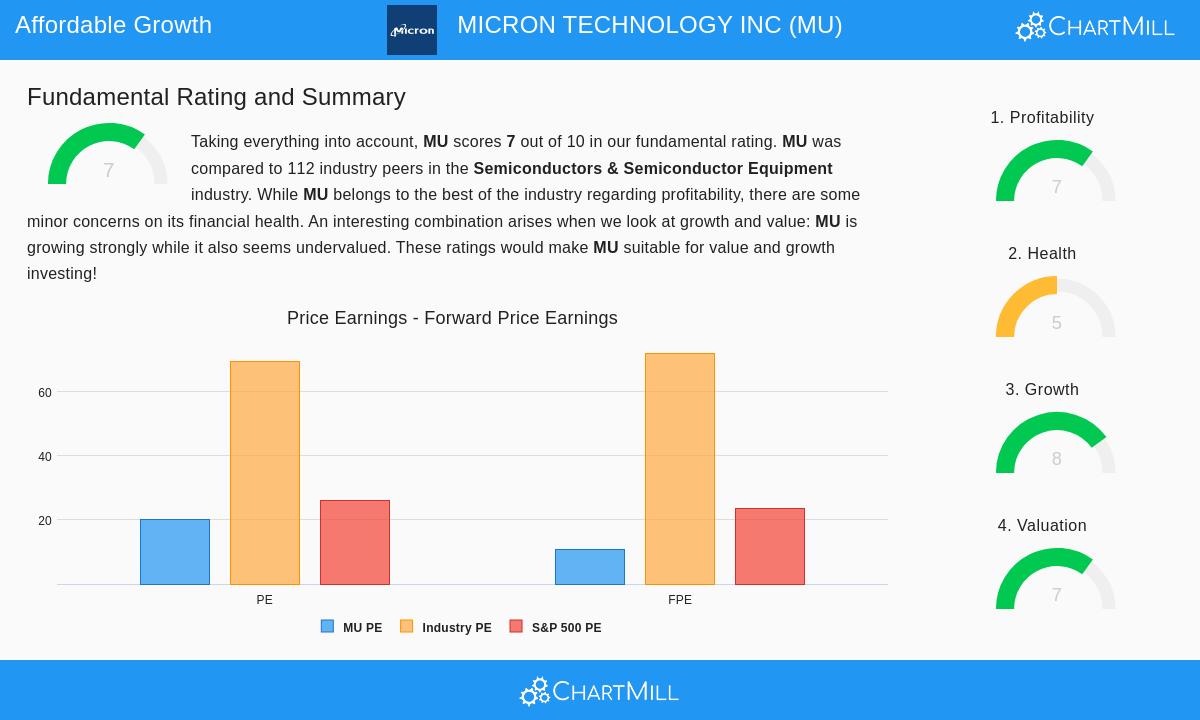
A wider view of Micron’s fundamental condition backs the results from the Lynch-based filter. According to a complete fundamental analysis report, Micron receives a total score of 7 out of 10, doing well against similar companies in the Semiconductors industry.
The company’s advantages are clear in Earnings Power and Growth. It has very good margins and returns on assets, equity, and invested capital that score well against its industry. Most importantly, its growth numbers are firm, with major year-over-year rises in both sales and earnings. While future growth is predicted to slow from recent high levels, analysts still forecast good forward growth rates.
The report mentions some small points in Financial Health, mainly connected to its Debt-to-Free-Cash-Flow ratio, though its overall stability, confirmed by a sound Altman-Z score, and low debt-to-equity level stay good points. From a Price view, while its standard P/E ratio seems high, its forward P/E and Enterprise Value/EBITDA ratios are viewed as low compared to the industry, supporting the good PEG ratio found by the filter.
A Stock for More Study
It is key to recall that a filter is a first step for study, not a instruction to buy. Peter Lynch himself highlighted the need to know the business behind the statistics. For Micron, an investor must think about the recurring pattern of the memory chip market, competition, and the durability of demand from main sources like artificial intelligence.
The company’s fit with Lynch’s standards for lasting growth, financial care, and fair price makes it an interesting example for the GARP idea. Investors wanting to examine other businesses that pass similar rules can see the complete Peter Lynch Strategy filter results here.
Disclaimer: This article is for information only and is not financial guidance, a support, or a suggestion to buy, sell, or keep any security. Investing has risk, including the possible loss of the original amount. Always do your own complete study and think about your personal money situation and risk comfort before making any investment choices.