
By Thursday's close, the Dow Jones had shed 0.4% and the Nasdaq gave back 0.9%, at one point the latter was down 1.7% intraday before buyers stepped back in. The catalyst was a cocktail that's becoming familiar: a fresh geopolitical flare-up in the Middle East, an oil spike, and a software sector that keeps bleeding through earnings season one name at a time.
The Rundown
- Markets reversed Wednesday's record gains as oil surged on renewed fears around the Strait of Hormuz
- Enterprise software stocks took heavy losses as AI disruption fears continue to weigh on sector valuations
- Earnings season overall remains solid, with 85% of S&P 500 reporters beating expectations so far
- Big Tech is accelerating workforce reductions to fund AI spending at a scale that is growing harder to justify without cuts elsewhere
The Oil Spike That Set the Tone
The session looked manageable at the open, until an Iranian news agency reported that air defense systems had been activated in parts of Tehran. Oil didn't wait for confirmation. WTI crude jumped nearly 5% intraday to almost $98 before settling at $96.40, still a 4% gain on the day. Brent closed around $105.
President Trump added to the tension, threatening via Truth Social that the US Navy would attack any vessel laying mines in the Strait of Hormuz. That strait handles a significant portion of global oil and gas exports from the region, and analysts are warning that even if it were to reopen on short notice, market normalisation would take considerably longer. For investors who had celebrated the recent easing of trade war pressures, this is an unwelcome reminder that geopolitical risk has a long memory and a short fuse.
Software Takes the Real Damage
The bigger story - from a portfolio impact perspective - was the carnage in software.
SERVICENOW INC (NOW | ▼17.75%) led the declines with a drop of more than 17% after posting Q1 results. Revenue grew 22% to $3.7 billion, broadly in line with consensus, but the market wanted something more convincing.
Growth took a hit of nearly 1 percentage point due to delayed large deals in the Middle East, a direct consequence of the regional conflict. The company's AI ambitions look credible, it raised its annual contract value target for AI from $1 billion to $1.5 billion, but investors aren't in a generous mood right now, and the guidance for the current quarter, while above expectations, wasn't enough to stem the selling.

The mood swept through the entire sector.
SALESFORCE INC (CRM | ▼8.69%), WORKDAY INC-CLASS A (WDAY | ▼9.42%) and INTUIT INC (INTU | ▼6.21%) all fell sharply on the day without even releasing numbers of their own. That's contagion pricing, one name misses the sentiment bar and the whole sector reprices in sympathy.

INTL BUSINESS MACHINES CORP (IBM | ▼8.25%) provided its own reason for concern. Results landed roughly in line with analyst expectations, but the guidance was the issue. The company held its full-year revenue growth target at "more than 5%" and that's where the problem lies.
IBM recently completed the acquisition of Confluent, a deal that analysts at Bloomberg Intelligence estimate should add more than 1 percentage point to revenue growth on its own. By not raising the outlook to account for that, IBM is effectively signaling that organic growth in other parts of the business is softer than expected. Evercore framed it plainly: consulting demand remains weak, and the incremental upside from Confluent was simply pocketed rather than passed through to guidance.
SAP SE-SPONSORED ADR (SAP | ▼6.19%) fell over 6% during the regular session despite reporting solid numbers after the close, cloud order backlog up 25% and cloud revenue up 27%, both at constant currency and in line with analyst expectations.
CEO Christian Klein spoke of Business AI accelerating momentum and market share gains, and the after-hours market was more receptive: the stock recovered 5% post-close. The daytime selling was a pre-results positioning move driven by the same AI disruption narrative weighing on the sector broadly. Software-as-a-Service companies have had a rough few months, and fear doesn't always wait for the facts.

Texas Instruments: A Different Kind of Chip Story
Not everything was red.
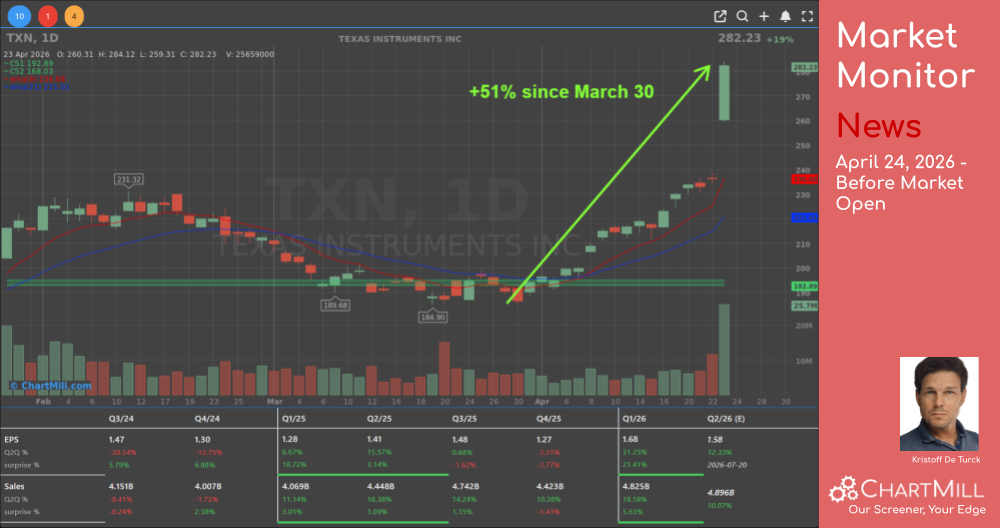
TEXAS INSTRUMENTS INC (TXN | ▲19.43%) was the standout of the session, closing up more than 19% after a quarter that beat on both revenue and earnings per share and prompted two analyst upgrades on the same day. This is what selective earnings season looks like, same market, completely different outcome depending on what's in the envelope.

Intel After Hours: Another Beat Worth Watching
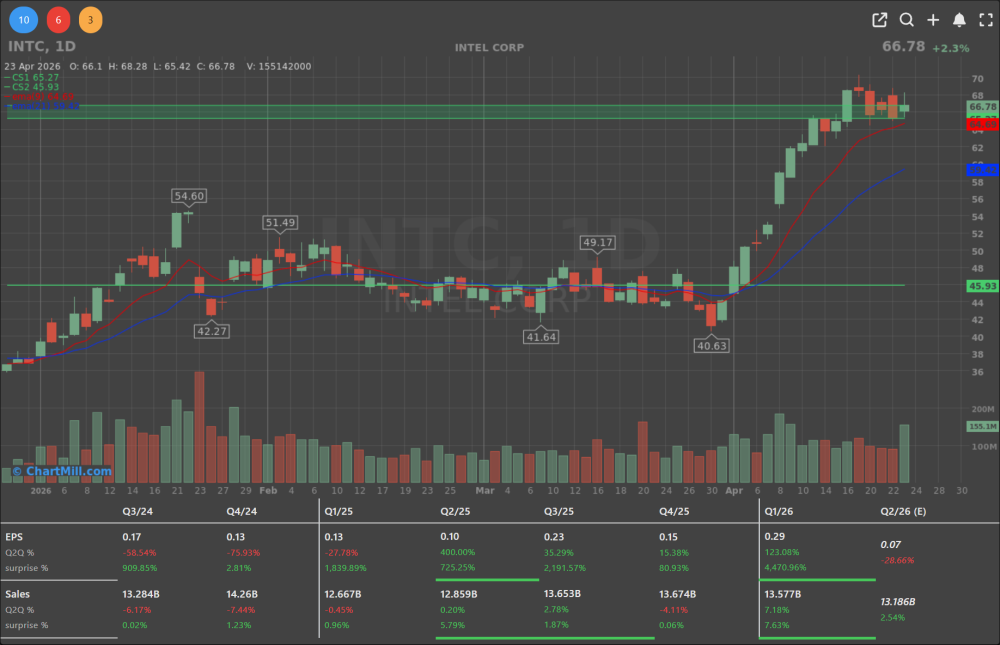
After the close, INTEL CORP (INTC | ▲2.31%) added to the positive semiconductor narrative in a big way. Revenue came in at $13.6 billion for Q1, well above the $12.4 billion consensus and comfortably ahead of Intel's own guidance range of $11.7 to $12.7 billion. The data center and AI segment grew 22% year-over-year to $5.1 billion.
Foundry revenue rose 16% to $5.4 billion. Adjusted EPS of $0.29 crushed the market's estimate of $0.02.
The caveat worth noting: GAAP net loss hit $3.7 billion versus $0.8 billion a year earlier, and operating margin came in at -23.1% compared to -2.4% in Q1 2025. These are numbers from a company still mid-restructuring, the adjusted figures are what the market is focused on. For Q2, Intel guided revenue of $13.8 to $14.8 billion against a consensus of $13.1 billion, and adjusted EPS of $0.20 versus the $0.10 expectation. The stock surged 14% in after-hours trading to above $76, building on what is already an 81% gain year-to-date.
Meta and Microsoft: The Cost of the AI Arms Race
META PLATFORMS INC-CLASS A (META | ▼2.31%) confirmed what Reuters first reported last week: 8,000 jobs will be cut in May, approximately 10% of the total workforce, with another 6,000 open positions going unfilled.
The rationale is direct, CEO Mark Zuckerberg has committed to spending up to $135 billion this year chasing what he describes as "personal superintelligence" for Meta's 3.5 billion daily users. The Llama models are a meaningful step, but Meta still has real ground to make up against OpenAI, Google, and Anthropic. The company's new proprietary model, Muse Spark, is a closed system built specifically to power Meta's AI chatbot and integrate into its social platforms, a different bet from the open-source strategy of the Llama family.
What struck me in the reporting was this detail: Meta is now monitoring employee keystrokes, mouse movements, and clicks to train the next generation of AI models on how to operate computers. That's a meaningful line for any employer to cross, and it tells you something about how seriously the company is treating the competitive gap it needs to close.
MICROSOFT CORP (MSFT | ▼3.97%) took a parallel path, offering voluntary exit packages to approximately 8,750 US employees, around 7% of its American workforce. Eligibility requires combined age and tenure of at least 70 years. Different method, same underlying logic: cut costs now to fund the AI build-out.

The Broader Earnings Picture
Despite the sector-specific stress, the overall earnings season is tracking well. Of the S&P 500 companies that have reported so far, 85% have beaten consensus expectations, according to FactSet data.
A few other names worth noting:
-
AMERICAN EXPRESS CO (AXP | ▼4.31%) posted stronger Q1 profit thanks to higher Platinum card fees and continued high spending from wealthier customers on restaurants and luxury goods and still fell 4% on the day, which says something about where the bar is set.
-
COMCAST CORP-CLASS A (CMCSA | ▲7.73%) ran the opposite playbook, slowing its broadband subscriber losses and reporting ad revenue boosted by the Olympics and Super Bowl.
-
KEURIG DR PEPPER INC (KDP | ▲7.50%) posted higher sales driven by beverages, though rising costs hit profit.
-
HONEYWELL INTERNATIONAL INC (HON | ▼2.56%) met expectations and reiterated its full-year outlook but still closed lower.
-
LOCKHEED MARTIN CORP (LMT | ▼4.62%) reported lower Q1 profit, with full-year revenue guidance midpoint just below the FactSet consensus of $79.2 billion.
-
AMERICAN AIRLINES GROUP INC (AAL | ▲2.43%) booked its third loss in five quarters, though the deficit narrowed.
-
SOUTHWEST AIRLINES CO (LUV | ▼4.07%) flagged that rising jet fuel costs are putting its full-year profit guidance under pressure.
-
On the media consolidation front, WARNER BROS DISCOVERY INC (WBD | ▼1.57%) shareholders voted Thursday to approve the sale of the company to PARAMOUNT SKYDANCE CL B (PSKY | ▼4.49%), moving the proposed merger a step closer to completion. Deal finalisation is expected in Q3, subject to regulatory approval. Paramount won the bidding contest over Warner in February.
Macro: PMI Holds Up, But the Fed Isn't Done
On the economic data side, the picture was generally constructive.
-
The composite PMI for April hit 52.0, the highest reading in three months. Services returned to expansion at 51.3, up from 49.8 in March, while manufacturing rose to 54.0. These are solid numbers that suggest the US economy is absorbing current pressures better than feared.
-
Weekly jobless claims came in at 214,000, up 6,000 from the prior week, still historically low.
-
The Chicago Fed National Activity Index softened slightly to -0.20 in March from +0.03 in February. The euro/dollar was trading at 1.1687 Thursday evening.
Conclusion
Thursday's session crystallised the fault line running through this market. On one side, semiconductors proving that AI investment creates genuine hardware demand, Texas Instruments and Intel both delivered on that thesis in compelling fashion.
On the other, enterprise software getting systematically repriced as investors question whether the subscription revenue model survives the transition to AI-native workflows.
The underlying earnings season remains solid, an 85% beat rate is hard to argue with. But sentiment is running ahead of fundamentals right now, and oil at $96 with a hostile Strait of Hormuz narrative in the background means the geopolitical overlay isn't going away any time soon. Choose your exposures carefully.
ChartMill Market Desk - Kristoff
This daily update is prepared by ChartMill for informational purposes only and does not constitute investment advice. Always do your own due diligence before making investment decisions.