


We are witnessing a high-stakes arms race in artificial intelligence, where the "entry fee" has just been hiked to levels that would make a small nation’s treasury blush.
It is a bizarre time for the markets; on one hand, the tech that was supposed to save our portfolios is now the very thing keeping investors awake at night due to the sheer cost of building it.
The Cloud Giants and the $200 Billion Question
The primary focus of the session was the eye-watering investment forecast from Amazon (AMZN | -4.42% and after hours -11.2%).
CEO Andy Jassy shocked the market by announcing a planned $200 billion capital expenditure for 2026, a figure that dwarfed the analyst consensus of $146.1 billion.
While Amazon saw its AWS cloud revenue jump 24% to $35.6 billion, investors initially pushed the stock down over 10% in after-hours trading.
I find Jassy’s defense of this spending particularly compelling: unlike Microsoft (MSFT | -4.95%), which has been hampered by internal capacity constraints, Amazon claims that nearly all its new AI capacity is immediately being utilized by external customers.
This "instant monetization" could be the differentiator that saves Amazon from the skepticism currently hounding Alphabet (GOOGL | -0.54%), which is planning its own 175–185 billion investment spree.
Alphabet did manage to recover some ground during the session after a 7% intraday dip, as bargain hunters realized that AI tools like Gemini aren't yet cannibalizing Google's core search business.

The "Anthropic Chill" Hits Financial Services
It wasn't just the big spenders feeling the heat; a new software release sent ripples through the financial data sector.
Anthropic released Claude Opus 4.6, an AI model specifically designed for deep financial research. The prospect of an AI performing days' worth of human analysis in seconds sent a shiver through established players.
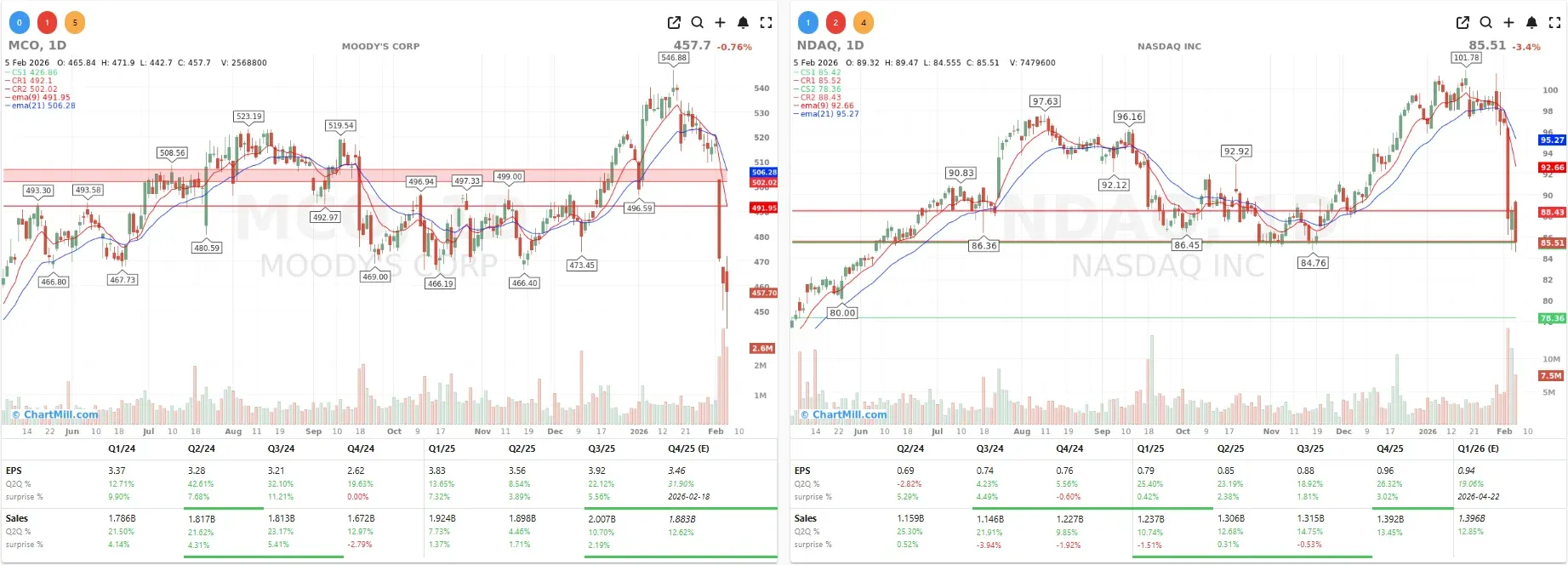
We saw sharp declines in FactSet Research (FDS | -7.21%), S&P Global (SPGI | -2.96%), Moody's (MCO | -0.76%), and Nasdaq (NDAQ | -3.37%). In my view, this is a classic "disruption scare."
Investors are terrified that these legacy data moats are being bridged by smarter, faster algorithms.

Macro Cooling and the Crypto Correction
While tech dominated the headlines, the broader economic picture suggests the U.S. labor market is finally showing some cracks.
Weekly unemployment claims are up, and job vacancies have seen a sharp decline. This data led some analysts to worry that the Federal Reserve might have pivoted its focus toward inflation a bit too early, potentially ignoring a cooling employment sector.
The risk-off sentiment was felt most acutely in the crypto markets.
Bitcoin plummeted 13% to roughly $64,300, dragging the entire sector down with it.

This led to a painful day for Coinbase (COIN | -13.34%), which saw its value slashed as long positions were liquidated across the board.

Meanwhile, on the geopolitical front, I’m keeping a close eye on the scheduled talks between the U.S. and Iran in Oman; any progress there could stabilize oil prices, which slid about 1.1% today.
Conclusion
The current market sentiment is one of "show me the money."
While the AI revolution is undeniably real, the costs of participation are rising faster than many expected. In my opinion, we are moving out of the "hype phase" and into the "execution phase."
Investors should look closely at their portfolios to ensure they aren't just holding "AI potential," but rather companies like Amazon that can prove they are turning that massive infrastructure spend into immediate, billable revenue.
Stay cautious.
Kristoff - ChartMill
Next to read: Sellers Take Control Again as Breadth Breaks Down