
For investors aiming to assemble a portfolio of lasting, high-standard businesses, the ideas of quality investing offer a useful structure. This method centers on finding companies with durable competitive strengths, reliable profitability, sound financial condition, and the capacity to produce strong returns on capital over many years. One orderly process for finding these companies is the "Caviar Cruise" stock screen, which uses a set of numerical filters to separate firms with a record of solid growth, high returns, and financial control. The screen highlights measures like continued revenue and profit growth, a strong return on invested capital (ROIC), reasonable debt amounts compared to cash flow, and high-grade earnings that become actual cash.
A present example that satisfies this strict screening is COSTCO WHOLESALE CORP (NASDAQ:COST). The warehouse retail leader displays many of the traits that quality investors value, making it a leading subject for more study within this investment approach.
Matching the Central Standards for Quality
The Caviar Cruise screen rests on several basic supports, each made to gauge a separate part of a company's lasting power. Costco's financial picture matches these main needs closely.
-
Continued Growth: The screen calls for at least a 5% compound annual growth rate (CAGR) for both revenue and EBIT (earnings before interest and taxes) over five years. Costco surpasses this clearly, with a 5-year revenue CAGR of 7.09% and a more notable EBIT CAGR of 11.20%. Importantly, EBIT growth rising faster than revenue growth—as observed here—is a good sign of gaining operational effectiveness and possible pricing strength, a central idea of quality investing that indicates the business is turning more profitable as it gets larger.
-
Excellent Capital Use: Maybe the most important filter for quality is a high Return on Invested Capital (ROIC), which calculates how well a company produces profits from its capital foundation. The screen needs an ROIC (leaving out cash, goodwill, and intangibles) over 15%. Costco stands out here with a number of 33.67%, showing outstanding effectiveness in using its capital to build value for shareholders. A steadily high ROIC is frequently the sign of a business with a lasting competitive edge.
-
Financial Strength and Earnings Grade: Quality investing prefers companies with firm balance sheets and actual, cash-based profits. The screen selects for a Debt-to-Free Cash Flow ratio under 5, meaning it should need no more than five years of present cash flow to clear all debt. Costco's ratio of 0.64 is ideal, showing very small debt load and major financial room to act. Also, the screen looks for a 5-year average Profit Quality (Free Cash Flow/Net Income) over 75%. Costco's average of 92.22% reveals that almost all its accounting profits become real free cash flow, highlighting the high grade and durability of its earnings.
A View of Costco's Basic Profile
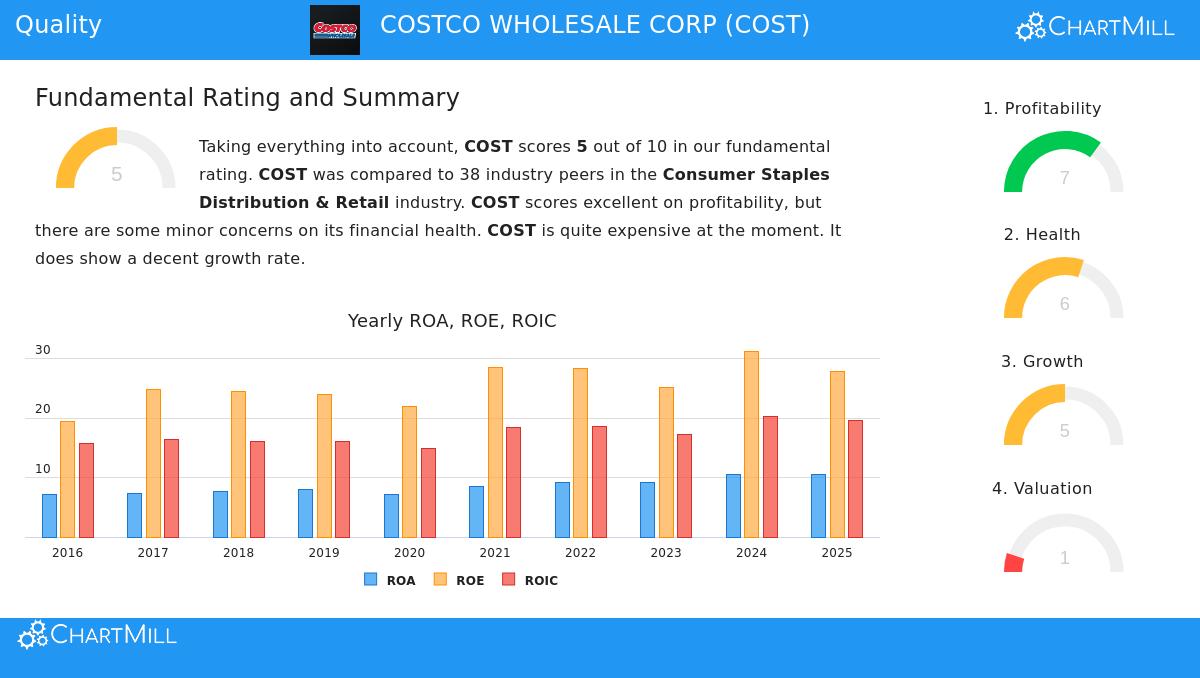
A look at Costco's wider basic analysis report supports its position as a quality candidate. The company gets a firm profitability score, pushed by sector-leading returns on equity and invested capital. Its financial condition is solid, backed by a very small debt amount and a firm Altman-Z score, though its current and quick ratios indicate a normally tight inventory management style common in retail. The growth view is good, with sound historical gains in revenue and EPS, although analysts expect a slight slowing in the growth rate in the future.
The most notable area of debate for any investor, particularly a quality-oriented one, is price. The report plainly marks Costco as high-priced on common measures like Price-to-Earnings and Price-to-Free Cash Flow, both compared to its sector and the wider market. This highlights a central idea of quality investing: while finding superior businesses is the initial stage, deciding a reasonable price to pay for ownership is a necessary next stage. You can examine the complete points of this analysis in Costco's fundamental report.
The Non-Measured Traits of a Quality Business
Outside the countable measures, Costco shows several non-measured features that fit with quality investing ideas. Its business model—based on membership fees, large sales, and very high operational effectiveness—creates a strong competitive barrier. The company holds notable pricing strength with suppliers because of its huge size, and its dedicated membership base supplies a repeating, forecastable income source. The model can be applied worldwide, as shown by its global growth, and is fairly stable during recessions, as customers focus on value in economic slowdowns. These qualities match the non-numerical checks a quality investor would do after a numerical screen.
Finding More Quality Candidates
Costco Wholesale acts as a useful example of a company that fits tight numerical filters for quality. For investors looking to study other companies that share these financial traits, the Caviar Cruise screen can be a helpful beginning point. You can see and adjust the screen to view the present list of passing stocks by using this link to the stock screener.
Disclaimer: This article is for information only and does not make up financial guidance, a suggestion, or an offer to buy or sell any security. Investing carries risk, including the possible loss of original capital. You should do your own study and talk with a certified financial advisor before making any investment choices.