
For investors looking to assemble a group of lasting, high-standard businesses, the quality investing method provides a useful structure. This method centers on finding firms with durable competitive positions, reliable earnings, sound financial condition, and the capacity to produce high returns on capital over many years. One organized way to find these firms is the "Caviar Cruise" stock screen, which uses a set of numerical filters to separate companies displaying these signature features of quality. The screen looks for persistent revenue and earnings expansion, high returns on invested capital, solid free cash flow production, and a prudent balance sheet.
A recent run of this screen has found COSTCO WHOLESALE CORP (NASDAQ:COST) as a candidate for more detailed review. The warehouse retailer seems to match a number of central ideas of quality investing, shown by its financial numbers.
Matching the Central Standards for Quality
The Caviar Cruise screen employs particular financial limits to describe a quality business. Costco's results against these main filters are good:
-
Persistent Expansion: The method requires companies to demonstrate a record of growth. Costco's five-year compound annual growth rate (CAGR) for revenue is 6.26%, above the screen's 5% lower limit. More notably, its EBIT (earnings before interest and taxes) has expanded at an 11.20% CAGR over the same time. This difference, where earnings growth exceeds sales growth, is a key screen filter. It points to better operational effectiveness, economies of scale, or pricing ability, all features of a company with a lasting competitive position.
-
Outstanding Capital Effectiveness: Possibly the most important measure for quality investors is the return on invested capital (ROIC), which calculates how well a company produces earnings from its capital base. The screen asks for an ROIC (leaving out cash, goodwill, and intangibles) over 15%. Costco is well above this, with a number of 33.67%. This high return shows that management is very good at using capital to build value for shareholders, a central idea of any long-term investment.
-
Financial Strength and Cash Flow Character: Quality investing emphasizes financial security and the capacity to change accounting profits into actual cash. The screen assesses this through two points:
- Debt Management: The Debt-to-Free Cash Flow ratio indicates how many years it would take to eliminate all debt using present cash flow. A ratio under 5 is seen as good. Costco's ratio of 0.63 is very strong, showing little debt load and ample financial room.
- Earnings Character: This measure contrasts free cash flow with net income, with a five-year average over 75% desired. Costco registers 92.22%, proving that its stated earnings are reliably turned into cash. This high-character cash flow can be used to fund the business, distribute dividends, or buy back shares without needing outside funding.
A Broad Fundamental Look
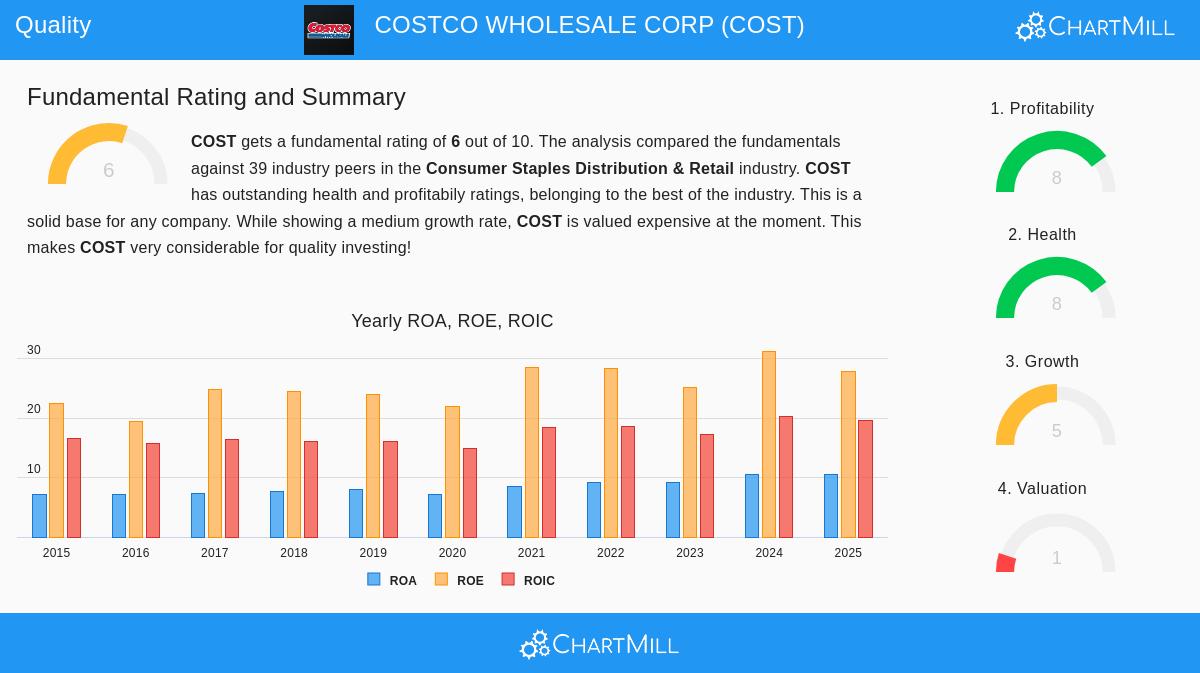
A check of Costco's wider fundamental analysis report supports the image shown by the screen. The company gets a total fundamental score of 6 out of 10, with specific good points in profitability and financial condition.
- Profitability is a definite positive, scoring 8 out of 10. The report notes Costco's sector-leading returns on equity (27.40%) and invested capital (19.55%), together with steady and rising profit margins.
- Financial Condition is sound, also scoring 8 out of 10. The very good Debt-to-FCF ratio is mentioned, as is a favorable Debt-to-Equity ratio of 0.19. While some standard liquidity ratios seem middling, the report explains this within Costco's particular business model and outstanding debt position.
- The main caution is in Valuation, which scores a low 1 out of 10. With a Price-to-Earnings ratio over 46, the stock is priced at a large premium compared to both its sector and the wider market. This is a common issue for quality companies, investors must determine if the premium is warranted by the company's lasting competitive strengths and growth path.
- Growth is scored as medium (5/10), with good past performance in revenue and EPS, although analysts expect a modest slowing in the growth rate in the future.
Is Costco a Quality Investment?
For an investor using a quality-centered, long-term strategy, Costco makes a strong argument. It runs a straightforward, clear business model based on a membership system that creates customer retention and repeat revenue. Its financials show the traits the Caviar Cruise screen aims to locate: reliable expansion, excellent capital use, very strong balance sheet, and high-character earnings.
The principal question for any possible investor is not about the company's quality, which seems clear, but about its cost. Quality often comes at a higher price, and Costco fits this pattern. The investment choice finally depends on whether one thinks the company's competitive position and future expansion can support its present price over a period of several years.
You can review other companies that meet the Caviar Cruise quality screen by viewing the full screen results here.
,
Disclaimer: This article is for informational purposes only and does not constitute financial advice, a recommendation, or an offer to buy or sell any securities. The analysis is based on data provided and certain screening criteria, which may not be suitable for all investors. You should conduct your own research and consult with a qualified financial advisor before making any investment decisions.