For investors looking for steady income, a methodical selection process is important. One useful tactic focuses on stocks that provide a good dividend and also show the financial capacity to keep paying it. This method favors companies with a high ChartMill Dividend Rating, which looks at yield, growth, history, and how safe the payout is. It also sets minimum levels for the ChartMill Profitability and Health Ratings. This makes sure the companies are fundamentally strong, profitable enough to produce cash for dividends and financially stable enough to handle economic shifts without putting those payments at risk. This process helps sort through the market to identify lasting income providers, not simply stocks with high yields that may be risky.
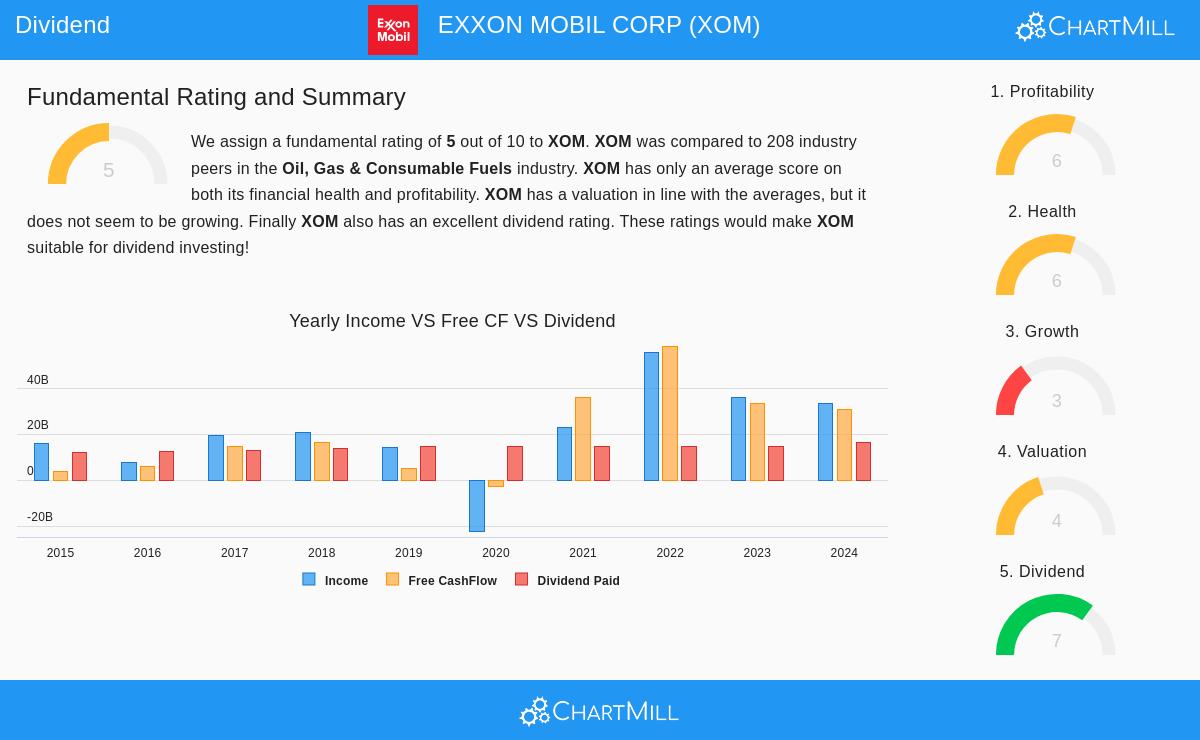
A clear example found using this filter is EXXON MOBIL CORP (NYSE:XOM). The large energy company scores well on the chosen measures, making a strong argument for portfolios centered on dividends.
A High-Quality Dividend Profile
The main attraction of XOM is found in its solid dividend traits, which give it a ChartMill Dividend Rating of 7 out of 10. This rating combines a few important elements for income investors.
-
Good and Steady Yield: The company provides a firm yearly dividend yield of 3.45%. This is almost two times the present average yield of the S&P 500 (about 1.87%), creating a notable income flow. Significantly, this yield is supported by a strong history. Exxon Mobil has paid and has not reduced its dividend for at least ten straight years, showing a deep company dedication to giving cash back to shareholders.
-
Maintainable Payments: A high yield loses value if it could be reduced. Here, Exxon’s financial numbers give confidence. The company pays about 57.5% of its earnings as dividends. Although this is above average, it stays within a workable level, keeping some profits for reinvestment and safety during weak periods. The dividend’s durability is further supported by the company’s history of earnings growth being faster than its dividend growth, a positive trend for long-term strength.
-
Small but Consistent Growth: Dividend growth shields an investor’s income from inflation. Exxon Mobil has provided a steady, though small, yearly dividend growth rate of about 3% in recent years. This regularity, instead of unpredictable high growth, fits with the company’s established, cyclical business and strengthens the view of a reliable income stock.
Supporting Basics: Profitability and Stability
The selection method correctly highlights that a good dividend needs a firm base. Exxon Mobil’s acceptable scores in profitability (Rating: 6) and financial stability (Rating: 6) supply that needed support.
The company’s profitability figures, like its Return on Equity (11.50%) and Return on Invested Capital (7.29%), are strong within the oil and gas industry, showing good use of capital. While margins have been challenged, they have gotten better lately. This basic profitability is what supplies the money for the dividend.
From a stability view, Exxon Mobil shows a firm balance sheet. Its low Debt-to-Equity ratio of 0.13 indicates very little use of debt financing compared to equity, a mark of financial toughness. Also, its Altman-Z score of 4.00 points to a very small short-term chance of financial trouble. These points are important for a dividend investor, since a company with heavy debt or cash problems often cuts its payment first during a market drop.
Price and Growth Points
Exxon Mobil’s price is mostly similar to industry averages, with a P/E ratio near 16.5. This implies the market is not paying too much for its earnings or dividend. Still, it is key to see the company’s growth outlook is quiet. Recent yearly earnings and sales have gone down, and future sales growth forecasts are level to slightly lower. This is a common trait of a big, established company in a commodity-based field. For an investor focused only on growth, this is a weak point. For a dividend investor, it clarifies the type of opportunity: this is a choice for stable income and protecting capital, not large gains in share price.
Conclusion
Exxon Mobil Corp shows the kind of stock a careful dividend selection process tries to find. It joins a good, well-backed yield with a notable history of payments, all supported by the profitability and financial stability required to continue it through industry changes. While its growth potential is low, it fills a particular place in a portfolio: as a basic income-producing holding from a leading industry company.
For investors wanting to use this approach and find other companies that fit these standards of high dividend quality, firm profitability, and good financial stability, you can review the fully set Best Dividend Stocks screen.
Disclaimer: This article is for information only and is not financial advice, a suggestion, or an offer to buy or sell any security. The review uses current information and past results, which do not guarantee future outcomes. Investors should do their own study and talk with a qualified financial advisor before making any investment choices.