

For investors looking for chances where the market price may not completely show a company's basic strength, a methodical screening method can be a helpful first step. One such process looks for companies that seem basically priced low by the market while still showing firm operational condition, earnings, and growth outlook. This tactic fits with central value investing ideas, which concentrate on finding good businesses selling for less than their inherent worth, thus offering a possible "margin of safety." The aim is to steer clear of "value traps"—low-priced stocks of weakening companies—by confirming that appealing valuation measures are backed by sound and improving fundamentals.
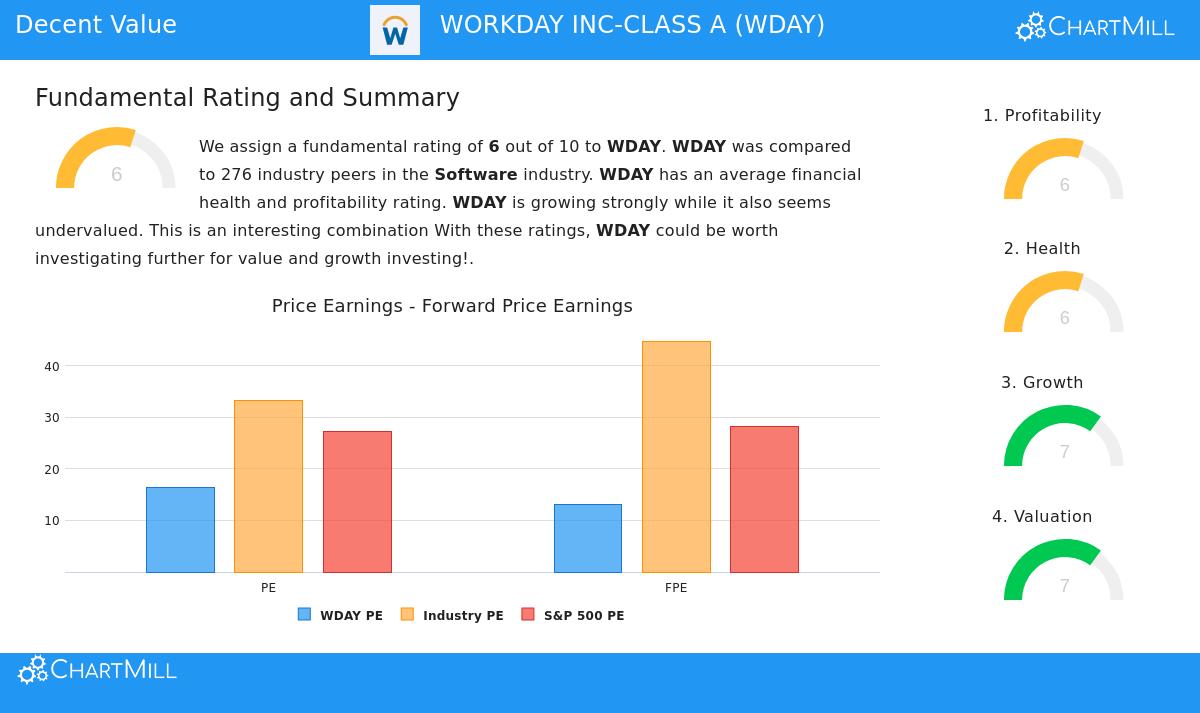
A recent filter using this thinking found Workday Inc. (NASDAQ:WDAY), a top provider of enterprise cloud applications for finance and human resources. The filter specifically selected for stocks with a high ChartMill Valuation Rating (above 7 out of 10) paired with acceptable scores in Growth, Financial Health, and Profitability. This pairing indicates a stock that the market may be valuing ineffectively compared to its business results and future possibility. A more detailed review of Workday's fundamental report shows why it met this filter and deserves more attention from investors focused on this tactic.
Valuation: Priced Lower Than Similar Companies
The main attraction of Workday in this filter is its valuation rating of 7. The full report shows the stock is priced cautiously relative to both its industry and the wider market.
- Price-to-Earnings (P/E): Workday's P/E ratio of 16.43 is seen as a fair valuation alone, but it becomes more interesting in comparison. It is less expensive than 76% of its software industry counterparts and is notably under the S&P 500 average of 27.27.
- Forward P/E: The view is similar for the future. With a forward P/E of 13.08, Workday is valued lower than 79% of its industry and seems low-cost next to the S&P 500's forward P/E of 28.16.
- Cash Flow & EBITDA Multiples: The value argument goes beyond earnings. Judging by its Enterprise Value to EBITDA and Price/Free Cash Flow ratios, Workday is priced more affordably than over 76% and 81% of industry firms, in that order.
For an investor focused on value, these numbers are important. They form the numerical beginning for spotting a possible difference between market price and inherent value. That these discounts are present while the company keeps other fundamental positives is what creates an interesting case.
Growth and Profitability: The Driver Supporting the Value
A low-priced stock is only a worthwhile investment if the company is expanding and earning money; if not, the low price may be reasonable. Workday's growth rating of 7 and profitability rating of 6 imply it has the operational driver to possibly support a higher valuation later.
Growth Path:
- Past Results: Workday has shown solid historical expansion, with Revenue rising by 13.16% over the last year and by a typical 18.42% each year over recent years. Even more notable, its Earnings Per Share (EPS) has increased by 24.89% in the past year, with a very strong typical yearly growth rate of 30.89%.
- Future Predictions: Experts think this progress will carry on, though at a somewhat slower rate. Future EPS growth is forecast at 17.66% per year, with Revenue predicted to grow by 12.42%.
Profitability Condition:
- Margins: The company has good margins that beat many rivals. Its Operating Margin of 15.55% is higher than 81% of the software industry, and its Profit Margin of 13.10% exceeds 75% of similar companies.
- Returns on Capital: Workday produces firm returns on the capital it uses. Its Return on Invested Capital (ROIC) of 9.29% is better than 82% of the industry, showing effective use of capital to create earnings.
This pairing is central to the screening tactic. Strong, continued growth and high earnings are signs of a lasting competitive edge and a high-caliber business—precisely the kind of firm a value investor wants to hold when it is briefly unpopular.
Financial Health: A Steady Base
A company's financial condition is its cushion during economic shifts. Workday gets a health rating of 6, showing a typical but steady financial standing, which helps lower risk.
- Balance Sheet Condition: Workday has a workable Debt/Equity ratio of 0.34, suggesting it is not too dependent on debt funding. More significantly, its Debt to Free Cash Flow ratio is a very good 1.16, meaning it could pay off all its debt with just a bit more than one year's cash flow. This is a positive sign of financial adaptability.
- Solvency & Liquidity: The company's Altman-Z score of 3.55 shows no short-term bankruptcy danger and is higher than 70% of the industry. Its Current and Quick Ratios (both 1.83) match industry averages, indicating it should easily meet immediate responsibilities.
For the value investor, a good financial health rating lessens the chance that the "low valuation" is really a sign of coming financial trouble. It offers the steadiness required for the company to follow its growth strategy and for the investment idea to develop with time.
Conclusion and Next Steps
Workday Inc. offers an example of how a screening method can point out possible chances. It shows the classic sign of what value investors frequently look for: a market price that seems separate from the company's basic fundamentals of growth, earnings, and financial steadiness. The stock sells at a clear discount to its software counterparts and the wider market while still reporting solid revenue growth, improving earnings, and keeping a firm balance sheet.
This picture suggests the stock may be priced low, but as with any filter, it is a beginning for more thorough investigation. Investors should think about industry trends, competitive challenges, and the company's specific growth plan to build a full opinion.
This review was made using Workday's fundamental report, which you can examine completely here.
If you want to look into other companies that fit similar standards of good valuation combined with acceptable fundamentals, you can use the "Decent Value Stocks" filter yourself. Click here to view the current filter outcomes and search for more possible chances.
Disclaimer: This article is for information only and is not financial guidance, a suggestion, or a bid to buy or sell any securities. The information given is based on supplied data and should not be the only ground for any investment choice. Investing holds risk, including the chance of losing the original amount. Always do your own investigation and think about talking with a certified financial advisor before making any investment choices.