

For investors aiming to assemble a portfolio of lasting, superior businesses, the quality investing method provides a structured system. This process centers on finding firms with durable competitive strengths, reliable earnings, sound financial condition, and the capacity to produce high returns on capital. Instead of searching for steep discounts, quality investors frequently accept a reasonable price for outstanding businesses they can own for many years. An organized method to find these prospects is using a stock filter constructed on measurable pillars of quality, like persistent revenue and earnings expansion, high returns on invested capital, solid free cash flow generation, and an acceptable level of debt.
One company that appears from such a quality-oriented filter is The Trade Desk Inc (NASDAQ:TTD), a top technology platform for digital advertising buyers. The company’s presence on a filter using the "Caviar Cruise" quality investing method indicates its financial characteristics match the strict standards desired by long-term investors.
Matching the Essential Quality Standards
The Caviar Cruise filter uses multiple criteria to find companies with a record of high performance and a base for future stability. The Trade Desk’s financial figures show a good alignment with these central ideas:
-
Persistent Expansion: The filter demands at least a 5% compound annual growth rate (CAGR) for both revenue and EBIT (earnings before interest and taxes) over five years. The Trade Desk significantly surpasses this, with a 5-year revenue CAGR of 15.93% and a notable EBIT CAGR of 30.65%. Crucially, its EBIT expansion exceeds its revenue expansion, a primary filter condition that points to improving profitability and possible pricing strength or operating efficiencies.
-
Outstanding Capital Effectiveness: A fundamental aspect of quality investing is a high return on invested capital (ROIC), which gauges how well a company produces earnings from its capital foundation. The filter selects for an ROIC (excluding cash, goodwill, and intangibles) over 15%. The Trade Desk’s ROICexgc of 25.37% shows it is a very effective user of capital, creating substantial value from its investments and holding a lasting competitive edge.
-
Financial Soundness and Cash Flow Integrity: The method prioritizes financial condition by examining debt compared to free cash flow (FCF) and the integrity of reported earnings.
- The filter seeks a Debt/FCF figure under 5. The Trade Desk has a figure of 0.0, carrying no interest-bearing debt on its balance sheet. This clean financial state offers great operational freedom and lowers risk.
- The "Profit Quality" measure, which contrasts free cash flow with net income, must average above 75% over five years. The Trade Desk’s average of 337.04% is very high, showing it turns accounting earnings into actual cash flow at an impressive rate. This supplies the means for reinvestment, possible shareholder rewards, or strategic purchases without needing outside funding.
A Broad Fundamental Perspective
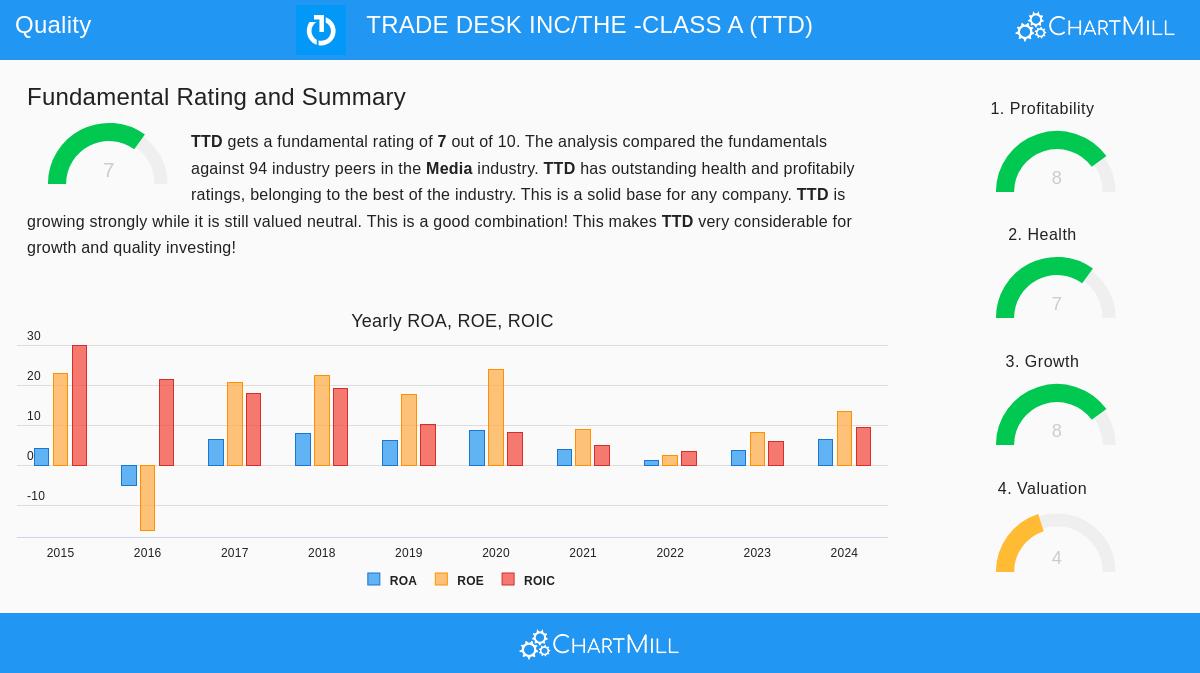
A detailed fundamental analysis of The Trade Desk supports the view obtained from the quality filter. The company receives a good total fundamental score of 7 out of 10, with specific high scores in two areas:
- Profitability (Score: 8/10): The company performs very well here, with profit and operating margins that place in the highest tier of its sector. Its high gross margin of almost 79% highlights the scalable, software-based character of its platform.
- Financial Condition (Score: 7/10): Besides having no debt, the company’s Altman-Z score shows no bankruptcy danger, and its liquidity figures are good. A point for investors to watch is the past rise in shares outstanding, which can reduce ownership proportion over time.
The analysis also mentions that while expansion is anticipated to stay strong, the speed is forecast to slow from the unusual historical levels. The valuation shows a varied image; while some standard price-to-earnings measures seem high, they are more acceptable relative to both the market and the company’s own high-expansion, high-profitability nature.
Is It a Quality Match?
For an investor applying the quality system, The Trade Desk offers a persuasive profile. It functions in the expanding digital advertising market, supplying an essential, cloud-based platform that gains from the long-term movement of ad spending toward programmatic and connected TV (CTV) avenues. Its absence of debt, excellent cash flow generation, and top-tier returns on capital indicate a business with a strong defense, operated by effective management.
However, the quality investing method also includes evaluating less measurable elements. Investors need to think about the durability of the company’s competitive position in an active technology environment, the skills of its management team, and if the present market price represents a reasonable cost for this degree of quality, a stage the filter purposely reserves for the individual investor’s assessment.
The Caviar Cruise filter is made to find companies deserving of this more thorough, non-quantitative study. You can review the present outcomes of this quality stock filter and view which other companies meet its criteria by clicking here.
Disclaimer: This article is for informational purposes only and does not constitute financial advice, a recommendation, or an offer or solicitation to buy or sell any securities. The information presented is based on data provided and should not be the sole basis for any investment decision. Investing involves risk, including the potential loss of principal. Always conduct your own due diligence and consult with a qualified financial advisor before making any investment decisions.