

For investors looking for a structured, long-term market method, few plans are as respected as the one made famous by Peter Lynch. The famous leader of Fidelity's Magellan Fund supported a "growth at a reasonable price" (GARP) idea, concentrating on firms with solid, lasting growth, very good financial condition, and prices that do not overvalue that future promise. His way is not about following the most popular fads but about finding soundly managed enterprises that an investor can comprehend and keep with assurance for years. A stock filter using Lynch's main ideas can find firms that match this pattern, and one such company that recently appeared is The Trade Desk Inc - Class A (NASDAQ:TTD).
Match with Lynch's Main Rules
The Peter Lynch filter uses particular, measurable checks to find companies that fit his investment view. The Trade Desk seems to match well with a number of these important rules, which are made to check for lasting growth, careful finances, and good price.
- Lasting Earnings Growth: Lynch preferred companies increasing earnings per share (EPS) between 15% and 30% each year over five years. Growth over 30% was often viewed as hard to maintain. The Trade Desk states a solid five-year EPS growth rate of 21.2%, putting it directly in Lynch's desired range. This shows a past of good, but not excessively fast, increase.
- Sensible Price via PEG Ratio: Maybe the central part of Lynch's pricing method is the Price/Earnings to Growth (PEG) ratio. He looked for companies with a PEG of 1 or lower, meaning the market is not paying too much for the firm's growth path. With a PEG ratio of 0.79, The Trade Desk sells at a price that rewards investors for its past growth, a good sign for GARP investors.
- Outstanding Financial Condition: Lynch highlighted a firm balance sheet. His filter asks for a Debt-to-Equity ratio under 0.6, with a liking for even smaller amounts. The Trade Desk does very well here, having no debt (Debt/Equity of 0.0). This gives great operating freedom and lowers risk in economic slowdowns. Also, its Current Ratio of 1.61 easily passes the filter's need of 1 or more, showing enough cash to cover near-term needs.
- High Profit Level: A smallest Return on Equity (ROE) of 15% was Lynch's standard for good use of shareholder money. The Trade Desk's ROE of 17.8% not only meets but goes past this line, showing that leadership is successfully creating profits from the money put into the firm.
Basic Condition and Quality Picture
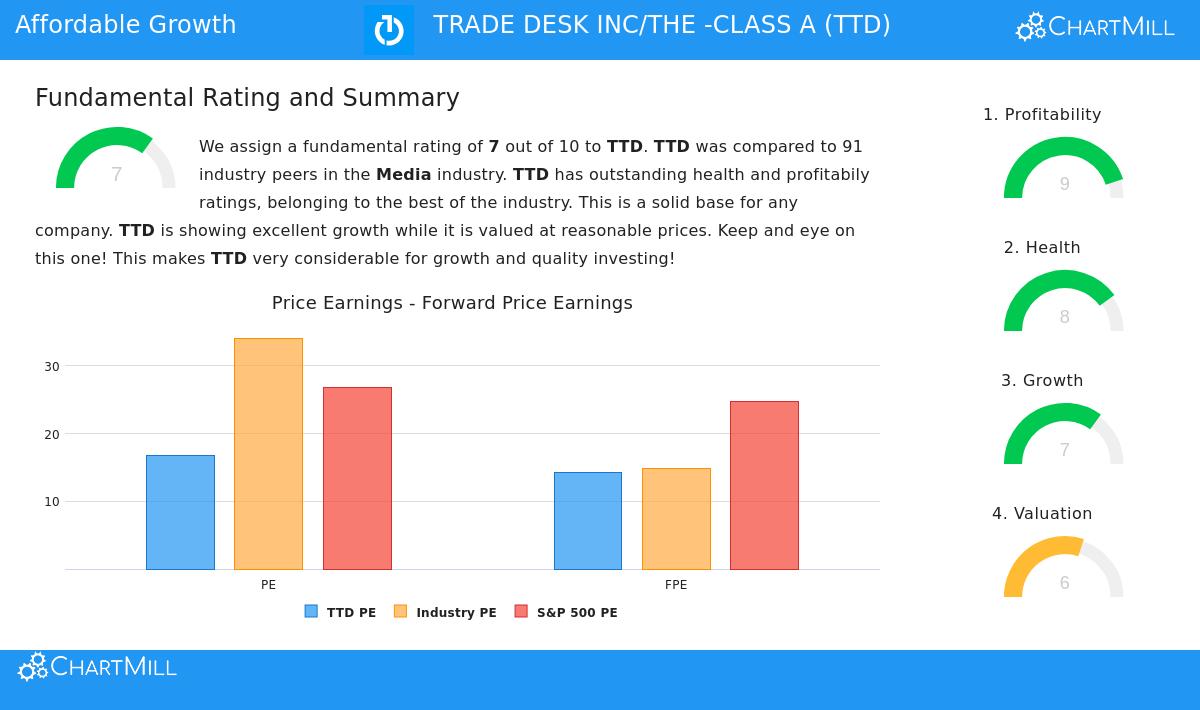
A closer view of the company's basic analysis report supports the image shown by the filter. The Trade Desk gets a high total basic score of 7 out of 10. The details show main positives that Lynch would probably value:
- Profit level is a noted trait, with a score of 9/10. The company regularly makes positive earnings and cash flow. Its profit margin of 15.3% and operating margin of 20.4% place in the best group of its media industry equals.
- Financial Condition is firm, scoring 8/10. The zero-debt balance sheet is a big reason, resulting in a very good Altman Z-Score that means a very small near-term failure risk. The company also has a past of buying back shares, another move Lynch saw as positive.
- Growth stays good, with a score of 7/10. While future sales and EPS growth guesses are thought to slow from the very high past rates, they are still forecast in the low-to-mid teens—a sound and possibly more maintainable speed.
- Price looks even, scoring 6/10. The analysis indicates the stock is priced normally to somewhat low compared to both its industry and the wider S&P 500, especially when thinking about its forward P/E ratio and high quality.
You can see the complete, itemized basic analysis for The Trade Desk here.
The Enterprise Behind the Data
The basic rules are vital, but Lynch always noted the need to understand the enterprise. The Trade Desk runs a cloud-based system for digital ad buying, a field that has changed marketing. The company helps data-led advertising across areas like connected TV (CTV), audio, and display. This places it where several long-term industry movements meet: the move of advertising money to digital systems and the fast rise of streaming TV. While not a "simple" business in the usual Lynch meaning, its system model can grow and its worth to advertisers is clear and quantifiable—points an investor can study and grasp.
End and Next Study
Built on a measured filter using Peter Lynch's ideas, The Trade Desk shows a strong picture for long-term GARP investors. It shows a past of good, maintainable earnings growth, outstanding financial condition with no debt, high profit level, and a price that seems fair compared to its growth picture. These are exactly the traits Lynch wanted for a long-term holding.
It is key to recall that a filter is a beginning place for study, not a final purchase sign. Possible investors should do their own full careful check, thinking about rival risks, client focus, and the changing digital advertising field.
The Peter Lynch plan filter can be a useful instrument for finding possible investments. If you want to look at other companies that now fit these structured growth and price rules, you can see the live filter results here.
Disclaimer: This article is for information and learning only. It does not form a suggestion to buy, sell, or keep any security. All investment choices have risk, and you should do your own study or talk with a skilled financial guide before making any investment choices.