

The investment philosophy of Peter Lynch, the legendary manager of Fidelity's Magellan Fund, focuses on finding high-quality, growing companies trading at reasonable prices, a strategy often called "Growth at a Reasonable Price" or GARP. Lynch supported a long-term, buy-and-hold method, concentrating on businesses with sustainable earnings growth, strong financial health, and valuations that do not overpay for future potential. His process uses specific quantitative filters to find candidates, which investors can then study more to build a diversified, long-term portfolio.
One company that recently appeared from a filter based on Lynch's main criteria is META PLATFORMS INC-CLASS A (NASDAQ:META), the parent company of Facebook, Instagram, WhatsApp, and a developing portfolio of virtual and augmented reality technologies. For investors looking for GARP opportunities, Meta presents a strong case for closer study based on the key measures Lynch highlighted.
Evaluating Meta Through a Lynchian Lens
Peter Lynch's strategy selects for companies with a specific profile: consistent but not excessive growth, high profitability, solid financial footing, and an attractive valuation when growth is considered. Here is how Meta compares against several of Lynch's important rules:
- Sustainable Earnings Growth: Lynch looked for companies with a 5-year earnings per share (EPS) growth between 15% and 30%, believing growth outside this range was either too slow or unsustainable. Meta's EPS has grown at an average yearly rate of 24.85% over the past five years, placing it directly within Lynch's target zone for solid, maintainable growth.
- Valuation Compensated by Growth: A central part of Lynch's approach is the PEG ratio (Price/Earnings to Growth ratio), which he liked to be at or below 1. This measure adjusts the traditional P/E ratio for a company's growth rate, helping to find stocks that may be reasonably priced relative to their earnings path. Meta's PEG ratio, based on its past five-year growth, is about 0.89, indicating the market may not be fully valuing its historical growth performance.
- Strong Profitability: Lynch required a high Return on Equity (ROE) as a sign of efficient management and a profitable business model. He typically looked for an ROE above 15%. Meta's ROE of 27.83% greatly exceeds this level, showing the company is producing substantial profit from shareholder equity.
- Financial Health: To ensure strength, Lynch preferred companies with conservative balance sheets. His rules included a Debt-to-Equity ratio below 0.6 (with a personal preference for under 0.25) and a Current Ratio above 1 to confirm short-term liquidity. Meta comfortably meets both standards, with a Debt-to-Equity ratio of 0.27 and a Current Ratio of 2.60, showing a sound financial position with little debt use and good liquidity.
A High-Level Fundamental Overview
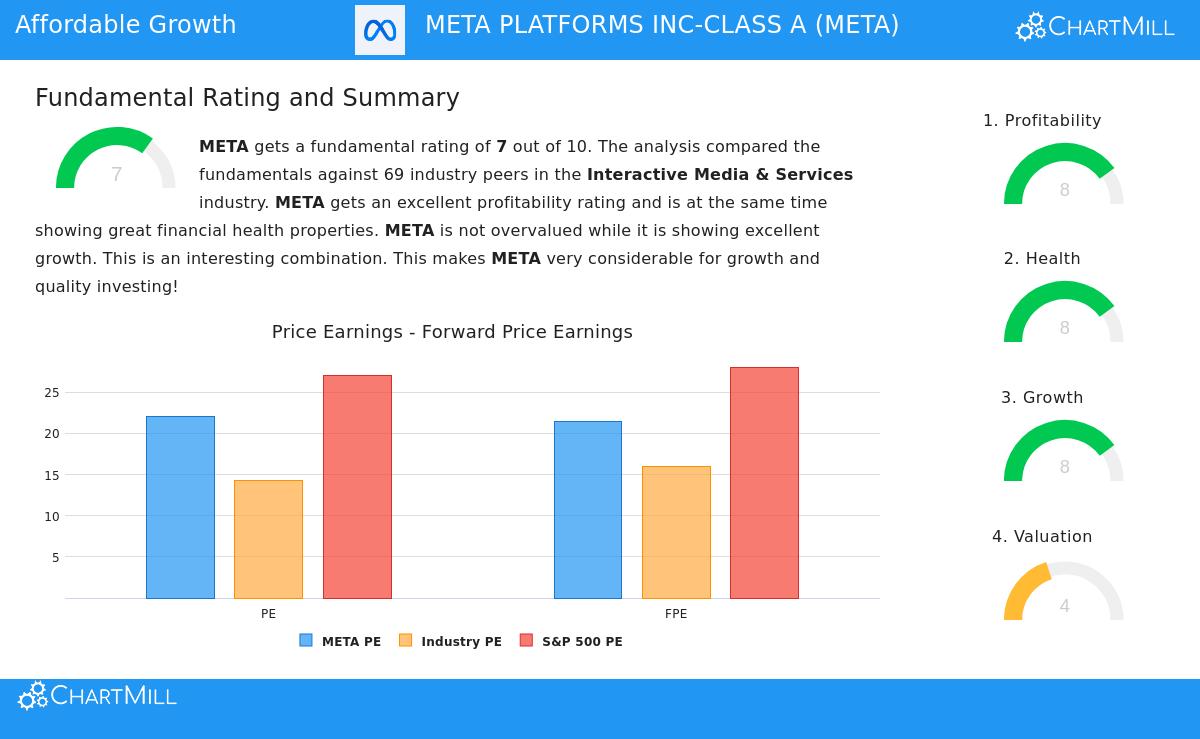
A wider fundamental analysis of Meta fits well with the image shown by the Lynch filter. The company receives a high overall fundamental rating, supported by excellent scores in profitability and financial health. Its profit margins are some of the best in its industry, and it regularly creates high returns on both equity and invested capital. The balance sheet is solid, marked by large cash reserves and a manageable amount of debt.
While the company's plain P/E ratio may seem high alone, its valuation appears more attractive when considered alongside its growth rate and profitability, as the PEG ratio shows. It is also notable that Meta has been actively lowering its share count through buybacks, a practice Lynch approved of. For a detailed view of these measures, you can see the full fundamental analysis report.
The GARP Investment Case
For the long-term GARP investor, Meta represents a possible mix of quality, growth, and value. The company runs leading social platforms with billions of users, providing a huge and stable revenue base from digital advertising. At the same time, it is making large investments in what it believes is the next computing platform, the metaverse, through its Reality Labs division. This mix of a powerful, cash-producing core business and a long-term growth project is typical of the kind of company Lynch might have examined carefully.
The Lynchian measures indicate the market is pricing Meta's shares with attention to its near-term earnings while possibly not fully accounting for its historical growth consistency and notable profitability. The sound balance sheet provides a safety buffer and the ability to manage economic changes and continue financing ambitious innovation.
Finding More Candidates
Meta Platforms is one example of a company that passes a filter designed on Peter Lynch's strategy. Investors curious about finding other possible GARP opportunities can view the Peter Lynch Strategy screen for a current list of qualifying securities. As Lynch himself noted, a filter is only the first stage; complete research into a company's business model, competitive strengths, and future outlook is necessary before any investment choice.
Disclaimer: This article is for informational purposes only and does not constitute financial advice, an endorsement, or a recommendation to buy, sell, or hold any security. Investing involves risk, including the potential loss of principal. Always conduct your own due diligence and consider consulting with a qualified financial advisor before making any investment decisions.