

For investors looking for steady income, a methodical selection process is important. One useful method focuses on finding companies that provide a good dividend and also have the fundamental financial soundness to maintain and possibly increase those payments. This method emphasizes quality by searching for stocks with high dividend grades, which assess elements such as yield, growth, and payment security, while also demanding satisfactory marks in earnings power and balance sheet condition. These extra criteria help steer clear of "value traps"—companies with high yields that could be endangered by low profits or a fragile financial position.
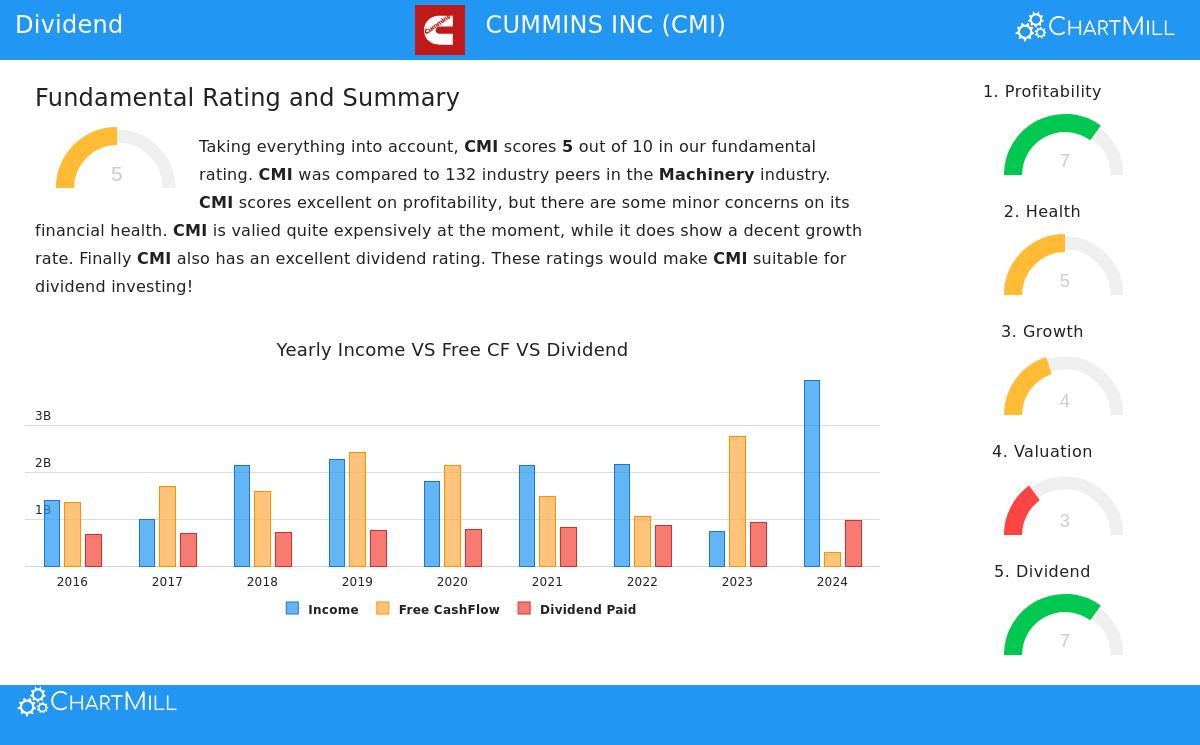
Cummins Inc. (NYSE:CMI), a worldwide top company in designing and making engine and power generation technology, appears as a result from this kind of filter. The company's basic financial picture indicates it could deserve more examination by investors focused on dividends.
Dividend Dependability and Increase
The center of any dividend investment idea rests on the payment itself. Cummins makes a strong argument founded on steadiness and a dedication to giving capital back to shareholders.
- History: Cummins has built a steady history, having given a dividend for at least ten straight years without a decrease. This record of dedication is a key sign of management's priorities favoring shareholders.
- Maintainable Increase: The dividend is not fixed. It has increased at a good compound yearly rate of about 7.1% over the last five years. Significantly, this increase looks maintainable. The company's payout ratio—the part of profits paid as dividends—is at a manageable 38.5%. This keeps a large amount of earnings to be put back into the business, finance future expansion, or handle economic slowdowns without putting the dividend at risk.
- Yield Perspective: With a present yield near 1.37%, Cummins gives a reasonable income flow. While not the greatest yield possible, it is useful to see it in context. The yield is higher than the average for its industrial machinery group and is backed by the good growth and safety measures described before, not a low stock price.
Supporting Earnings Power
A maintainable dividend needs to be paid for by a profitable business. This is why filtering for satisfactory earnings power is a main part of the method, and Cummins does well here. The company's skill in creating returns on its assets and equity is a basic positive.
- Good Returns: Cummins shows solid earnings measures. Its Return on Equity (ROE) of 22.1% is especially good, doing better than a large part of its industry rivals. This shows effective use of shareholder money.
- Acceptable Margins: The company keeps acceptable operating and net profit margins. Its operating margin of 12.0% is superior to most industry peers, giving a cushion to take in cost increases and guard profits, which are the final source of dividend payments.
Financial Condition Evaluation
Financial condition is the base that supports both earnings power and dividend payments over the long term. A company with too much debt or cash problems might have to reduce its dividend in a difficult period. Cummins' balance sheet displays a varied but mostly okay picture for an established industrial company.
- Stability Strength: The company's Altman-Z score, an important gauge of bankruptcy danger, is sound at 4.77, showing a low short-term risk of financial trouble. Also, its Debt to Free Cash Flow ratio of 3.3 is seen as positive, meaning it could pay off its debt duties fairly fast with its present cash flow production.
- Points to Watch: The review mentions some small points of attention, including a year-over-year softening in the debt-to-assets ratio and cash readiness measures (Current and Quick Ratios) that are near or a bit under industry averages. While not direct warning signs, these are elements for investors to watch, as they highlight the value of the condition filter in the selection process to avoid companies with more serious balance sheet problems.
Price Assessment
From a strict price perspective, Cummins does not seem low-cost. With a Price-to-Earnings (P/E) ratio near 24.7, the stock is valued above many industrial peers, although it is about equal to the wider S&P 500 average. The higher P/E ratio is probably backed by the company's good earnings power, dependable dividend, and anticipated profit growth. For a dividend investor concentrating on long-term income and capital protection, paying a fair premium for a high-grade, financially stable company can be acceptable, though it might reduce short-term price gain possibility.
A Subject for More Study
Based on an organized filter for dividend grade, earnings power, and condition, Cummins Inc. displays several traits that match a careful income-investing method. Its ten-year history of dependable and increasing payments, paid for by good earnings power and a mostly stable financial base, makes it a notable subject for a dividend portfolio. Investors should balance its reasonable yield and present price against the soundness and maintainability of its basic business model.
For investors wanting to examine other companies that pass similar grade dividend filters, you can see the complete list of outcomes using the pre-set "Best Dividend Stocks" selection tool.
Disclaimer: This article is for information only and does not make up financial guidance, a suggestion, or an offer to purchase or sell any security. Investors must do their own complete study and think about their personal money situation and risk comfort before making any investment choices.