

For investors looking to build a portfolio that produces steady passive income, a systematic selection process is important. One useful approach is to look for companies that provide a good dividend now and also have the basic financial soundness to maintain and possibly raise those payments in the future. This method often centers on three main parts: a strong dividend score, good profitability, and firm financial condition. By focusing on these areas, investors try to find stocks where the dividend is backed by a solid company, not just a temporary result of a low stock price.
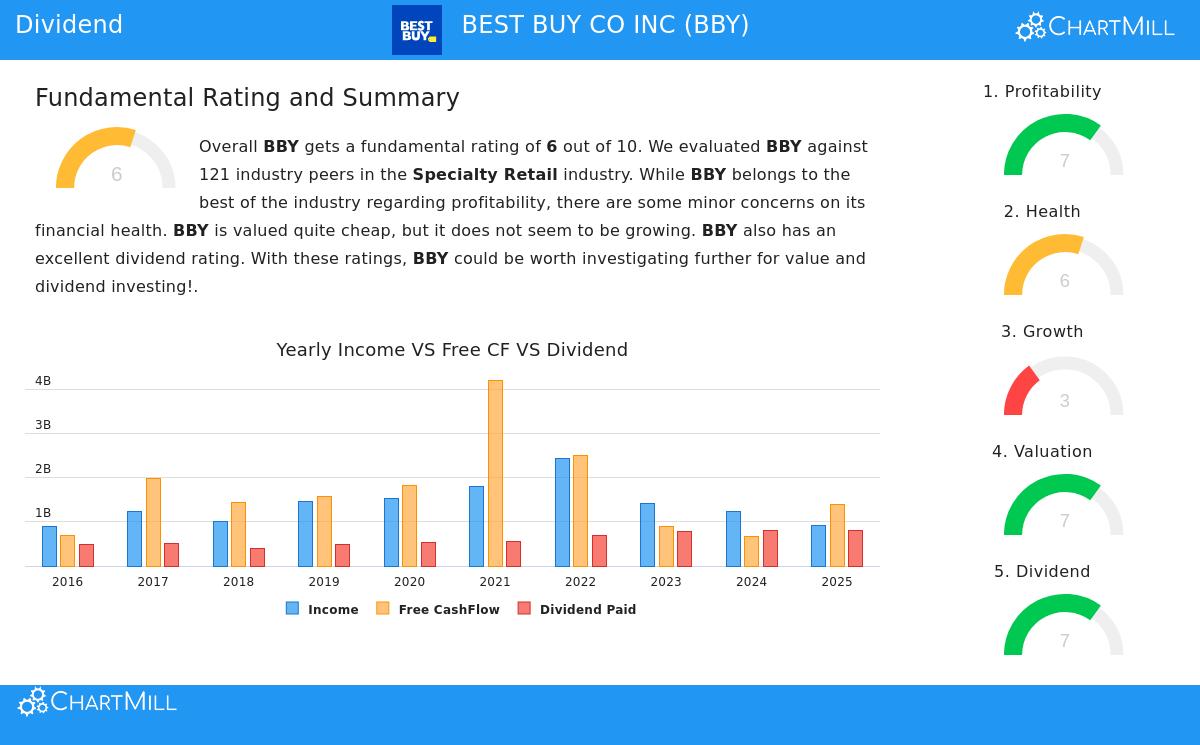
Best Buy Co Inc (NYSE:BBY) appears as a stock that deserves more attention within this structure. As a top seller of consumer electronics and appliances, its basic financial picture shows an interesting combination for investors focused on income, especially when judged on dividend longevity.
A Notable Dividend Picture
The main point for considering Best Buy is its significant return to shareholders. The company now gives a large yearly dividend yield of 5.83%, which is much higher than its industry average of 2.20% and the wider S&P 500 average of about 1.82%. This high yield is not a short-term irregularity caused by a falling stock price; it is supported by a long and steady history. Best Buy has both paid and regularly raised its dividend for at least ten years, with a notable average yearly increase of 13.38% over the past five years. This pairing of high present yield and good past increase is a main reason the stock gets a high dividend score.
Yet, a high yield and good history are only one side. The lasting quality of the payment is most important, and here the study needs a more detailed look. The company's payout ratio, which compares dividends to earnings, is now high at over 124%. This shows that Best Buy paid more in dividends than it made in the last year, which is usually not maintainable for a long period. This is an important measure for dividend investors to watch, as a maintainable payout ratio, often thought to be much lower than 100%, gives protection for the dividend during weak economic times.
Supporting Parts: Profitability and Financial Condition
This is where the selection standards for good profitability and condition become very important. While the payout ratio gives a warning, Best Buy's basic business numbers indicate it has the ability to handle this. The company gets a very good profitability score, pushed by good returns on capital. Its Return on Invested Capital (ROIC) of 19.52% is much better than its cost of capital, meaning the company is building real shareholder value with its spending. Also, this ROIC is better than most of its competitors in the specialty retail industry. This high level of profitability supplies the basic engine that can, over time, maintain the dividend plan.
Financially, Best Buy keeps a firm condition score. Its balance sheet displays a good debt-to-equity ratio of 0.44, and a very good debt-to-free-cash-flow ratio of 0.77. The second is especially important, suggesting the company could pay off all its debt in under a year using its present free cash flow production, a sign of high ability to pay debts. The main worry on the condition side is in liquidity, with a quick ratio of 0.26 showing possible issues in meeting very immediate bills without selling stock. Still, an Altman-Z score of 3.67 clearly puts the company away from any short-term bankruptcy danger.
Price and Growth Setting
From a price standpoint, Best Buy seems fairly valued. With a Price-to-Earnings (P/E) ratio of 10.69 and a forward P/E of 10.07, the stock is priced lower than more than 85% of its industry peers and the wider market. This pricing gives a safety margin for investors. The growth situation is varied; while sales have been unchanged to slightly down in recent years, analysts predict a return to small growth in both revenue and earnings per share moving forward, with EPS predicted to grow almost 10% each year.
For a complete look at all these basic factors, readers can see the full ChartMill Fundamental Analysis report for BBY.
Is Best Buy Right for Dividend Portfolios?
Best Buy shows a standard situation for dividend investors to balance attractive yield and history against present longevity measures. The high yield and long increase record are clearly appealing, supported by a profitable business model and a mostly sound balance sheet. The high payout ratio, however, highlights the importance of the selection plan: it is the company's basic profitability and financial condition that give the setting and possible reason for this high payment. Investors must decide if the company's good cash production and expected earnings growth will let it reduce the payout ratio to a more careful level with time.
For investors wanting to use this systematic selection method to find other possible options, the pre-set "Best Dividend Stocks" screen can work as a good beginning point for more study.
Disclaimer: This article is for information only and is not financial advice, a suggestion, or an offer or request to buy or sell any securities. The information shown is based on supplied data and should not be the only reason for any investment choice. Investors should do their own complete study and think about their personal money situation and risk comfort before making any investment.