

For investors looking to create passive income from dividend-paying stocks, a systematic selection method is important. One useful technique is to look for companies that provide a good dividend now and also have the fundamental financial soundness to continue and possibly raise those payments in the future. This tactic frequently centers on stocks with a high total dividend score, which assesses items such as yield, increase, and continuity, while also checking the company holds fair ratings in earnings power and fiscal soundness. This measured method tries to find dependable income sources, not merely stocks with high yields that may be risky.
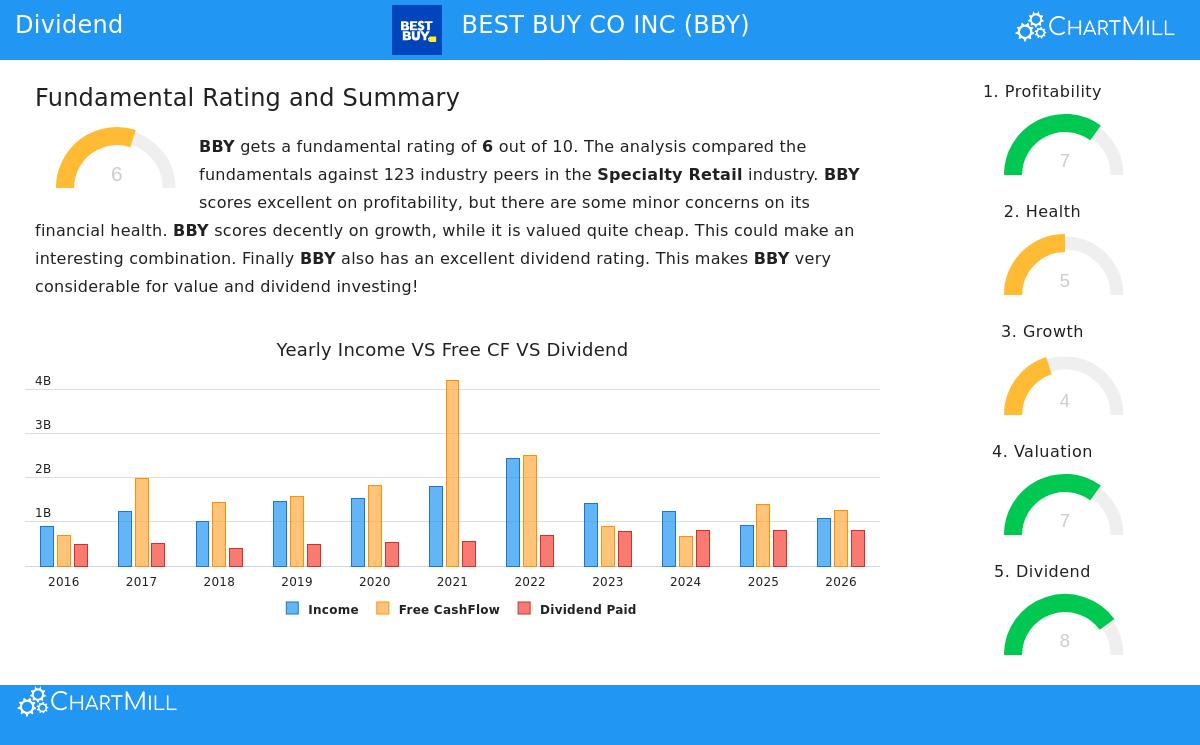
BEST BUY CO INC (NYSE:BBY), the consumer electronics seller, appears as a selection from this kind of method. Its basic profile makes a strong argument for investors focused on dividends, especially when reviewed considering yield, increase, and the company's capability to finance its returns to shareholders.
A Notable Dividend Yield
The most direct appeal for an income investor is frequently the yield, and Best Buy provides a notable one. The company's annual dividend yield is now near 5.70%. This number is significant for a few causes:
- It is much greater than the sector norm for specialty retail, which is near 2.34%.
- It is over three times the average dividend yield of the S&P 500, which is about 1.82%.
- This puts Best Buy in the leading group of its sector, distributing a higher dividend than more than 90% of similar companies.
A high yield by itself can be a signal of caution, sometimes caused by a falling stock price due to basic business problems. But, when combined with firm selection standards for earnings power and soundness, it justifies deeper study instead of instant rejection.
A Dependable and Increasing Payout
Apart from the current yield, the quality of a dividend is measured by its past and increase path. Best Buy performs well here, showing a dedication to giving capital to shareholders.
- The company has kept a dependable history, giving a dividend for at least ten straight years without a cut.
- Even more notably, it has raised its dividend at an average yearly rate of about 11.46% over the last five years. This steady increase is a main sign of management's belief in the business's ability to create cash and its commitment to shareholder returns.
This past of dependable and rising payments matches well with a dividend investment plan that looks for not only present income, but income that could rise over time, aiding to counter the impacts of inflation.
Assessing Continuity and Basic Soundness
The vital question for any stock with a high yield is if the payout can continue. This is where the extra selection standards for earnings power and fiscal soundness give needed background. According to the detailed basic review, Best Buy's situation is varied but backed by central strong points.
On the continuity side, there are points for attention. The company's payout ratio—the part of its net income given as dividends—is high at about 75%. Also, analysts point out that recent dividend increase has been faster than earnings increase, a situation that cannot continue forever. These are significant items for an investor to watch.
However, these points are balanced by the company's good earnings power and acceptable fiscal soundness, which were required in the selection method:
- Earnings Power: Best Buy receives a firm ChartMill Earnings Power Rating of 7. It has very good returns on invested capital (ROIC) and equity (ROE), doing better than a big majority of its sector rivals. This shows the company is very effective at creating earnings from its capital.
- Valuation and Cash Flow: The stock seems basically low-priced, with a Price-to-Earnings ratio near 10, much under both sector and wider market averages. More significantly, it has a very firm Debt-to-Free-Cash-Flow ratio of 0.93, indicating it could settle all its debt in under a year using its present cash flow. This very large cash-creating ability is a main support for the dividend.
- Fiscal Soundness: With a ChartMill Soundness Rating of 5, the company's fiscal condition is viewed as acceptable. Its ability to meet obligations, supported by the firm cash flow, is solid. While some liquidity measures are closer than sector averages, the total soundness score shows the company is not in immediate fiscal trouble.
Final Point for Dividend Investors
Best Buy shows a standard example of an established, cash-creating business trading at a reasonable price and returning a big part of its earnings to shareholders. For dividend investors, the mix of a high initial yield, a firm history of dividend increase, and basic earnings power is appealing. The selection system purposely looks beyond yield alone to make sure the company has the financial capacity—shown by its high returns on capital and firm free cash flow—to maintain its shareholder payments.
The high payout ratio and modest sales patterns show the value of the "acceptable soundness and earnings power" filters; they make sure the company has the ability to operate in a competitive retail environment while keeping its dividend. Investors should see this as a possible income option in a stable, though slow-growth, sector instead of a fast-growth prospect.
This review of Best Buy came from a systematic search for good dividend payers. You can review the present results of this "Best Dividend Stocks" search yourself here.
Disclaimer: This article is for information and learning only and does not form financial guidance, a suggestion, or an offer or request to buy or sell any securities. The information given is based on supplied data and should not be the only foundation for any investment choice. Investors should do their own separate study and talk with a qualified financial guide before making any investment. Past results are not a guide for future results.