

The search for undervalued stocks is a central part of value investing, a method that aims to find companies trading below their inherent value. This method, supported by figures like Benjamin Graham and Warren Buffett, uses detailed fundamental study to find chances the market might have missed. A typical screening approach involves selecting for companies that seem inexpensive using standard measures while also showing good basic business condition, earnings strength, and acceptable expansion potential. This plan tries to sidestep "value traps", stocks that are low-priced for a cause, by confirming the business foundations are strong enough to back a possible reassessment by the market.
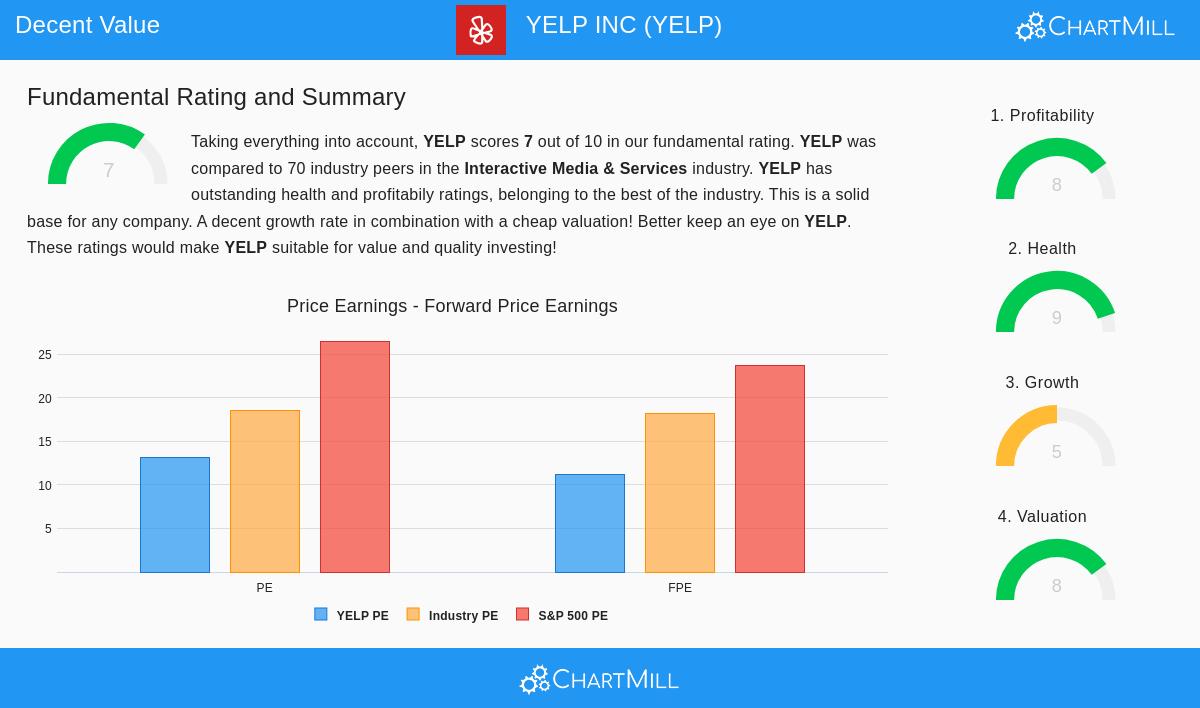
Yelp Inc (NYSE:YELP), the company behind the familiar local business review service, recently appeared from such a screening process. The company’s fundamental picture indicates it could be a notable option for investors using this value-focused approach. A close fundamental analysis report on Yelp shows a combination of firm financial strength and appealing valuation, describing a company that is possibly valued lower than its business merit.
Valuation: An Appealing Entry Point
For value investors, valuation is the main screen. The aim is to pay a price that gives a "margin of safety" against mistakes in analysis or unexpected business difficulties. Yelp’s valuation measures show the stock is trading at a lower price compared to both its sector and the wider market.
- Price-to-Earnings (P/E): Yelp’s P/E ratio of 13.16 is seen as fair on its own. More significantly, it is less expensive than about 74% of similar companies in the Interactive Media & Services sector, which has an average P/E close to 18.6. Compared to the S&P 500's average P/E of over 26.5, Yelp seems notably low-priced.
- Forward P/E and Cash Flow: The valuation argument becomes stronger when considering future estimates. Yelp’s Price/Forward Earnings ratio of 11.23 is less expensive than 80% of its sector rivals. Also, its Price/Free Cash Flow ratio is lower than a notable 94% of the sector, indicating the market is giving a low multiple to the real cash the business produces.
- Enterprise Value (EV) to EBITDA: This measure, which includes debt and cash, also points to a low valuation. Yelp’s EV/EBITDA ratio is below 84% of sector companies.
These numbers together indicate that if Yelp’s business results stay consistent or get better, there is potential for the market to reassess and reduce this valuation difference, a central idea for value investors.
Financial Health: A Firm Foundation
A low valuation is unimportant if the company is financially weak. Value investing needs a strong balance sheet to endure economic slowdowns and supply the endurance required for the investment idea to develop. Yelp does very well in this essential area, receiving a near-top Health score of 9 out of 10.
- Debt-Free Operation: Yelp has no debt. This removes interest cost risk and gives great operational and planning freedom. Its Debt/Equity and Debt/Free Cash Flow ratios are basically zero, rating with the best in its field.
- Strong Liquidity: The company’s Current Ratio and Quick Ratio are both a solid 2.99, showing more than enough short-term assets to meet obligations. This liquidity is better than about 74% of sector peers.
- Low Bankruptcy Risk: Yelp’s Altman-Z score of 5.12 is firmly in the "safe" range, showing a very small short-term chance of financial trouble and doing better than over 82% of its rivals.
This flawless financial health supplies the safety net value investors look for. It means Yelp can fund its business, give capital to shareholders, or handle problems without the burden of debt payments.
Profitability: Quality at a Lower Price
Profitability measures help tell a successful business from a failing one. A company that creates good returns on its capital is more able to maintain and increase its inherent value over time. Yelp’s Profitability score of 8 shows a high-grade earnings profile.
- Excellent Returns: The company’s Return on Invested Capital (ROIC) of 20.29% and Return on Equity (ROE) of 20.46% are first-rate, doing better than about 86% and 89% of the sector, in that order. This shows management is very good at creating earnings from the capital it uses.
- Healthy and Widening Margins: Yelp has a very good Gross Margin of 90.47%, better than 91% of its peers. Its Operating Margin of 13.35% and Profit Margin of 10.23% are also firm, putting it in the top group of the sector. Importantly, both Operating and Profit Margins have displayed gain in recent years, a signal of rising operational effectiveness.
For a value investor, finding a company with this degree of profitability trading at a lower price is the perfect situation. It suggests the market might be misjudging the strength and quality of Yelp’s earnings.
Growth: A Steady, if Moderate, Path
While pure value stocks occasionally miss expansion, the screening plan that found Yelp particularly looks for "acceptable" growth to add to the other factors. Yelp’s Growth score of 5 shows a steady, if not rapid, path.
- Strong Earnings Growth: The company’s Earnings Per Share (EPS) increased by a notable 38.92% over the past year and has shown a firm average yearly growth rate of almost 25% over recent years. Analysts think this solid EPS growth will keep going at an average rate of nearly 27% each year.
- Steady Revenue Base: Revenue growth has been more moderate, with a 5.35% rise last year and a past average in the high single digits. Future revenue growth predictions are now in the low single digits.
The growth picture shows Yelp is not a still company. Its strong earnings growth, even with slower revenue increase, shows margin gain and successful cost control. This supplies a growth driver that could help push the stock price up along with any valuation multiple increase.
Conclusion
Yelp Inc offers a notable example for a current value investment screen. It joins a clearly low valuation, trading at lower prices than its sector and the wider market, with outstanding financial health and high-grade profitability. The company’s debt-free balance sheet and firm cash generation give a important margin of safety, while its solid earnings growth offers a way for the business to develop into a higher valuation. For investors following a careful value plan that looks for quality businesses at sensible prices, Yelp justifies closer study.
This study of Yelp came from a methodical screening process. Investors curious in finding other companies that fit similar standards of good valuation, acceptable profitability, health, and growth can view more outcomes using the Decent Value Stocks screen on ChartMill.
Disclaimer: This article is for informational purposes only and does not constitute financial advice, a recommendation, or an offer to buy or sell any securities. Investors should conduct their own research and consult with a qualified financial advisor before making any investment decisions.