

In the search for long-term investment opportunities, many investors turn to the principles laid out by legendary fund manager Peter Lynch. His strategy, often categorized as Growth at a Reasonable Price (GARP), focuses on finding companies with solid, sustainable growth, strong financial health, and attractive valuations. It is a disciplined method that avoids speculative hype, instead looking for businesses that are both profitable and carefully managed. A filter built on Lynch’s main criteria can act as a beginning for finding such possible holdings.
One name that recently appeared from such a filter is X Financial-ADR (NYSE:XYF), an online personal finance company based in China. The company runs a technology platform linking borrowers with institutional partners and provides products like the Xiaoying Credit Loan. For investors using a Lynch-style filter, XYF presents an interesting case study in how a financial technology firm can fit with classic fundamental investing rules.
Alignment with Peter Lynch Criteria
Peter Lynch stressed sustainable earnings growth, reasonable valuation relative to that growth, and a strong balance sheet. The filter settings from his philosophy give a quantitative structure to find candidates, and XYF seems to satisfy several of these central checks.
- Sustainable Earnings Growth: Lynch preferred companies with a steady history. XYF reports a 5-year average Earnings Per Share (EPS) growth of about 16.75%. This fits inside the Lynch-inspired filter’s target range of 15% to 30%, meant to find companies increasing at a speed that is strong yet possibly sustainable, avoiding the instability of very fast growth.
- Attractive Valuation via PEG Ratio: A central part of the Lynch method is the Price/Earnings to Growth (PEG) ratio, which aims to value a stock while including its growth rate. A PEG ratio at or below 1.0 is usually seen as attractive. XYF’s PEG ratio, based on its past 5-year growth, is very low at about 0.05. This shows the market is pricing the company’s earnings at a large discount to its historical growth path, a main signal for value-aware growth investors.
- Strong Profitability (ROE): Return on Equity (ROE) shows how well a company creates profits from shareholder equity. Lynch wanted high ROE as a sign of a lasting competitive edge and skilled management. XYF’s ROE of 22.61% easily passes the 15% level often used in Lynch filters, indicating the company is very good at turning its equity into earnings.
- Financial Health Checks: To steer clear of value traps and make sure of strength, Lynch highlighted the need for financial stability. Two important measures here are the Debt-to-Equity (D/E) ratio and the Current Ratio.
- XYF’s D/E ratio of 0.50 is under the filter’s limit of 0.6, showing the company is not too dependent on debt financing. Lynch himself wanted an even lower ratio, seeing little debt as a cushion in economic declines.
- The company’s Current Ratio of 1.47 indicates it has enough short-term assets to meet its short-term obligations, passing another simple test of financial health and operational soundness.
Fundamental Analysis Overview
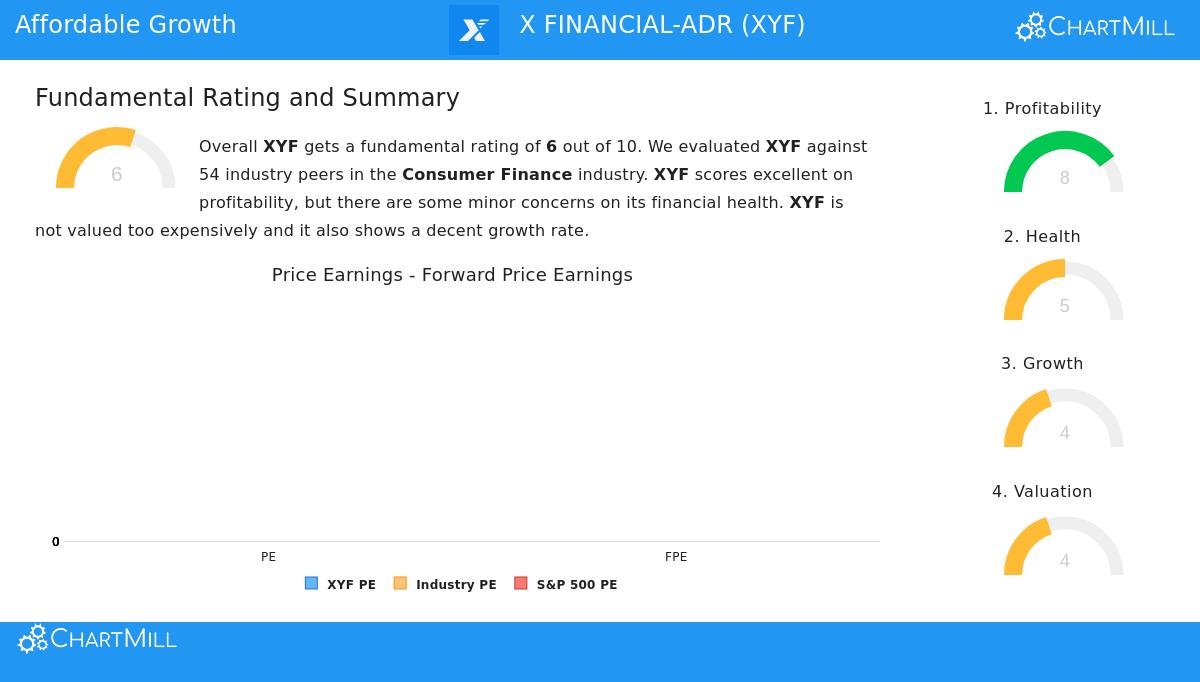
A wider fundamental analysis of XYF, which gives it a 6 out of 10 total, adds more detail to the filter results. The analysis shows a varied but interesting profile.
The company’s biggest strength is in its profitability, where it gets an 8 out of 10. It has industry-leading margins, including an Operating Margin of 58.72% and a Return on Invested Capital (ROIC) of nearly 30%. These numbers point to a very efficient operation. Its valuation score of 4 is backed by a very low Price-to-Earnings (P/E) ratio of 0.85, making it one of the lowest-priced stocks in its field on that measure. Also, it provides a large dividend yield of 8.52%.
However, the analysis also mentions points for thought. The company’s financial health score is a neutral 5, with an Altman Z-Score in a "grey zone" and a D/E ratio that, while acceptable, shows some debt use. The growth score is also a 4, reflecting good past revenue and EPS growth but a shortage of available analyst forecasts for future performance, which adds uncertainty for forward-looking evaluations.
Investor Considerations
For the long-term, GARP-focused investor, XYF represents an interesting situation: a company showing high profitability and good historical growth trading at a low value multiple. The fit with specific Peter Lynch filters, especially its sustainable growth rate, very low PEG ratio, and high ROE, makes it a valid candidate for more study from this investment viewpoint.
The low valuation and high dividend yield could be seen as a large margin of safety, a idea valued by value investors. However, the neutral financial health score and the absence of clarity on future earnings estimates highlight the need for deeper investigation. Investors would need to study the competitive field of China's online finance sector, regulatory setting, and the company's specific plans for maintaining its growth and profitability.
Interested in finding other companies that pass a Peter Lynch-inspired filter? You can locate and adjust the filter using this link: Peter Lynch Strategy Stock Screener.
Disclaimer: This article is for informational purposes only and does not constitute financial advice, a recommendation, or an offer to buy or sell any security. The analysis is based on data provided and certain investment methodologies, which carry inherent limitations. Investors should conduct their own thorough research and consider their individual financial circumstances and risk tolerance before making any investment decisions.