

For investors looking for a dependable source of passive income, a methodical screening process is needed to distinguish truly lasting dividend payers from risky high-yield situations. One useful technique involves selecting for companies that provide an appealing dividend and also have the fundamental financial soundness to keep and raise those payments. This method favors stocks with a high ChartMill Dividend Rating, which assesses yield, growth, and sustainability, while also demanding a minimum level for profitability and financial soundness. This multi-step method aids in finding companies where the dividend is backed by a strong business model, instead of being a temporary sign of a low stock price.
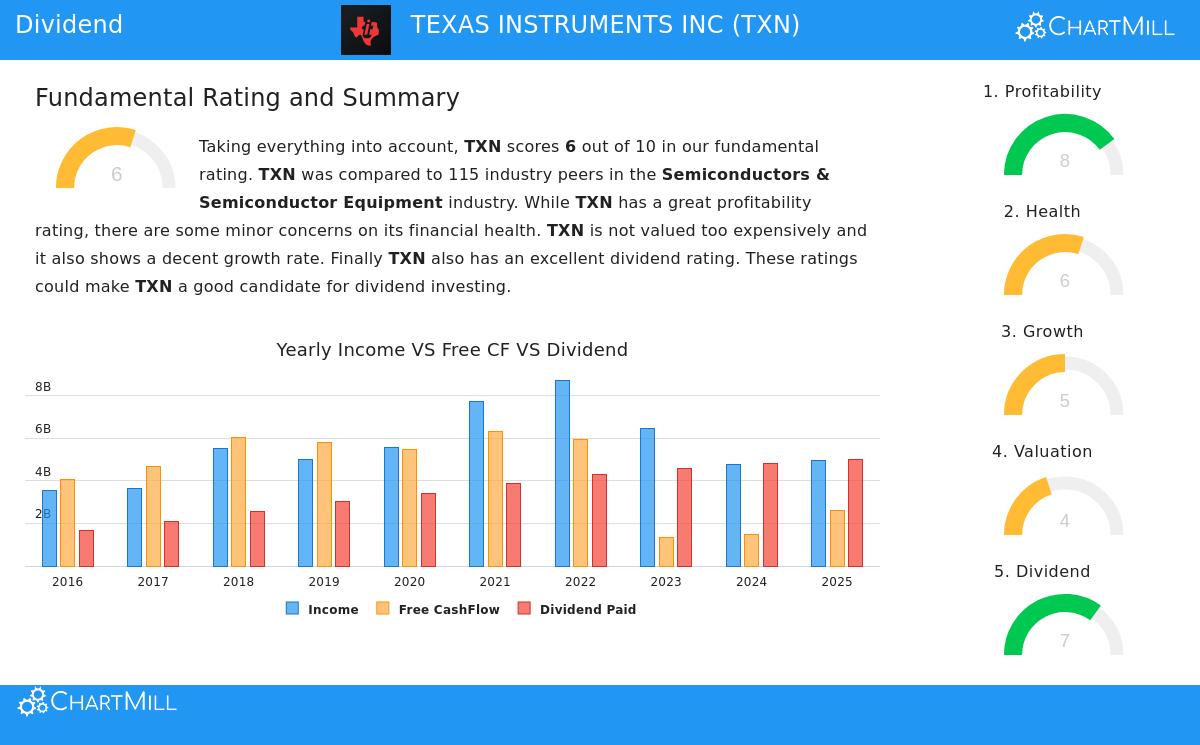
A clear example found by this screen is Texas Instruments Inc (NASDAQ:TXN), a long-established company in the semiconductor industry. The company’s fundamental profile indicates it deserves additional examination by dividend-oriented investors, as it combines a reasonable income stream with the operational strength required for the future.
Dividend Profile: A Dependable History
The central attraction for a dividend investor is the payment itself, and Texas Instruments shows several important positives here, receiving its good Dividend Rating of 7 out of 10.
- Good Yield and Industry Comparison: TXN presently provides a dividend yield of 2.99%. This is not the greatest yield available, but it is useful to see it in comparison. This yield is notably higher than the industry norm for semiconductors and is above the present yield of the S&P 500. For investors wanting income from the technology sector, TXN supplies a substantial yield that is notable compared to similar companies.
- Steady and Rising Payments: Dependability is critical. TXN has built a reliable history, having paid and, importantly, raised its dividend each year for more than ten years. The dividend has increased at an average yearly rate above 8% over the last five years, showing a dedication to giving more capital back to shareholders.
- A Point on Sustainability: The report does note one item for watch: the present payout ratio, which shows the portion of earnings distributed as dividends, is high. This number suggests the company is distributing nearly all of its net income. Still, this point-in-time measure must be understood next to the company’s good profitability and positive future earnings growth forecasts. The fundamental review shows that while the payout is elevated, the expected increase in earnings should help this ratio improve to a more maintainable level later, aiding continued dividend increases.
Supporting Fundamentals: Profitability and Financial Soundness
A high dividend yield can be misleading if not supported by a sound business. This is why the screening rules demand acceptable scores for profitability and financial soundness, to confirm the dividend is not endangered by business frailty. TXN performs well on these supporting measures.
Profitability Quality: The company gets a very good Profitability Rating of 8. This is fueled by sector-leading margins and returns on capital.
- Its operating margin of almost 35% and return on invested capital above 17% are some of the top figures in the semiconductor industry.
- This high degree of profitability is important, as it creates the earnings capacity that finally supplies dividend payments. A company with low margins has limited room to keep payments during a decline, while TXN’s strong profitability offers a notable safety margin.
Satisfactory Financial Soundness: TXN receives a Health Rating of 6, showing a mostly solid but not perfect balance sheet. The review points out good liquidity, with current and quick ratios well above levels that would suggest short-term payment issues. This means the company can readily meet its near-term responsibilities. The long-term debt situation is varied; although the company has more debt than some industry counterparts, its overall Altman-Z score is very good, showing a very small close-term chance of financial trouble. For a dividend investor, the essential conclusion is that the company possesses the liquidity to pay its dividend and the general financial steadiness to manage economic changes.
Valuation and Growth Setting
No investment review is finished without looking at price. TXN’s valuation is mixed, common for a high-caliber company. Its P/E ratios are higher than the wider market average, a sign of its premium position and good profitability. However, inside its own high-performing industry, TXN’s valuation seems more moderate. More significant for dividend growth investors, analysts forecast a notable pickup in both revenue and earnings per share growth in the next few years. If this growth happens, it would directly aid the maintainability of the dividend and support the present valuation premium over time.
Conclusion
For investors using a method that looks for dividends supported by fundamental quality, Texas Instruments offers a strong argument. It merges a good and increasing yield with the indicators of a lasting business: very good profitability, sound liquidity, and a long record of shareholder-oriented capital distribution. While the high payout ratio needs watching and the valuation is not low, the company’s competitive standing and projected earnings growth give a reason for its place in a varied dividend portfolio. The stock illustrates the kind of candidate a quality-oriented dividend screen aims to find: one where the income payment is constructed on a base of operational quality.
A closer look at the company's complete fundamental review, with specific charts on dividend history compared to earnings, is provided in the ChartMill Fundamental Report for TXN.
Find Additional Dividend Ideas Texas Instruments was found using a set "Best Dividend Stocks" screen that selects for high dividend ratings together with satisfactory profitability and health. This screen can be a useful beginning for more study. You can review the present results and modify the filters to your own standards using the Best Dividend Stocks screener.
,
Disclaimer: This article is for informational purposes only and does not constitute financial advice, a recommendation to buy or sell any security, or an endorsement of any investment strategy. All investments involve risk, including the potential loss of principal. Investors should conduct their own independent research and consider their individual financial circumstances and risk tolerance before making any investment decisions.