

For investors looking for a disciplined, long-term method to build wealth, few strategies hold the authority of Peter Lynch's approach. The famous manager of the Fidelity Magellan Fund supported a "growth at a reasonable price" (GARP) idea, concentrating on companies with solid, maintainable growth, very good financial condition, and appealing prices. His method is not about following the latest fads, but about discovering comprehensible businesses that are profitable, financially secure, and selling at a price that does not overvalue their future potential. A filter built on Lynch's main criteria, including earnings growth, the PEG ratio, debt amounts, liquidity, and return on equity, can reveal possible candidates for more study. One company that recently came from this filter is QFIN Holdings Inc-ADR (NASDAQ:QFIN).
Match with Lynch's Central Ideas
QFIN Holdings, a Shanghai-based credit technology service provider, seems to match well with a number of Peter Lynch's investment rules. The filter's settings are made to select for companies that are increasing at a maintainable speed, are not carrying too much debt, and provide good price relative to their growth and earnings. An examination of QFIN's main numbers shows a strong fit.
- Maintainable Earnings Growth: Lynch preferred companies with steady, solid earnings growth, but was cautious of extreme growth that could not be kept up. The filter needs a 5-year EPS growth between 15% and 30%. QFIN's EPS has increased at an average yearly rate of 19.96% over the last five years, putting it directly in this favored zone of maintainable increase.
- Appealing Price via PEG Ratio: Maybe the central part of Lynch's GARP method is the Price/Earnings to Growth (PEG) ratio, which tries to find stocks that may be priced low relative to their earnings growth path. A PEG ratio of 1 or less is usually seen as appealing. QFIN's PEG ratio, based on its past growth, is very low at 0.11, hinting the market may be greatly underpricing its historical growth performance.
- Sound Financial Condition: Lynch stressed investing in companies with firm balance sheets. Two main filters in the screen are a Debt/Equity ratio below 0.6 and a Current Ratio above 1. QFIN does very well on both points, with a Debt/Equity ratio of 0.26, showing little dependence on debt financing, and a solid Current Ratio of 3.48, which shows sufficient liquidity to meet short-term needs easily.
- High Earnings (ROE): Return on Equity (ROE) calculates how well a company produces profits from shareholder equity. Lynch searched for high and steady ROE. QFIN's ROE of 30.15% is exceptional, showing superior earnings and efficient use of investor money.
Basic Condition and Price Summary
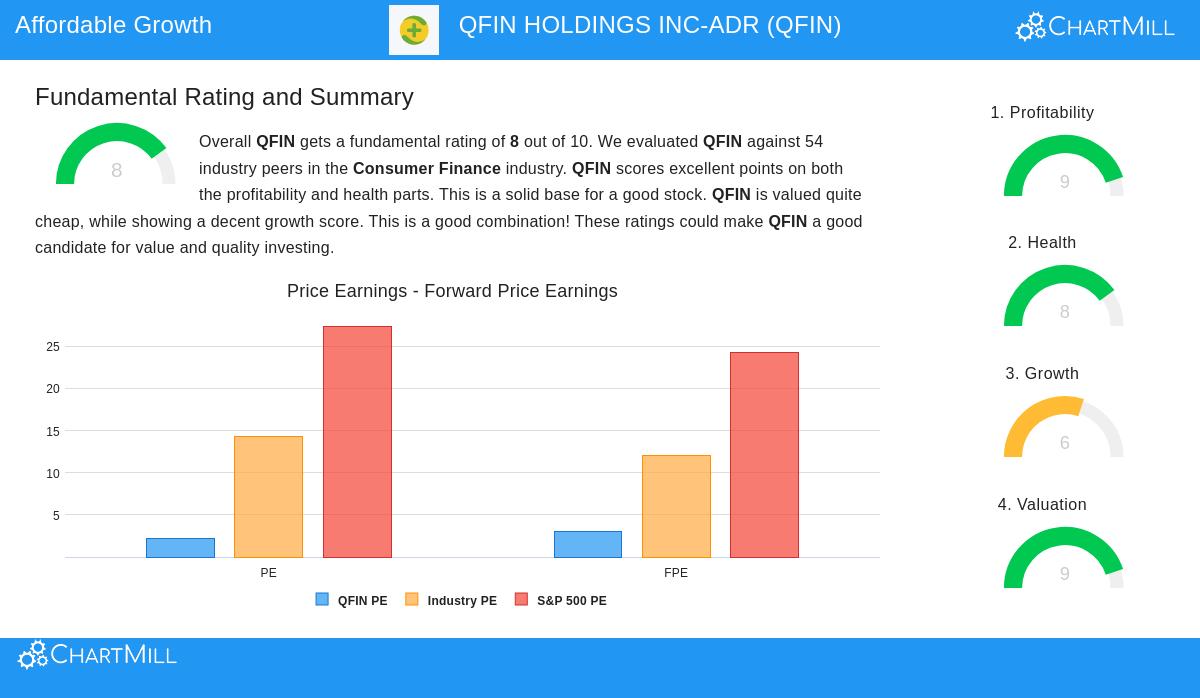
A wider view of QFIN's basic profile strengthens the argument made by the Lynch filter. According to ChartMill's detailed fundamental analysis report, the company gets a very good total score of 8 out of 10.
The report notes QFIN's exceptional earnings, with sector-leading margins and returns on assets, equity, and invested capital. Its financial condition is also scored highly, backed by the strong solvency and liquidity numbers mentioned before. Most notably, the price numbers are prominent. QFIN sells at a Price-to-Earnings (P/E) ratio of only 2.24, which is not only much lower than the S&P 500 average but also less expensive than over 92% of similar companies in the Consumer Finance sector. This low price is set next to its high earnings, forming a possibly strong mix for investors focused on price and quality.
It is important to mention that the analysis indicates a high dividend yield and a slowdown in predicted future earnings growth, elements that long-term investors should examine and watch as part of their continued study.
A Candidate for More Study
For investors who agree with Peter Lynch's idea of finding reasonably priced growth companies, QFIN Holdings offers a strong profile for more detailed examination. It meets a strict group of Lynch-inspired filters, showing maintainable historical growth, a very strong balance sheet, high earnings, and a price that seems very low. As Lynch himself suggested, a filter is only the beginning step for learning the business, its competitive strengths, its sector forces, and its long-term possibilities.
Interested in examining other companies that fit the Peter Lynch investment method? You can run the filter yourself and see the complete list of outcomes here.
Disclaimer: This article is for information only and does not make up financial guidance, a suggestion to buy or sell any security, or a support of any investment method. The information given is based on supplied data and should not be the only foundation for an investment choice. Investors must do their own complete study and think about their personal financial situation and risk willingness before making any investment.