

For investors looking for a dependable source of passive income, a systematic screening process is needed to distinguish truly lasting dividend payers from risky high-yield choices. One useful technique involves selecting for companies that have a high dividend rating, which points to a good history and lasting payout, and also show firm basic financial condition and earnings. This method focuses on the endurance of the dividend over its current amount, seeking to create a portfolio of companies strong enough to keep and possibly raise their payouts through different market periods. A stock that recently appeared using this plan is MICROSOFT CORP (NASDAQ:MSFT).
Examining the Dividend Profile
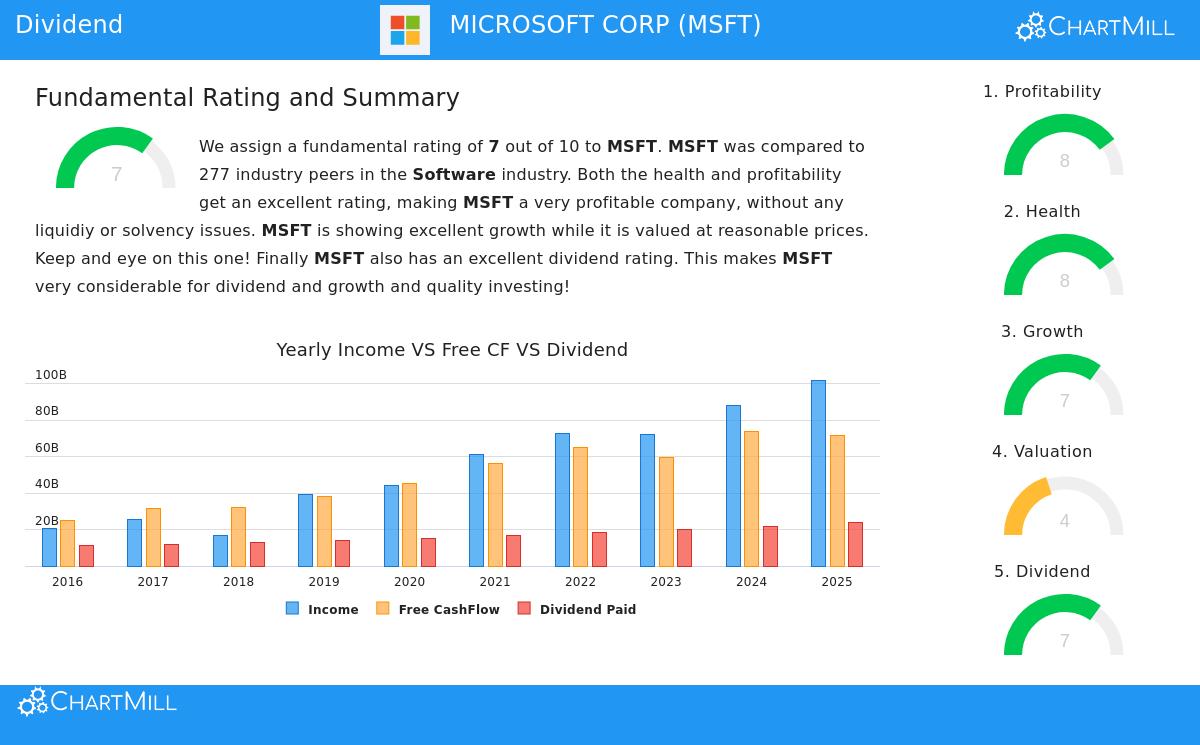
Microsoft's attraction for dividend investors starts with its excellent record and the standard of its payout. The company's ChartMill Dividend Rating of 7 out of 10 shows a firm base supported by several important elements:
- Dependable History and Growth: Microsoft has both paid and regularly raised its dividend for more than ten years. This creates a record of management dedication to giving capital back to shareholders. The dividend has increased at a notable yearly rate of about 10.24% over the last five years, clearly exceeding inflation and delivering real income growth.
- Lasting Payout Ratio: The durability of a dividend is possibly more important than its present yield. Microsoft performs well here, with a payout ratio of only 21.19%. This indicates the company uses under one-fourth of its net income to pay the dividend, leaving a large cushion to put money back into the business, manage economic slowdowns, or keep increasing the payout. This low ratio is a sign of a safe dividend.
- Context on Yield: It is important to see that Microsoft's dividend yield is near 0.91%. While this is higher than the average for its software industry group and shows a policy favorable to shareholders, it is lower than the wider S&P 500 average. This is a standard balance in dividend investing: Microsoft emphasizes high growth, safety, and dividend growth over providing a high starting yield, which frequently involves more risk.
The Foundations of Earnings and Financial Condition
A high dividend rating by itself is insufficient; it must be backed by a successful business. This is where Microsoft's excellent ratings for earnings and financial condition become vital, directly connecting to the screening plan's aim of finding lasting payers.
-
Outstanding Earnings (Rating: 8/10): A company cannot reliably and generously share profits with shareholders if it is not highly profitable itself. Microsoft's measures are exceptional:
- Return on Equity (ROE): 30.51%, showing efficient use of shareholder capital.
- Profit Margin: A strong 39.04%, indicating its pricing ability and operational effectiveness.
- Operating Margin: A leading 46.67% in its industry. These numbers are not only high; they have been getting better in recent years, suggesting the company's competitive advantage is growing. This great earnings ability supplies the basic profit power that supports the dividend.
-
Firm Financial Condition (Rating: 8/10): A sound balance sheet guarantees a company can endure difficulties without threatening its dividend. Microsoft's financial state is strong:
- Low Debt: A Debt-to-Equity ratio of 0.23 shows very little dependence on debt financing.
- Strong Solvency: An Altman-Z score of 8.27 suggests almost no bankruptcy risk and puts it in the highest group of its industry.
- Sufficient Cash Flow: The company produces enough free cash flow that it could, in theory, repay all its debt in just over a year, giving it great financial room to maneuver.
This pairing of high earnings and excellent condition means Microsoft's dividend is not being paid for by debt or by harming the company's future. It is a distribution of real, extra cash created by a top-tier business.
Growth Backing Future Raises
For dividend growth investors, the future direction is as significant as the present. Microsoft's growth picture indicates its dividend growth narrative is not finished. The company is projected to grow its earnings per share (EPS) at close to 19% each year in the near future, a pace that easily surpasses its past dividend growth. This expected earnings growth supplies a clear route for continued, lasting dividend raises without pressuring the payout ratio. The steadiness in both its past and forecasted growth rates adds a level of predictability that income investors appreciate.
Valuation Points
While the focus for dividend investors is often on yield and safety, valuation remains relevant. Microsoft sells at a premium, with a Price-to-Earnings (P/E) ratio near 25.7. However, this valuation seems more acceptable in context:
- It is lower than the average for its software industry group.
- It is mostly similar to the wider S&P 500 index.
- The premium can be explained by the company's exceptional earnings, good growth prospect, and the defensive nature of its cash flows and dividend. For a long-term owner focused on dividend growth, paying a fair price for a top-quality asset is often a wise plan.
A Full Basic View
The examination above is backed by a detailed basic report for Microsoft, which brings together these points across growth, valuation, condition, earnings, and dividend groups. Investors can see the complete, thorough analysis via the ChartMill Fundamental Analysis report for MSFT.
Finding More Possibilities
Microsoft serves as a leading example of the kind of company a quality-focused dividend screen can find, one with a dependable and increasing payout, supported by a strong balance sheet and exceptional profit power. For investors aiming to create or improve a dividend portfolio, this approach can show other interesting candidates. You can use this "Best Dividend" screen yourself and see the present outcomes by going to the pre-set stock screener page.
Disclaimer: This article is for informational purposes only and does not constitute financial advice, a recommendation, or an offer to buy or sell any security. Investing involves risk, including the potential loss of principal. Investors should conduct their own research and consider their individual financial circumstances and risk tolerance before making any investment decisions.