

For long-term investors aiming to assemble a portfolio of good companies, few methods are as lasting as the one made famous by celebrated fund manager Peter Lynch. His method, outlined in One Up on Wall Street, centers on finding expanding companies with solid financials that are available at sensible prices, a thinking frequently called Growth at a Reasonable Price (GARP). It stresses persistent earnings expansion, good profitability, a solid balance sheet, and a price that does not overvalue future potential. A stock filter built on Lynch's ideas can discover companies deserving of more study, and one business that recently appeared is Morningstar Inc (NASDAQ:MORN).
Fit with Lynch's Main Standards
A Peter Lynch-type filter uses particular number-based tests to locate companies matching his investment view. Morningstar seems to pass many of these important measures, which are made to find persistent expansion without too much risk.
- Persistent Earnings Expansion: Lynch liked companies expanding earnings per share (EPS) between 15% and 30% each year, as growth outside this span was often seen as not lasting. Morningstar's five-year EPS expansion rate of 19.51% sits directly inside this goal area, pointing to a record of solid, yet possibly continued, increase.
- Sensible Price (PEG Ratio): A key part of the method is the Price/Earnings to Growth (PEG) ratio, which tries to price a company next to its expansion rate. Lynch searched for a PEG of 1 or lower. Morningstar's PEG ratio, using its past five-year expansion, is 0.93, hinting the market may not be completely valuing its historical expansion path.
- Good Profitability (Return on Equity): A high Return on Equity (ROE) shows efficient use of investor money. Lynch usually wanted companies with an ROE above 15%. Morningstar's ROE of 24.83% is well above this mark, putting it with the best in its field and showing very good profitability.
- Financial Soundness (Debt & Liquidity): A careful balance sheet was very important for Lynch. He wanted a Debt-to-Equity ratio below 0.6 (and preferably under 0.25). Morningstar's ratio of 0.56 passes the main test, showing a workable amount of debt use. Also, its Current Ratio of 1.04 meets Lynch's need for enough short-term cash to pay bills.
Basic Soundness Review
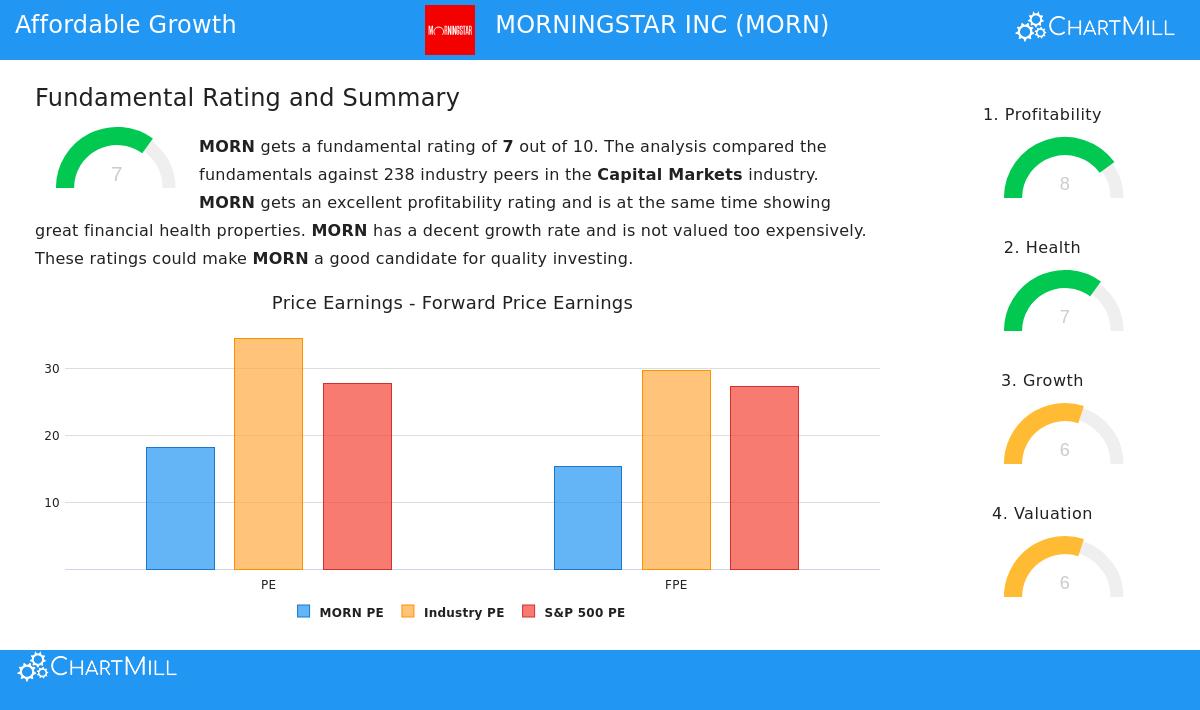
Outside the specific filter measures, a wider view of Morningstar's basic picture backs the investment idea. As stated in a full basic analysis report, the company gets a total score of 7 out of 10, with special good points in profitability and financial soundness.
The report notes Morningstar's very good returns on assets, equity, and invested capital (ROIC of 14.49%), all ranking in the highest group of the Capital Markets field. Its profit margins have gotten better in recent years. While the price looks acceptable instead of very low, with a P/E ratio about equal to field friends but under the wider S&P 500 average, the solid expansion and profitability numbers help support the price. Experts also forecast good future EPS expansion averaging over 18% each year.
The Company Behind the Figures
The number-based tests point to a financially solid company, but Lynch's first rule was to "invest in what you know." Morningstar's work is naturally clear for many investors: it is a top supplier of independent investment study, data, and numbers. Its parts, including Morningstar Data and Analytics, PitchBook (private market data), and Morningstar Credit, serve a worldwide client group of investors, advisors, and organizations. This places the company as a needed tool for the finance field, making a repeat income model based on data memberships and software answers, a "simple" but key business that Lynch might like.
A First Step for More Study
It is key to remember that passing a filter is only the initial stage in the Lynch process. The following part involves story-based study to learn the company's competitive strengths, or "moat," and judge if its expansion reasons stay in place. For Morningstar, an investor would need to look at patterns in its user group, competitive forces, and its skill to bring together purchases like PitchBook well.
A Peter Lynch-type filter is made to produce a small list of good choices for a long-term portfolio. Morningstar Inc, with its solid fit with the method's expansion, profitability, and price checks, shows itself as an interesting choice for more careful review by GARP-minded investors.
You can look at other companies that fit the Peter Lynch investment standards by using the pre-set stock filter.
Disclaimer: This article is for information only and does not make financial guidance, a suggestion, or a deal to buy or sell any securities. The study uses data and a particular investment method frame. Investors should do their own complete study and think about their personal money situation before making any investment choices.