
For investors aiming to assemble a portfolio of durable, long-term holdings, the ideas of quality investing offer a useful structure. This method centers on finding companies with lasting competitive strengths, sound financial condition, and the capacity to produce steady, high-grade profits through economic periods. One organized way to find these companies is the "Caviar Cruise" stock screen, which selects for firms displaying better past revenue and profit expansion, high returns on invested capital, strong free cash flow production, and reasonable debt amounts. The screen highlights not only expansion, but profitable and efficient expansion, where earnings before interest and taxes (EBIT) grow faster than sales rises, indicating pricing strength and operational skill.
A present top result from this strict screening process is WW Grainger Inc (NYSE:GWW), a main distributor of maintenance, repair, and operating (MRO) products. Grainger’s business model and financial numbers match closely with the central beliefs of quality investing, making it a candidate deserving of more detailed study for those using this long-term approach.
Matching the Central Financial Standards
The Caviar Cruise screen uses several measurable filters to distinguish quality companies from the wider market. Grainger’s financial results over the last five years show it meets these standards easily.
-
Maintainable Expansion: The screen calls for a minimum 5% compound annual growth rate (CAGR) for both revenue and EBIT. Grainger passes this readily, with a 5-year revenue CAGR of 6.65% and a more notable EBIT CAGR of 13.83%. More significantly, EBIT expansion has greatly exceeded revenue expansion. This is a main screen filter because it points to better profitability and operational leverage, a signal that the company is growing efficiently and may have pricing strength, both signs of a quality business.
-
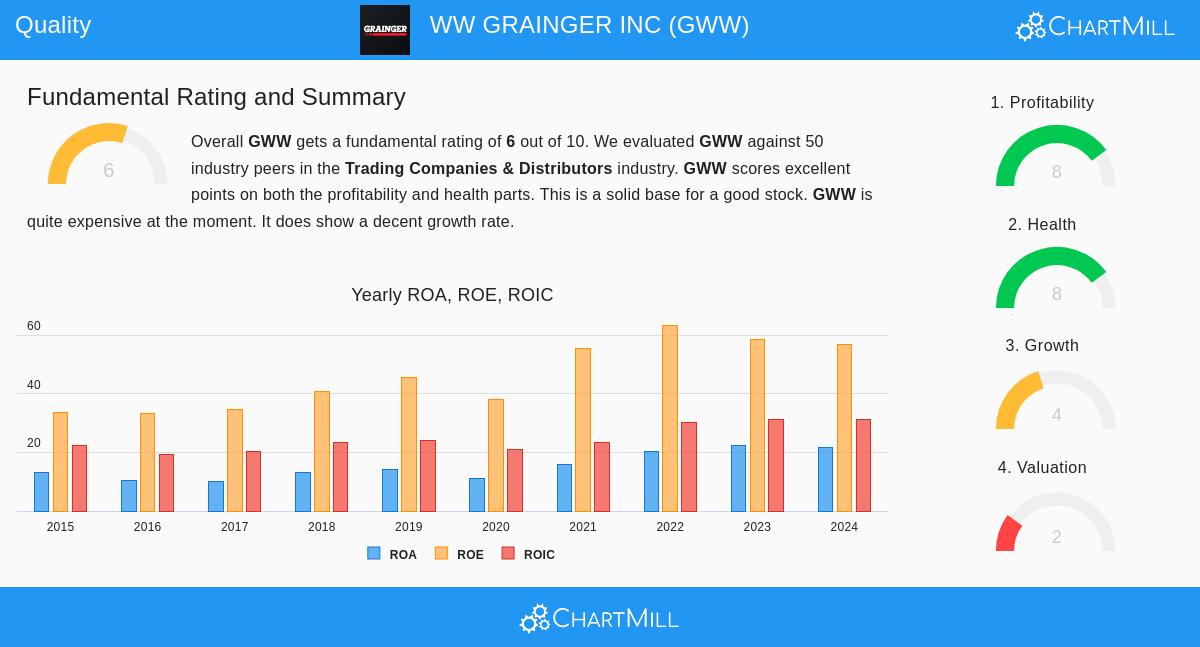
Outstanding Capital Effectiveness: Maybe the most important measure for quality investors is the return on invested capital (ROIC), which gauges how well a company produces profits from its capital base. The screen requires an ROIC (leaving out cash, goodwill, and intangibles) over 15%. Grainger’s number of 33.65% is outstanding, putting it in the highest group of its industry. A persistently high ROIC suggests a lasting competitive edge, as it shows the company can put its earnings back to work at high rates of return, building a strong compounding result for long-term shareholders.
-
Financial Soundness and Profit Grade: The screen assesses balance sheet condition by examining the Debt-to-Free Cash Flow (FCF) ratio, favoring companies that could in theory clear all debt within five years using their present FCF. Grainger’s ratio of 1.92 is very good, pointing to little financial danger and plenty of ability to fund operations, give capital back to shareholders, or put money into expansion without taking on too much debt. Also, the screen looks for high "profit grade," measured as the 5-year average of FCF to net income. A ratio above 75% implies accounting profits are turning into real, usable cash. Grainger’s average of 87.44% points to a high-grade earnings stream that is less likely to be affected by accounting changes and more easily used for shareholder returns or reinvestment.
Basic Condition and Price Setting
A look at Grainger’s detailed basic analysis report supports the image shown by the screen. The company receives high scores for Profitability and Financial Condition, with notable grades for return measures, margins, and solvency. Its expansion profile is rated as satisfactory, backed by a solid past record even as future analyst projections point to a slowing from prior peaks.
The main point of care, frequent for many high-grade companies, is in Price Setting. The report notes Grainger’s present price-to-earnings ratio is high compared to its own past. However, for quality investors, price setting often comes after the condition and lasting nature of the business itself. The higher price can be accepted because of the company's outstanding profitability, financial toughness, and the possibility for dependable long-term compounding. The choice to invest depends on whether an investor thinks these quality features are lasting enough to support the present market price.
A Business Made for the Long Term
Beyond the figures, Grainger’s business has non-quantitative features that quality investors like. It works in the necessary, though not flashy, MRO distribution field, supplying products that keep other businesses operating. This creates a tough demand profile. The company has put significant money into its supply chain and digital systems, building competitive edges through service, speed, and product range. Its activities across North America, Japan, and the UK give geographic spread. In summary, it shows the features of a "toll-bridge" business within the industrial economy, a model that can be straightforward to grasp and able to endure economic cycles.
Finding Other Quality Prospects
Grainger acts as a leading example of the kind of company the Caviar Cruise method tries to find. For investors wanting to see the complete list of companies that now meet this screen’s filters, you can see the live screening results here: View the Caviar Cruise Screen on Chartmill. This list can be a useful beginning for more basic study.
Disclaimer: This article is for information only and is not financial guidance, a suggestion, or an offer to buy or sell any security. The study is based on data and a particular screening method; investors should do their own complete study and think about their personal financial situation and risk willingness before making any investment choices.