

For investors looking to assemble a portfolio of lasting, high-quality businesses, the quality investing philosophy offers a strong framework. This method centers on finding companies with lasting competitive strengths, sound financial condition, and the capacity to produce high returns on capital over many years. The "Caviar Cruise" stock screening method turns this philosophy into a group of measurable filters, made to find firms that show both past high performance and the traits needed for continued future success. One well-known company that regularly passes these strict filters is ALPHABET INC-CL C (NASDAQ:GOOG).
A Base of Strong and Profitable Growth
The Caviar Cruise screen first asks for a history of steady expansion. A company must show at least a 5% compound annual growth rate (CAGR) in both revenue and EBIT (earnings before interest and taxes) over the last five years. It also requires that EBIT growth is higher than revenue growth, a sign of better operational efficiency and pricing strength.
Alphabet’s financial numbers easily meet these basic needs, presenting a business that is expanding strongly and becoming more profitable.
- Revenue Growth (5Y CAGR): 12.49%
- EBIT Growth (5Y CAGR): 26.03%
The reality that Alphabet’s EBIT growth is over two times its already-good revenue growth is a vital sign for quality investors. It implies the company gains from major economies of scale and has strong pricing strength in its main markets, features of a wide economic moat.
Outstanding Capital Use and Financial Strength
Central to quality investing is the effective use of capital. The screen requires a high Return on Invested Capital (ROIC), using a calculation that leaves out cash, goodwill, and intangibles to concentrate on the core business. A number above 15% is needed, and Alphabet performs outstandingly.
- ROIC (Excluding Cash, Goodwill & Intangibles): 35.65%
This notable number shows that for every dollar Alphabet puts back into its core operations, it creates over 35 cents in profit. This capacity to compound capital at such a high rate is a main force behind long-term shareholder value and is a key reason the company scores well in quality screens.
Financial condition is also very important. The screen uses a Debt-to-Free Cash Flow ratio below 5 to make sure a company can handle its debts easily. Alphabet’s ratio is very low.
- Debt / Free Cash Flow: 0.29
This number means Alphabet could pay off all its debt with less than four months of its present free cash flow. This great financial power offers a wide safety buffer, pays for ongoing innovation (like in AI and cloud computing), and allows for significant shareholder returns via buybacks.
High-Quality Earnings and Cash Generation
Quality investors value "real" earnings over accounting profits. The Profit Quality filter, which calculates the five-year average change of net income into free cash flow, looks for a minimum of 75%. This makes sure reported profits are supported by real cash entering the business.
- Average Profit Quality (5Y): 92.29%
Alphabet’s score well above the limit confirms the high quality of its earnings. The company is very good at changing its accounting profits into usable cash, which supports the noted financial flexibility and strengthens the durability of its business model.
Fundamental Analysis Summary
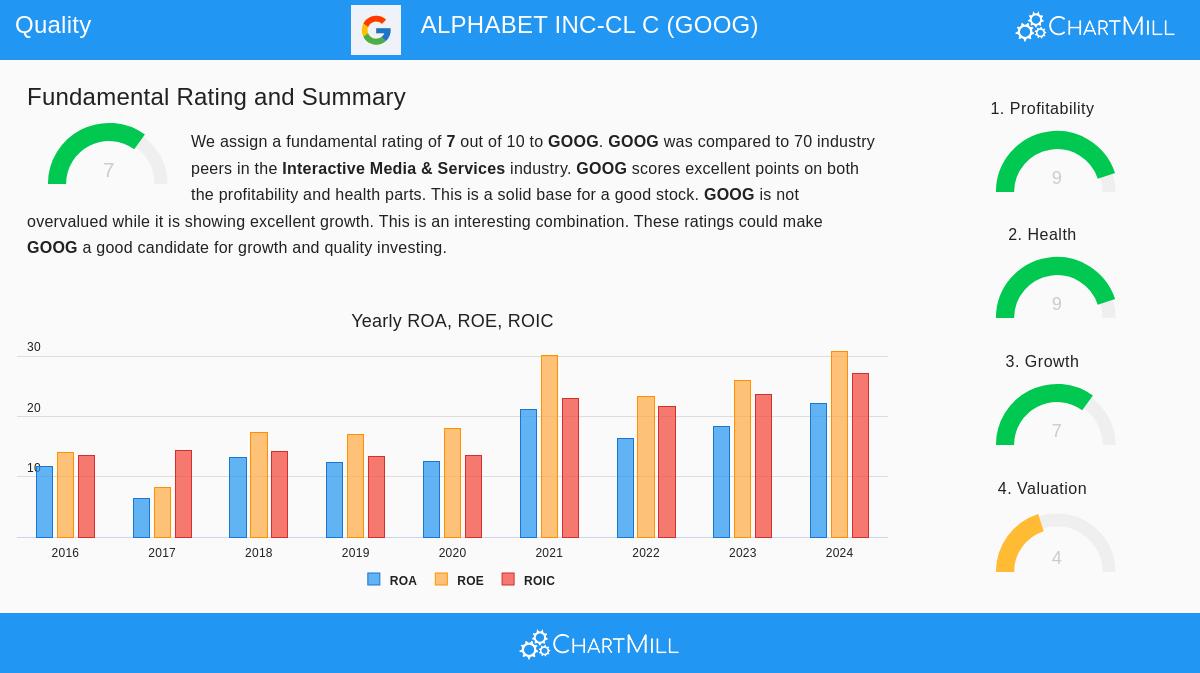
A look at Alphabet’s detailed fundamental report supports the results from the Caviar Cruise screen. The report gives Alphabet a high total score of 7 out of 10, with special strength in Profitability (9/10) and Financial Health (9/10). Important points from the report are:
- Profitability: High returns on assets, equity, and invested capital that are in the top group of its industry. Both operating and profit margins are with the best in the Interactive Media & Services sector and have shown steady gain.
- Financial Health: A flawless balance sheet shown by a top-level Altman-Z score and very little debt. The report clearly states the company is "creating value" as its ROIC is much higher than its cost of capital.
- Growth: Good past growth in revenue and EPS, along with positive analyst forecasts for continued double-digit growth in the coming years.
- Valuation: While the Price-to-Earnings ratio is high, the report states this is similar to industry peers and the wider market. It also suggests the higher price may be reasonable given the company's high profitability and expected growth, with a low PEG ratio pointing to a fair valuation when growth is considered.
A Top Choice for a Quality Portfolio
Alphabet’s success with the Caviar Cruise filters is not random. It shows a business founded on leading, cash-producing platforms (Search and YouTube), constant innovation (Cloud and AI), and careful capital use. The numerical standards, high ROIC, good cash-supported profit growth, and a strong balance sheet, all indicate the traits quality investors seek: lasting competitive advantages, skilled management, and stability through economic changes.
For investors wanting to examine other companies that meet these strict quality measures, the Caviar Cruise screen is a useful beginning. You can view and adjust the present screen results here.
Disclaimer: This article is for informational purposes only and does not constitute financial advice, a recommendation, or an offer to buy or sell any security. Investing involves risk, including the potential loss of principal. Always conduct your own research and consider your individual financial circumstances before making any investment decisions.