

For investors looking to balance the search for growth with a degree of caution, the Growth At A Reasonable Price (GARP) method provides a noteworthy middle path. This method focuses on companies showing strong and lasting earnings improvement, but whose shares are not trading at very high prices. The aim is to sidestep the speculative excess of high-growth stocks while still benefiting from better-than-average business progress. One way to find such companies is through a structured search for "Affordable Growth," which selects for stocks with high growth scores, good basic profitability and financial condition, and a price that does not seem too high.
Gold Fields Ltd (NYSE:GFI) serves as an example in this investment method. As a large global gold producer with activities in South Africa, Australia, Ghana, and Peru, the company's results are naturally linked to the price of gold. However, a closer examination of its basic measures shows a business that is performing well in its field, producing strong profits and improvement that may not be completely seen in its present stock price.
A Base of High Profitability
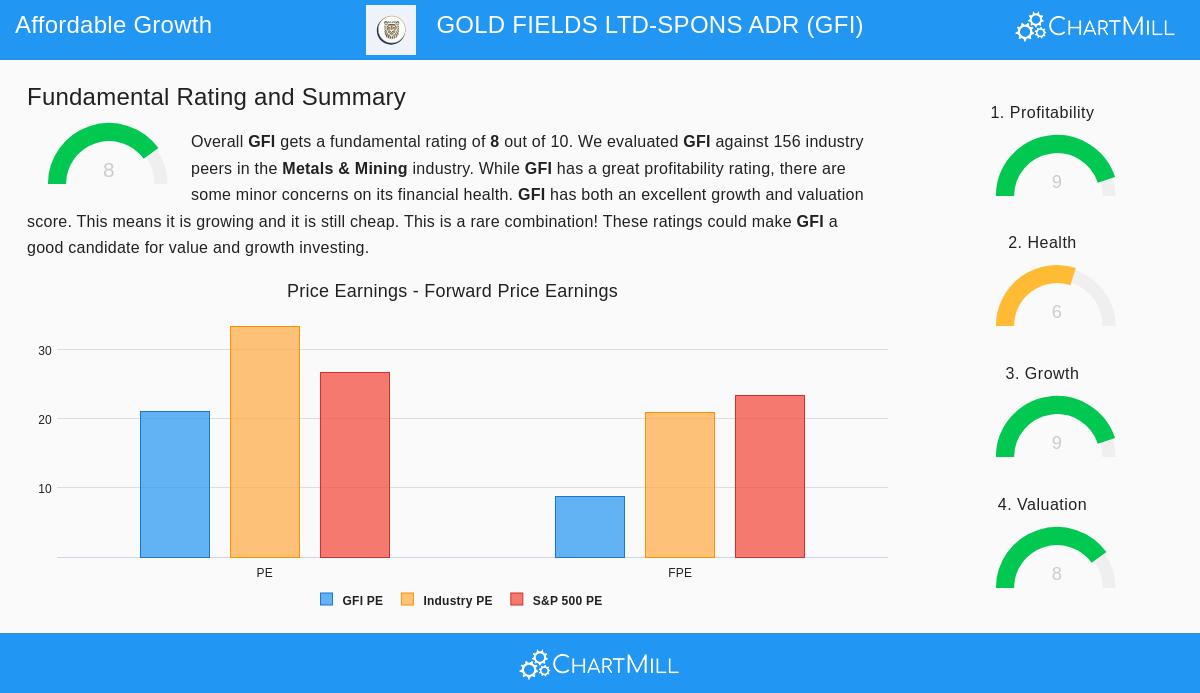
Before judging improvement or price, the financial soundness of a company is most important. A GARP method needs a profitable business, as earnings improvement from a position of loss is naturally less secure. Gold Fields does very well here, receiving a top Profitability Rating of 9 out of 10. The company turns its sales into earnings with notable effectiveness.
- Better Margins: The company has an Operating Margin of 53.1% and a Profit Margin of 28.7%, doing better than over 90% of similar companies in the Metals & Mining industry. These margins have improved in recent years.
- High Returns on Capital: The quality of profitability is shown by a Return on Invested Capital (ROIC) of 22.6%, which puts it in the top 4% of its industry. This shows management is using capital to create significant value.
This high level of profitability gives a stable base from which improvement can be financed and maintained, lessening the need for high debt or share dilution.
Noteworthy Improvement Path
The central idea of the GARP method is finding real improvement, and Gold Fields also meets this, getting a Growth Rating of 9. The company is showing solid momentum in both its recent results and its future view.
- Very Strong Recent Results: Over the last year, the company reported a 196.7% improvement in Earnings Per Share (EPS) with a 50.4% rise in Revenue.
- Good Historical Pattern: Looking back over several years, the company has improved its EPS at a yearly rate of 48.1%.
- Solid Future Predictions: Analysts expect this momentum to persist, with estimates indicating average yearly EPS improvement of 52.6% and Revenue improvement of 25.0% in the next few years.
This mix of good past results and an optimistic forward view is exactly what improvement investors look for. The faster expected revenue improvement compared to the historical pattern is a specifically good sign.
Price: The "Reasonable Price" Point
A stock can be a good company but a bad investment if the cost is too steep. The Affordable Growth search specifically looks for prices that are not too high, and Gold Fields gets a good Valuation Rating of 8. While some common measures might cause concern, context within the industry and the company's improvement picture shows a different view.
- Good Relative Price: Gold Fields trades at a Price-to-Earnings (P/E) ratio of 21.1. While this may appear high alone, it is clearly less expensive than 83% of its industry peers, where the average P/E is above 33.
- Forward-Looking Measures Are More Interesting: The price argument improves when looking forward. The stock's Price/Forward Earnings ratio is 8.7, which is less expensive than 88% of the industry and much below the S&P 500 average.
- Improvement Justification: The low Price/Earnings-to-Growth (PEG) ratio implies the current P/E is well supported by the company's high expected earnings improvement rate.
This price profile is key to the GARP argument. Investors are not paying extra for past results; they are buying a high-improvement, highly profitable business at a lower price relative to its industry.
A Point on Financial Condition
No review is whole without a check on the balance sheet. Gold Fields receives a Health Rating of 6, indicating a generally acceptable but not perfect financial state. The company has a workable Debt/Equity ratio of 0.41 and an Altman-Z score that strongly implies no bankruptcy risk. However, liquidity ratios like the Current Ratio are a bit under the industry median. It is important to balance this against the company's high profitability and good free cash flow, which provides notable ability to meet its debts. For a GARP investor, this condition profile is seen as "acceptable"—it does not raise serious warnings that would outweigh the strong improvement and profitability signs, but it is an area to watch.
A full list of all these basic ratings can be seen in the full fundamental analysis report for GFI.
Conclusion
Gold Fields Ltd has the traits looked for by the Affordable Growth or GARP method. It is a company operating very well, shown by its top profitability and speeding improvement picture. Yet, the market values its shares at a notable discount to its industry peers, especially on forward earnings estimates. This creates a possible chance where the "improvement" part is clear and the "reasonable price" point is backed by comparative price measures. While investors must always think about field-specific risks like commodity price changes, from a pure basic search view, GFI matches closely with the needs for a stock providing improvement at a reasonable price.
This review of GFI came from a specific Affordable Growth search. Investors curious about finding other companies that meet similar needs of strong improvement, sound basics, and fair price can use this search themselves to see more results.
Disclaimer: This article is for information only and does not make up financial advice, a suggestion, or an offer or request to buy or sell any securities. The information given is based on supplied data and should not be the only base for any investment choice. Investing has risk, including the possible loss of the original amount. Always do your own research and think about talking with a qualified financial advisor before making any investment choices.