

Growth investing strategies often focus on identifying companies with strong financial momentum and operational quality. One methodical approach comes from Louis Navellier's "The Little Book That Makes You Rich," which presents eight specific rules for choosing high-quality growth stocks. These rules focus on positive earnings revisions and surprises, increasing sales and earnings growth, widening operating margins, solid cash flow generation, and high returns on equity. A recent screen based on these ideas has found Dave Inc (NASDAQ:DAVE) as a company that deserves more attention from growth-focused investors.
Meeting the Little Book Criteria
Dave Inc, a digital banking service provider, seems to fit well with Navellier's method. The company's recent financial data indicate it is showing the type of strong growth and operational effectiveness the strategy aims to find.
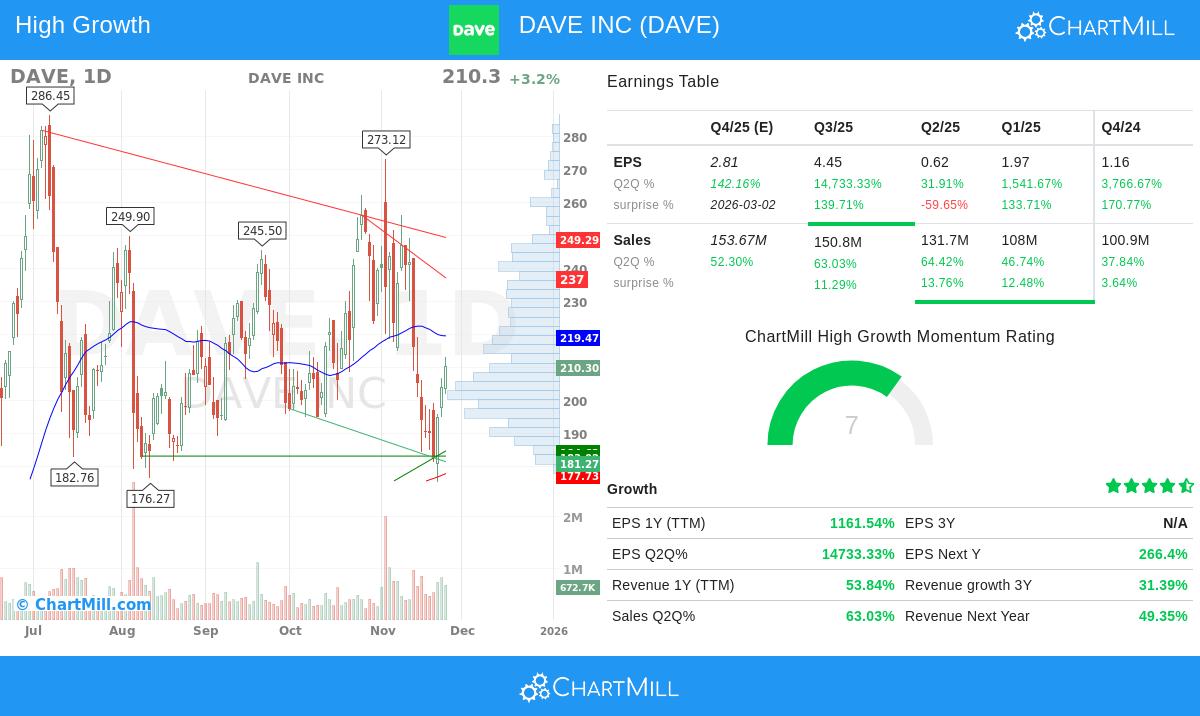
- Positive Earnings Revisions: A key part of the strategy is that upward revisions by analysts frequently point to strong business momentum. Dave shows a notable 62.2% rise in the average EPS estimate for the next quarter over the last three months, showing significant analyst confidence about its near-term future.
- Positive Earnings Surprises: Companies that regularly exceed forecasts can cause analysts to adjust their models, which may lead to future price gains. Dave has exceeded EPS estimates in three of its last four quarterly reports, with an average surprise of 96.1%, showing a consistent record of beating expectations.
- Increasing Sales and Earnings: The strategy requires not just growth, but growth that is getting faster. Dave's financials display strong momentum here:
- Quarterly revenue increased 63.0% year-over-year.
- Trailing twelve-month revenue increased 53.8%.
- Quarterly EPS rose by an exceptional 14,733.3% year-over-year.
- Trailing twelve-month EPS increased by 1,161.5%.
- Widening Operating Margins: A main sign of better profitability is the widening of operating margins, showing that sales growth is happening without hurting profits. Dave's operating margin has widened by over 504% in the past year, a major improvement that fits this rule.
- Solid Cash Flow: Creating strong cash flow gives a company financial stability and the ability to fund its own growth. Dave's free cash flow increased by a notable 4,294.4% over the past year, pointing to a very solid and improving cash situation.
- High Return on Equity (ROE): The strategy looks for companies that create profits from shareholder equity effectively. Dave's ROE of 50.4% is very high, showing better capital use and profitability than many similar companies.
Fundamental Analysis Overview
A wider fundamental analysis of Dave Inc supports the view from the Little Book screen. The company gets an overall good fundamental rating, with specific strong points in its financial health and growth. The analysis points to a strong balance sheet with high solvency and liquidity scores, together with exceptional historical growth in both earnings and revenue. While its present valuation using standard Price-to-Earnings measures seems high, this could be reasonable given its very high growth rates and profitability margins, which are some of the top in the Consumer Finance industry.
A Starting Point for Further Research
The use of Louis Navellier's screening rules has effectively identified Dave Inc as a company displaying many traits of a high-growth stock. Its strong patterns in sales, earnings, cash flow, and profitability make it an interesting candidate for investors using this method.
It is important to note that a screen is a beginning for research, not a final list of buys. Investors should perform their own complete due diligence.
For investors interested in finding other companies that match this growth-oriented strategy, you can view the live screen and its present results here: Louis Navellier's Little Book Screen.
,
Disclaimer: This article is for informational purposes only and does not constitute financial advice, a recommendation, or an offer or solicitation to buy or sell any securities. The information presented should not be used as the sole basis for making any investment decision. All investors should conduct their own independent research and consult with a qualified financial advisor before making any investment.