

In the field of long-term investing, few methods have earned as much regard as the one described by famed fund manager Peter Lynch. His method, often called Growth at a Reasonable Price (GARP), centers on finding companies with durable, steady growth, sound financial condition, and earnings, all while available at a price that does not overestimate that quality. The central concept is to locate reliable compounders for a long-term portfolio, steering clear of the limits of speculative growth stocks and inactive deep-value choices. A filter using Lynch's ideas recently pointed to Cabot Corp (NYSE:CBT) as a possible option for more examination.
A Sound Base in Specialty Chemicals
Cabot Corp is a worldwide specialty chemicals and performance materials company functioning through two primary divisions: Reinforcement Materials and Performance Chemicals. Its products, which involve reinforcing carbons for tires, fumed metal oxides, and conductive additives, are key parts in many industrial and consumer uses, from automotive and construction to electronics and energy storage. This place in necessary, if sometimes "unexciting," industrial areas matches a Lynch principle: invest in clear businesses with lasting need.
Fitting the Lynch Standards
A Peter Lynch-influenced filter uses particular checks to find companies with a balanced mix of growth, value, and financial soundness. Cabot Corp's present measurements show a solid match with these rules:
- Steady Earnings Growth: Lynch looked for companies with an established growth history that was good but not extreme, as very high growth is frequently not maintainable. Cabot's earnings per share have increased at a notable average pace of 28.5% over the last five years, well above the filter's 15% minimum. Importantly, this growth pace stays under the 30% limit Lynch proposed to prevent overextended expansion.
- Appealing Valuation using PEG Ratio: Maybe the most important Lynch measurement is the Price/Earnings to Growth (PEG) ratio, which tries to find stocks where the price is fair compared to their growth pace. A PEG ratio of 1 or below is usually seen as appealing. Cabot stands out here, with a PEG ratio of 0.38, suggesting the market may be pricing its historical growth too low. This low PEG is a central part of the "reasonable price" case for GARP investors.
- Strong Profitability (ROE): Lynch demanded companies be highly profitable and effective with shareholder money. Return on Equity (ROE) is a main gauge of this. Cabot's ROE of 19.4% is much higher than the filter's 15% requirement, putting it in the leading group of its industry and indicating very good management performance and a durable competitive advantage.
- Sound Financial Condition: To confirm longevity, Lynch stressed sturdy balance sheets. The filter checks for a Debt-to-Equity ratio below 0.6 and a Current Ratio above 1. Cabot satisfies both conditions, with a D/E ratio of 0.55 and a Current Ratio of 1.67. This shows a careful amount of debt financing and enough short-term cash to cover costs, offering a safety buffer in economic slowdowns.
Broad Fundamental Review
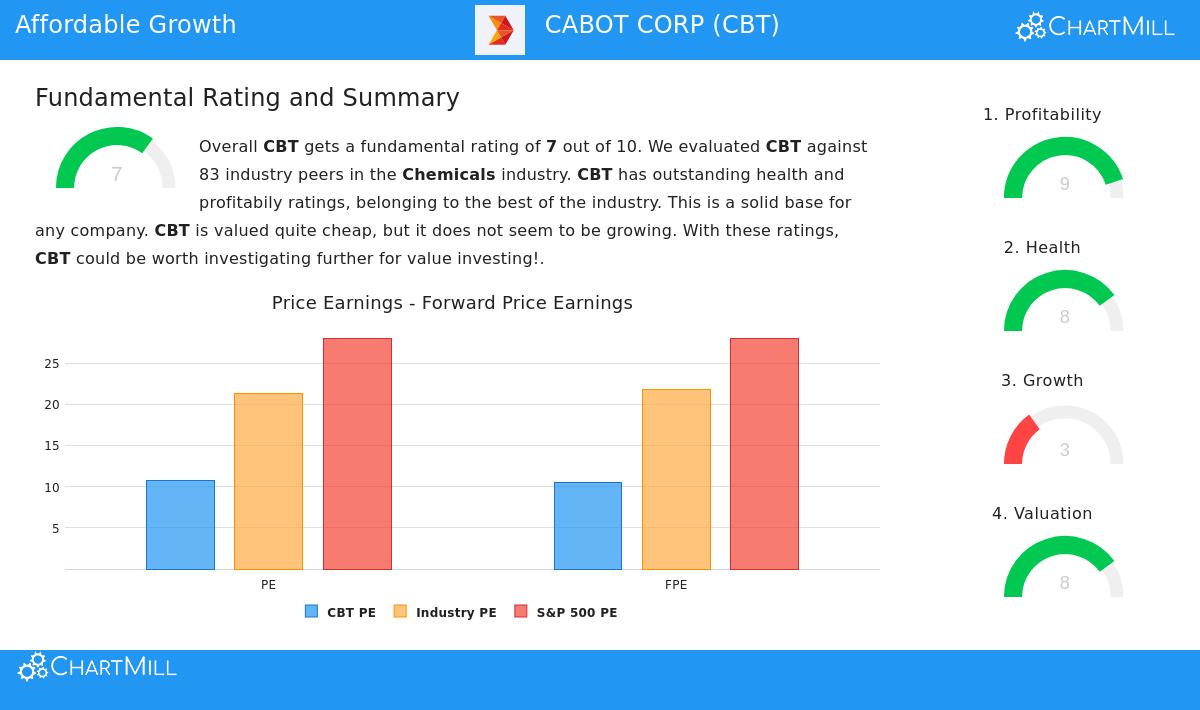
A wider view of Cabot's fundamental profile supports the image shown by the Lynch filter. The company gets a good total fundamental score of 7 out of 10. Its notable qualities are very high profitability and sound financial condition, with leading industry positions for measurements like Return on Invested Capital (ROIC) and Debt to Free Cash Flow. The valuation is also a positive, with its P/E and Price/Forward P/E ratios seen as low next to both industry competitors and the wider S&P 500.
The main point for care, as mentioned in the full fundamental report, is in the growth group. While past growth has been good, recent sales and earnings have met obstacles, and future growth projections are moderate. For a Lynch-type investor, this change requires more detailed study to decide if the slowdown is temporary, possibly linked to weaker need in main industrial areas, or a sign of a more lasting reduction. The method requires knowing why growth has shifted and judging the company's capacity to resume a steady growth trend.
Is Cabot a Lynch-Type Investment?
For investors following a strict GARP philosophy, Cabot Corp offers a solid example. It meets the necessary points of Lynch's structure: a clear business model, a record of good and steady EPS growth, high profitability, a firm balance sheet, and a valuation that seems inexpensive, particularly when considering its growth through the PEG ratio. The company’s regular dividend, paid for more than ten years, includes another form of shareholder return.
Yet, following Lynch's guidance, a filter is only the first step for study, not a purchase suggestion. The essential question for a potential investor is if Cabot's present growth difficulties are short-term or lasting. Examining the company's competitive standing within its chemical specialties, its development pipeline, and management's plan for handling present market situations is necessary before any long-term decision.
Interested in reviewing other companies that meet this strict investment filter? You can see the present list of passing stocks using the Peter Lynch Strategy screener.
Disclaimer: This article is for informational and educational reasons only and does not form financial advice, a suggestion, or an offer to purchase or sell any securities. The examination is based on data and a set filtering method, it is not a replacement for your own complete research and assessment. Investing in stocks includes risk, involving the possible loss of capital. You should think about your own financial position, investment goals, and risk comfort before making any investment choice.