

For investors looking for a disciplined, long-term way to build wealth, few strategies are as respected as Peter Lynch’s method. The famous manager of Fidelity’s Magellan Fund supported investing in what you understand, concentrating on companies with clear operations, steady growth, and good finances, all bought at a fair price. This "growth at a reasonable price" (GARP) idea steers clear of speculative stocks, choosing instead profitable, consistently growing companies that can be owned for years. A stock filter based on Lynch’s ideas can find such candidates by sorting for specific measures of profit, financial strength, and price.
One company that recently appeared from such a filter is CABOT CORP (NYSE:CBT), a worldwide specialty chemicals and performance materials company. A detailed look shows how its characteristics match several important parts of the Lynch investment approach.
Match with Peter Lynch Standards
The main Lynch filter looks for companies that are growing profitably without too much financial danger, and whose stock price is not too high compared to that growth. Cabot Corp. shows a good match with these number-based filters:
- Steady Earnings Growth: Lynch preferred companies with solid but steady growth, often wanting a 5-year EPS growth rate between 15% and 30%. Cabot’s EPS has increased at a notable average yearly rate of 28.53% over the last five years, putting it at the higher end of this steady range. This shows a good history of profit growth.
- Good Price via PEG Ratio: Maybe the most important Lynch measure is the Price/Earnings to Growth (PEG) ratio, which tries to find stocks that might be priced low compared to their growth path. Lynch wanted a PEG of 1 or lower. Cabot’s PEG ratio, using its past five-year growth, is a very low 0.34. This implies the market is pricing the company’s earnings well below its historical growth rate.
- High Profitability (ROE): Return on Equity (ROE) shows how well a company creates profit from shareholder money. Lynch wanted an ROE above 15%. Cabot’s ROE of 21.03% not only meets this but is also high in its industry, showing very good management and a lasting business edge.
- Careful Financial Setup: To limit danger, Lynch stressed financial soundness. He liked companies with a Debt-to-Equity ratio below 0.6 (and preferably under 0.25). Cabot’s D/E ratio of 0.56 is within the allowed range, showing a sensible mix of debt and equity. Also, its Current Ratio of 1.61 is above Lynch’s minimum of 1, showing enough short-term cash to pay its bills.
Basic Strength and Price Summary
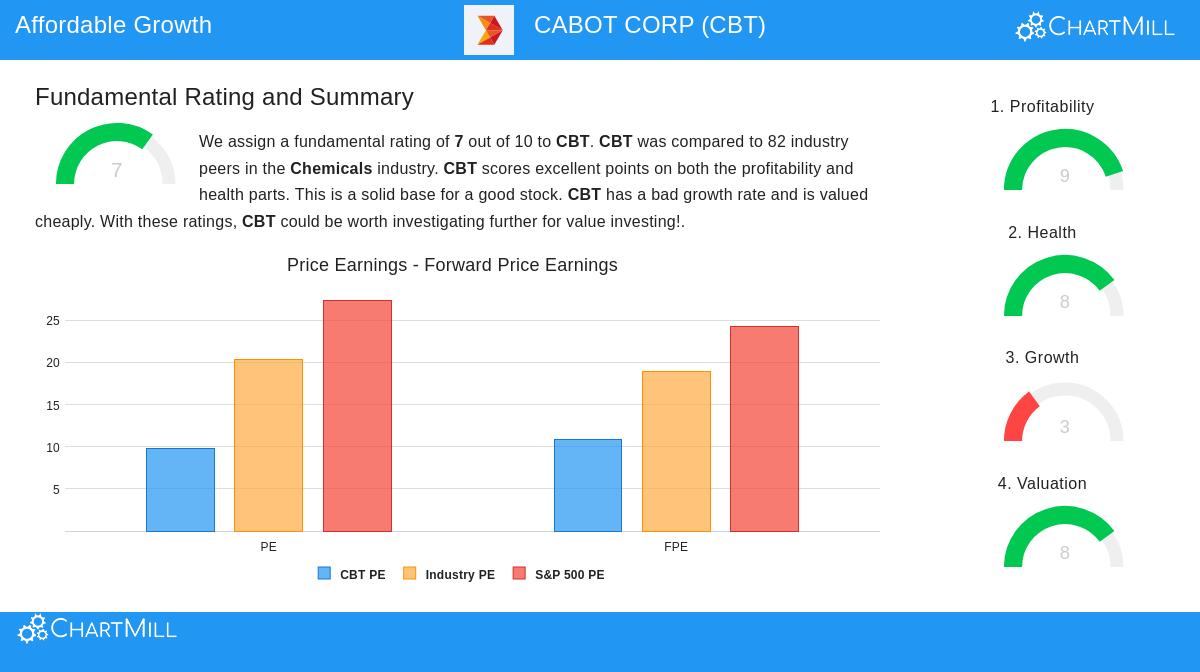
Beyond the specific filter standards, a wider view of Cabot’s basic profile supports its possible interest to GARP investors. According to Chartmill’s full fundamental analysis report, Cabot gets a total rating of 7 out of 10, with specific high points in profitability and financial soundness.
The company gets a high profitability score of 9, led by better returns on assets, equity, and invested capital (ROIC) that regularly beat most of its chemical industry competitors. Its profit margins have gotten better in recent years. On financial soundness, Cabot scores an 8, with a good Altman-Z score pointing to low failure risk and a workable debt level compared to its free cash flow.
The price argument is strong. Cabot’s P/E ratio of 9.77 and Forward P/E of 10.85 are seen as low next to both the wider S&P 500 and its industry average. This price rating of 8 suggests the stock is priced cautiously, giving a safety buffer—an idea Lynch and other careful investors liked.
The main warning in the report focuses on growth. While past EPS growth has been good, recent sales have decreased, and future growth guesses for both sales and earnings are low. This slowing growth path is a key point for investors to watch, as it supports the "steady growth" idea of the strategy.
A Candidate for More Study
Cabot Corp. offers a strong example of a company that meets a strict, rule-based filter inspired by Peter Lynch. It shows the features he valued: good historical earnings growth, high profitability, careful debt, and a price that does not overvalue those traits. Its business—supplying needed materials for tires, inks, electronics, and energy uses—fits the Lynch example of a "simple" but clear industry with lasting need.
For investors making a varied, long-term portfolio, Cabot is the kind of basically sound company that deserves more detailed study. As Lynch noted, a filter gives a beginning list, not a list of what to buy. The following steps require studying the company’s competitive place, management, and the long-term needs of its markets to judge if its growth can continue.
You can review other companies that fit the Peter Lynch investment standards by using the pre-set stock filter.
Disclaimer: This article is for information only and is not financial advice, a suggestion, or an offer or request to buy or sell any securities. The information given is based on supplied data and should not be the only reason for any investment choice. Investors should do their own complete study and talk with a qualified financial advisor before making any investment decisions. Past results do not guarantee future outcomes.