

CAL-MAINE FOODS INC (NASDAQ:CALM) has been identified by a systematic screening process intended to find possible value investments. The screening process focuses on stocks with good fundamental valuation scores, specifically a ChartMill Valuation Rating above 7, while also having acceptable scores in profitability, financial condition, and growth. This mix indicates a company could be priced below its inherent worth while still having the operational soundness and steadiness important to long-term investors. The approach fits with basic value investing ideas, looking for securities where the market price may not completely represent the fundamental business quality.
Valuation Metrics
The foundation of the value investment argument for Cal-Maine Foods is based on its appealing valuation metrics. The company's present valuation seems separate from its strong financial results, offering a possible opening for investors looking for undervalued opportunities.
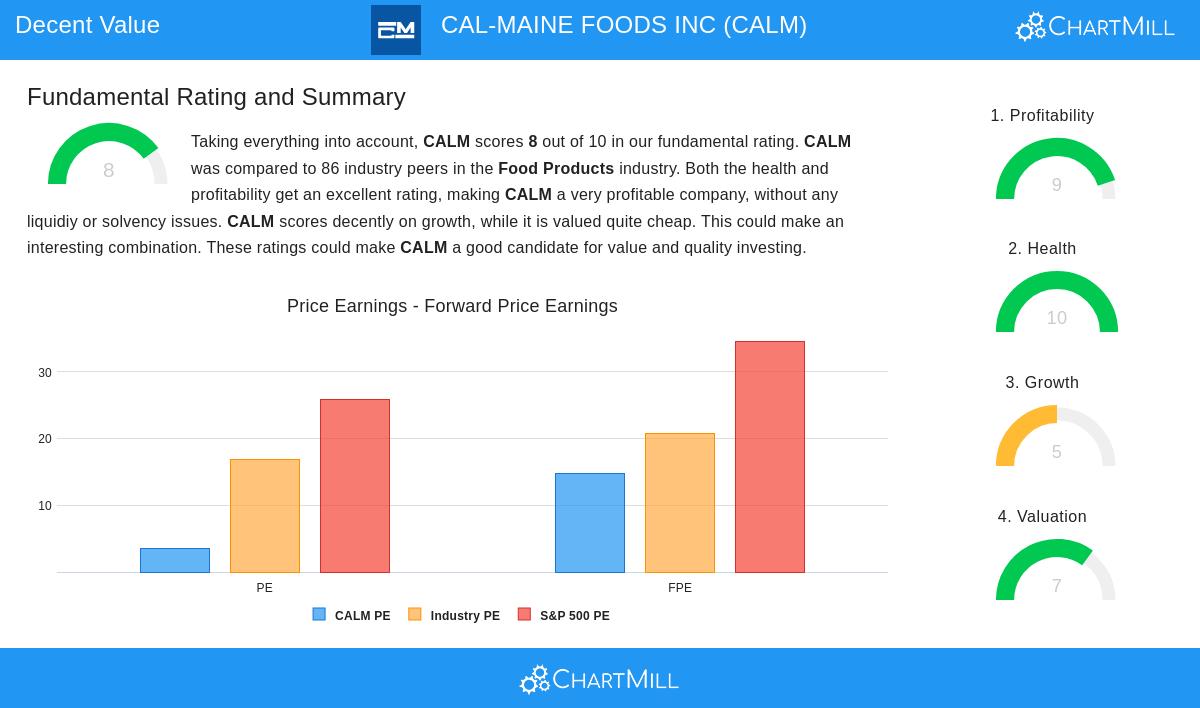
- Price-to-Earnings (P/E) Ratio: At 3.48, CALM's P/E ratio is very low, signaling an inexpensive valuation. It is less expensive than almost 98% of similar companies in the Food Products industry and is much lower than the S&P 500 average of 25.89.
- Price-to-Free-Cash-Flow: According to this ratio, CALM is valued more affordably than more than 95% of the firms in its industry, pointing to good cash creation compared to its market price.
- Enterprise Value to EBITDA: This measure also indicates a quite inexpensive valuation in the industry, with CALM being more affordable than over 96% of its rivals.
For value investors, these low valuation multiples are important. They propose a considerable safety margin, a cushion between the market price and the estimated inherent value, which is a fundamental idea for reducing investment risk. The company's Valuation Rating of 7 out of 10 supports this, verifying that the stock is not just low-priced, but low-priced relative to its fundamental earnings and cash flow.
Financial Health and Profitability
While a low price is attractive, value investing demands the company in question to be a good business, not just a statistically inexpensive one. Cal-Maine Foods performs well here, having excellent scores in both financial condition and profitability. A company with a solid balance sheet is less prone to be a value trap, where a low valuation signals a fundamental business decline rather than a market error.
- Excellent Financial Condition (Rating: 10/10): CALM functions with no debt, an uncommon and cautious financial situation that removes interest costs and bankruptcy danger. This is supported by very good liquidity, with a Current Ratio of 6.84 and a Quick Ratio of 5.62, showing sufficient ability to cover short-term liabilities.
- High Profitability (Rating: 9/10): The company's capability to produce returns is first-rate. Its Return on Equity (47.07%), Return on Assets (39.71%), and Return on Invested Capital (41.57%) all place with the top in its industry. Also, its Profit Margin of 28.86% and Operating Margin of 36.21% show very effective operations.
These measures are crucial because they validate the company's inherent soundness. A financially sound and very profitable business trading at a discount is the perfect prospect for a value investor, as the possibility for price increase is supported by a lasting competitive position and operational effectiveness.
Growth and Dividend Profile
The investment argument is additionally supported by a varied but notable growth and income picture. While future growth expectations are low, the company's recent results and shareholder payments add interesting aspects to the narrative.
- Good Past Growth: CALM has achieved significant growth over the last year, with Earnings Per Share increasing 221.11% and Revenue increasing 65.80%. The multi-year average growth rates for these measures are also quite good.
- Difficult Future View: Analysts predict a decrease in both EPS (-33.60%) and Revenue (-4.92%) in the next few years. This expected reduction probably plays a role in the stock's low valuation and is a main point for investor examination.
- Appealing Dividend Yield: The stock provides a considerable annual dividend yield of 6.02%, which is higher than the industry average and more than twice the yield of the S&P 500. The payout ratio of 32.04% is manageable, indicating the dividend is sufficiently supported by earnings.
For a value investor, the high dividend yield offers a concrete return while anticipating the market to revalue the stock. The outstanding past growth shows the company's earnings capacity, even if a cyclical decline is expected. The main question for an investor is if the present low valuation sufficiently accounts for this expected downturn.
A thorough examination of these fundamental elements is accessible in the full fundamental analysis report for CALM.
Investment Considerations
Cal-Maine Foods offers an interesting case for investors using a value-focused approach. The stock trades at a large discount to the market and its industry according to standard valuation measures, giving a wide safety margin. This is joined with a clean balance sheet, high profitability, and a substantial, well-supported dividend. The main warning exists in the predicted earnings and revenue decrease, which implies the company could be experiencing a cyclical or industry-specific difficulty. Value investors need to consider if these issues are short-term or representative of a more lasting structural problem.
This examination of CALM was found using a preset screening method. Investors curious about finding other firms that meet similar standards of good valuation, condition, profitability, and growth can review the Decent Value Stocks screen on ChartMill for more possible ideas.
Disclaimer: This article is for informational purposes only and does not constitute financial advice, a recommendation, or an offer or solicitation to buy or sell any securities. The content represents an analysis based on publicly available data and should not be the sole basis for any investment decision. Investors should conduct their own independent research and consult with a qualified financial advisor before making any investment.