

For investors looking for a disciplined, long-term way to build wealth, few strategies are as respected as Peter Lynch's method. The famous manager of Fidelity's Magellan Fund supported a "growth at a reasonable price" (GARP) idea, concentrating on companies with solid, lasting earnings growth that are not priced too high by the market. His strategy stresses fundamental soundness, profit generation, and a price that accounts for growth, trying to find strong businesses before they become popular on Wall Street. A recent filter using Lynch's main rules has identified a well-known, yet interesting, candidate: AMAZON.COM INC (NASDAQ:AMZN).
A Main Lynch Idea: Lasting Growth
A central part of Lynch's strategy is finding companies with a clear history of earnings growth, but at a speed that can be kept up. He was cautious of extreme growth that might collapse, preferring stable, reliable increase. Amazon fits this rule well. The company's earnings per share (EPS) has increased at an average yearly rate of about 28% over the last five years. This number easily passes Lynch's usual minimum of 15% and, notably, is under the 30% limit he mentioned to steer clear of growth paths that cannot last. This past record shows Amazon's capacity to turn its huge size into regular profit gains.
Price Compared to Growth: The PEG Ratio
Maybe the most important Lynch measure is the Price/Earnings to Growth (PEG) ratio, which tries to decide if a stock's price is fair compared to its earnings growth rate. Lynch famously preferred companies with a PEG ratio of 1 or lower, meaning the market might not completely account for the future growth. Using its past five-year growth rate, Amazon's PEG ratio is 0.99. This falls right inside Lynch's desired area, implying that even with its size and market fame, the stock's price might still be reasonable, or even appealing, when its historical growth is considered.
Financial Soundness and Profit Generation
Lynch required investing in financially stable companies. His filters usually involved tests on balance sheet fortitude and profit generation to avoid cheap stocks with problems or operations with too much debt.
- Cautious Balance Sheet: Amazon shows a very careful debt structure, with a Debt-to-Equity ratio of 0.16. This is much better than Lynch's general liking for a ratio under 0.6 and matches his stricter ideal of under 0.25. It means the company is financed mainly by ownership stake, lowering money risk.
- Sufficient Short-Term Cash Flow: The company's Current Ratio is 1.05, meeting Lynch's basic need of being at least 1. This shows Amazon has enough short-term assets to pay its short-term debts.
- Solid Profit Generation: A Return on Equity (ROE) of 18.9% easily exceeds Lynch's 15% standard. This measure points out management's skill in creating earnings from shareholder money, a key mark of a good business.
High-Level Fundamental Summary
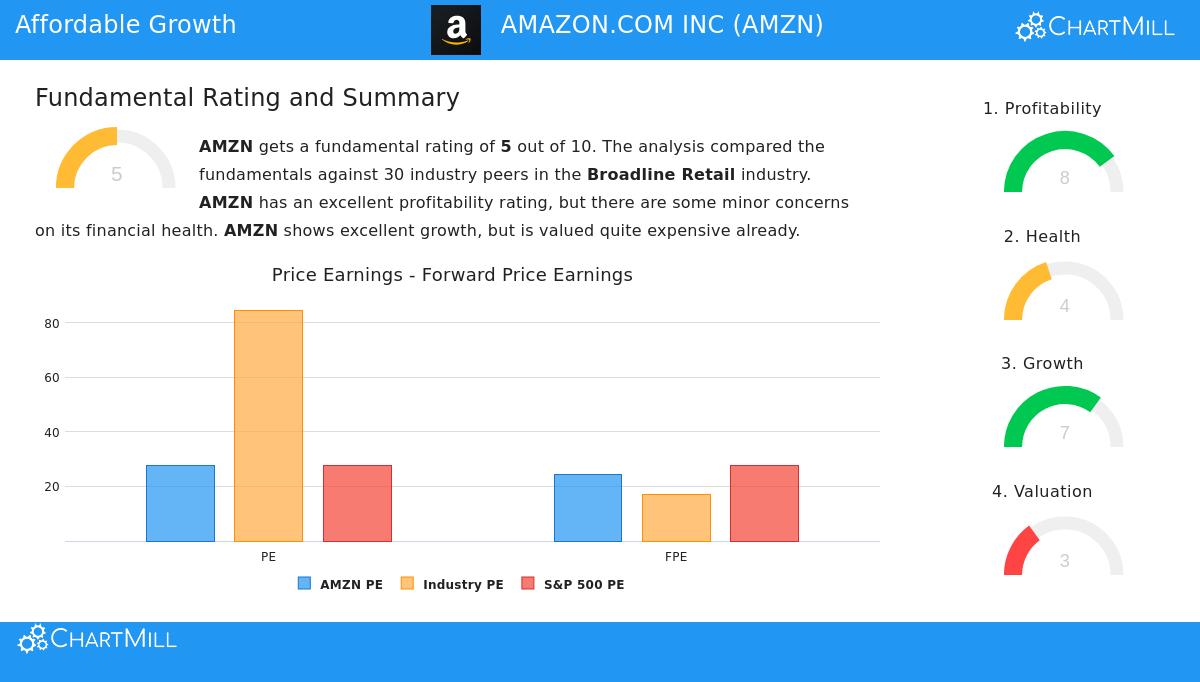
A wider view of Amazon's fundamental picture, as shown in a detailed study report, gives background for these Lynch-focused numbers. The report gives Amazon a medium total fundamental score, noting a varied situation that long-term investors should consider.
- Positive Points: Amazon's picture is led by very high profit generation and growth scores. Its profit margins have grown notably, and its returns on assets and invested capital are high in the competitive broadline retail field. The increase in both sales and earnings remains solid.
- Points to Note: The main areas of attention are on price and parts of financial soundness. The stock is seen as costly on standard Price-to-Earnings measures, though this is partly balanced by its high growth rate (as seen in the PEG ratio). From a soundness view, while the balance sheet is strong on debt level (low debt), cash availability ratios like the Quick Ratio are seen as not as strong as many industry competitors.
- Wrap-Up: The fundamental study ends by saying that while Amazon is a top performer in profit generation and growth in its field, investors are paying a high price for that quality, and there are small cash availability points on the balance sheet.
Is Amazon a Lynch-Type "GARP" Stock?
Using Peter Lynch's system, Amazon offers an interesting study. It meets his number-based filter very well: it has shown solid, lasting EPS growth, sells at a fair PEG ratio based on that growth, keeps a very strong balance sheet with little debt, and reaches high returns on equity. For the GARP investor, this mix is key, it is a growth narrative where the price does not seem to have risen faster than the historical growth fact.
Yet, Lynch also suggested investing in what you know and searching for companies that might be overlooked. Amazon is likely the reverse of unknown. The high level of big fund ownership and expert attention means most of its story is common knowledge, which is shown in its high standard P/E ratio. The investment argument, then, depends not on finding a hidden opportunity but on trusting that Amazon's established growth path, especially in high-profit areas like AWS and advertising, can keep supporting and possibly exceed its current price over many years.
For investors wanting to examine other companies that currently meet the Peter Lynch filter, you can see the complete, current list of findings here.
,
Disclaimer: This article is for informational purposes only and does not constitute financial advice, a recommendation, or an offer to buy or sell any security. The analysis is based on historical data and specific investment methodologies, which do not guarantee future results. Investors should conduct their own research and consult with a qualified financial advisor before making any investment decisions.