

For investors looking for chances where a company's market price may not completely show its basic business strength, a disciplined value investing method can be a practical structure. This plan focuses on finding stocks trading for less than their calculated intrinsic value, often shown by appealing valuation measures, while making sure the company has good financial condition and earnings to back future expansion. One stock that recently appeared through a systematic filter for such "decent value" traits is AUTOLIV INC (NYSE:ALV).
A Snapshot of Autoliv
Autoliv is a global leader in automotive safety systems, supplying major manufacturers with important parts like airbags, seatbelts, and steering wheels. Headquartered in Stockholm and operating 62 production facilities worldwide, the company plays a central role in the passive safety market. Its business is naturally linked to global automotive production volumes, but also gains from long-term movements toward higher safety content per vehicle.
Valuation: The Cornerstone of the Thesis
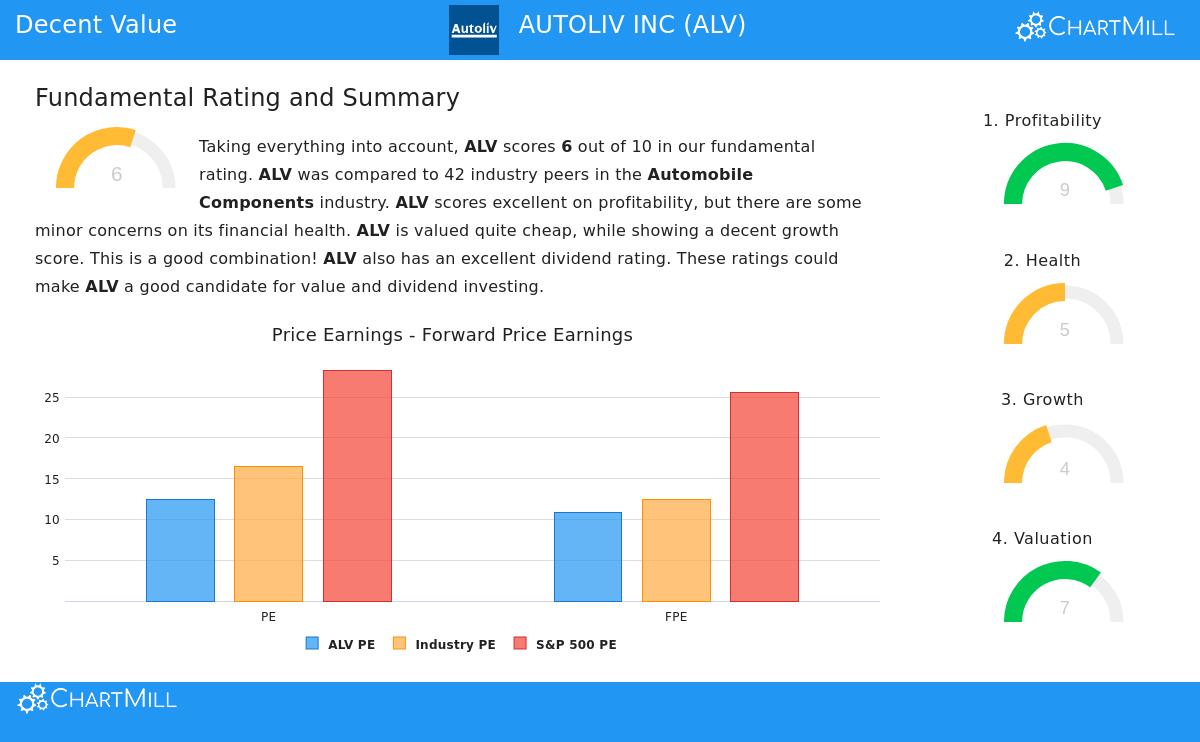
The main attraction of Autoliv from a value view rests in its present valuation numbers. According to ChartMill's fundamental analysis report, the stock receives a good Valuation Rating of 7 out of 10. This score comes from several convincing data points:
- Attractive Earnings Multiples: The stock trades at a Price-to-Earnings (P/E) ratio of 12.46, which is clearly less expensive than both the S&P 500 average (28.30) and most (76%) of its peers in the Automobile Components industry. The forward P/E ratio of 10.84 further supports this view of a fairly priced stock.
- Compensated for Growth: The PEG ratio, which changes the P/E for expected earnings expansion, is low, hinting the market is not paying too much for the company's future possibility. This is an important check for value investors to steer clear of "value traps" – stocks that are inexpensive for a worsening reason.
- Enterprise Value Perspective: The company's Enterprise Value to EBITDA ratio also looks positive compared to the industry, pointing to a possibly underrated business when looking at both its equity and debt.
For a value investor, these measures indicate a margin of safety could be present. The market is valuing Autoliv cautiously, maybe because of its cyclical industry, allowing space for gain if the company keeps performing well.
Profitability and Financial Health: Ensuring Quality
An inexpensive stock is only a good investment if the basic business is stable. This is where Autoliv's fundamentals give important support for the valuation idea. The company has a very good Profitability Rating of 9/10.
- Strong Returns: Autoliv produces notable returns on capital. Its Return on Invested Capital (ROIC) of 18.53% and Return on Equity (ROE) of 29.50% are some of the best in its industry, doing better than 98% and 100% of peers, in that order. This shows very efficient use of shareholder capital.
- Healthy and Widening Margins: The company's operating margin is at a solid 10.64%, superior to 88% of industry rivals, and has displayed positive increase in recent years. A value investor searches for such earnings to make sure the business can survive economic slowdowns and pay for future activities.
The Financial Health Rating shows a more varied image, scoring a neutral 5/10. The study shows a main positive and a significant negative:
- Solvency is Solid: The company has a sound Altman-Z score (3.01) and a workable Debt-to-Free Cash Flow ratio (3.55 years to pay off debt), suggesting low near-term bankruptcy danger and better solvency than many peers.
- Liquidity is a Watch Point: The chief worry is liquidity, with a Current Ratio and Quick Ratio both under 1.0. This means possible difficulties in meeting short-term responsibilities with short-term assets, a detail investors should observe carefully. However, the good and steady cash flow production noted in the report helps lessen this worry.
Growth and Dividend: The Forward-Looking Elements
While not a fast-expansion story, Autoliv displays stability with a Growth Rating of 4/10. Revenue increase has been slight but constant. More significantly, Earnings Per Share (EPS) expansion is predicted to rise to over 13% each year in the coming years, exceeding its past pattern. For a value investor, this anticipated betterment in earnings ability can be a driver for the stock price to move toward a higher intrinsic value.
Also, the stock gives a Dividend Rating of 7/10, providing an income part to the total return possibility. With a yield of 2.77%, much higher than both the industry and S&P 500 averages, and a maintainable payout ratio near 30%, the dividend seems dependable and increases the stock's attraction for value-focused portfolios looking for income together with capital gain.
Conclusion: A Balanced Value Proposition
Autoliv presents a case of a well-set, profitable company trading at a markdown to the wider market and its own historical possibility. Its good profitability and return numbers, combined with an appealing valuation and a reasonable dividend, match the ideas of searching for quality businesses at sensible prices. The filter that found ALV particularly looked for stocks with positive valuation scores while keeping acceptable fundamentals in other areas, trying to sort out deep value traps. Autoliv's profile, noted by high profitability, average growth expectations, and a few health measures to observe, fits this "decent value" form.
Investors using a value structure may find Autoliv deserving of more study, as its present price may not completely show its operational strength and cash-producing ability.
For more stocks that meet related standards of good valuation together with acceptable fundamentals, you can examine the predefined "Decent Value Stocks" filter here.
Disclaimer: This article is for informational purposes only and does not constitute financial advice, a recommendation, or an offer to buy or sell any security. Investing involves risk, including the potential loss of principal. You should conduct your own research and consult with a qualified financial advisor before making any investment decisions.