

Investors looking for growth often face the challenge of balancing a company's expansion potential with its current price. The "Affordable Growth" or "Growth at a Reasonable Price" (GARP) method addresses this by finding companies that are growing well and also trade at prices that may not fully reflect that future. This method usually looks for stocks with good growth measures, acceptable basic financial condition and earnings, and a price that is still sensible. The aim is to sidestep the extremes of costly high-growth narratives and stagnant value disappointments, instead locating businesses set for continued expansion without a too-high cost.
Uber Technologies Inc (NYSE:UBER) recently appeared from such a filtering method, which demanded a high growth rating, together with acceptable scores for earnings, financial condition, and price. The ride-hailing and delivery company's basic profile indicates it may meet the standards for an affordable growth possibility.
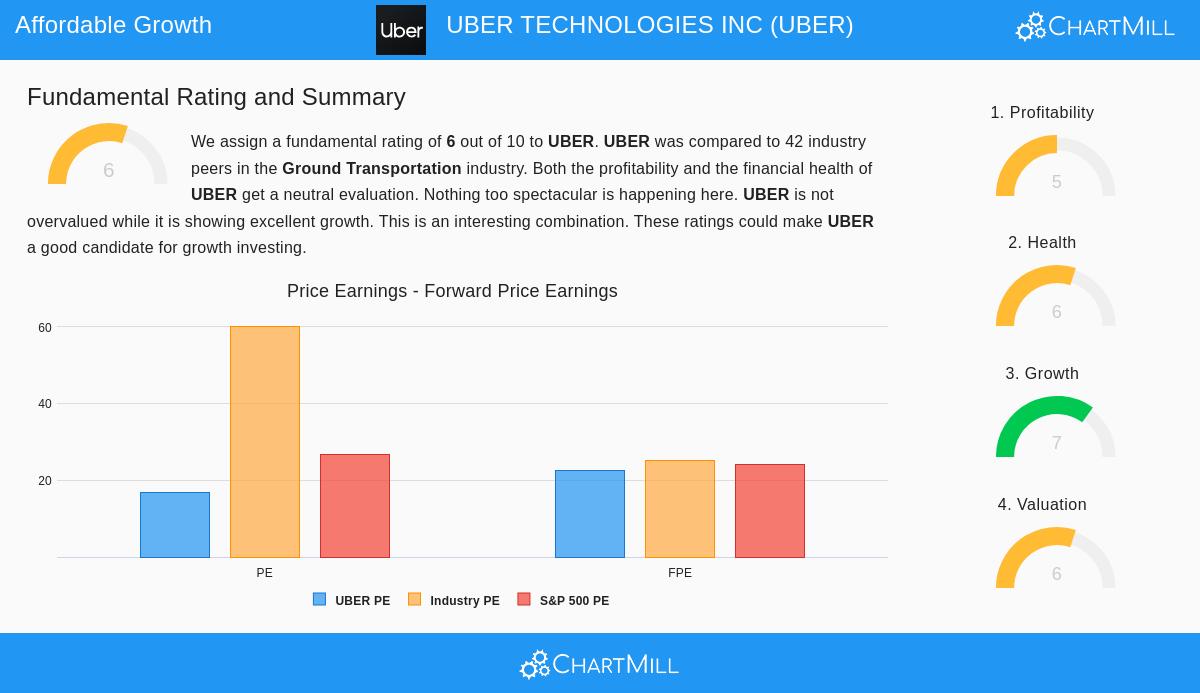
Growth Driver: Firm Past and Projected Expansion
The central attraction of Uber within a GARP structure is its firm growth path, which is a main filter in the filtering process. A company must show a capacity to increase its revenue and earnings notably to validate investor attention to its future.
- Notable Revenue Growth: Uber has displayed a very firm historical growth rate, with revenue rising by an average of 27.60% over recent years. In the last year alone, revenue increased by 18.25%, signaling continued speed in its core Mobility and growing Delivery parts.
- Remarkable Earnings Speed-Up: More significantly, the company has moved to firm earnings. Earnings Per Share (EPS) rose by 137.62% over the past year, a sharp gain that points to effective scaling and cost control.
- Firm Forward View: Growth is anticipated to persist, though at a possibly more measured rate. Analysts forecast average yearly EPS growth of 30.03% and revenue growth of 13.75% in the next years. This forward-looking firmness is vital, as the affordable growth method depends on future expansion, not only past results.
Price: Sensible Despite the Growth
A main principle of the affordable growth method is making sure the cost paid for growth is not too high. A stock with excellent growth but a very high price carries greater risk if growth hopes decrease. Uber's price measures show a varied but generally sensible view.
- Appealing on Standard Measures: With a Price/Earnings (P/E) ratio of 16.91, Uber is priced lower than 85.71% of its industry group in Ground Transportation and also seems low-priced compared to the wider S&P 500's average P/E of 26.59.
- Low-Priced on Cash Flow: The company's Price/Free Cash Flow ratio is especially notable, ranking lower than 92.86% of its industry, suggesting the market may be pricing the cash the business produces too low.
- Growth Adjustment: The PEG Ratio, which modifies the P/E for projected earnings growth, signals a quite low price. This is an important measure for GARP investors, as it directly connects price to growth outlook.
- Parts of Higher Price: Some measures show a higher valuation. The Price/Forward Earnings ratio of 22.62 is on the costly side in simple terms, and the Enterprise Value to EBITDA ratio is greater than most industry peers. This signals the market is costing in some future achievement, but not to a high level based on the total evaluation.
Supporting Basics: Condition and Earnings
For growth to be lasting and "affordable," the company must be built on a firm base. The filtering standards require acceptable scores in financial condition and earnings to filter out weak companies.
- Earnings Change: Uber's earnings rating, while medium, marks a meaningful change for the company. It has excellent Return on Assets (26.27%) and Return on Equity (59.15%) numbers, doing better than almost all industry peers. Its Profit Margin of 33.54% is also with the best in the sector. This shift from a cash-consuming startup to a profitable business basically lowers investment risk.
- Sufficient Financial Condition: Uber's financial condition rating is also medium. Its ability to pay debts is firm, with an Altman-Z score signaling no short-term bankruptcy risk and an excellent Debt to Free Cash Flow ratio of 1.36. Liquidity ratios match industry standards. However, investors should note the report's warning that the company's Return on Invested Capital currently lags its Cost of Capital, signaling space for more effective value creation.
Conclusion
Uber Technologies Inc presents an example of a company changing from pure growth to profitable growth, now trading at prices that may not completely capture its continuing expansion path. Its firm earnings growth, acceptable revenue gains, and firm forward projections meet the central "growth" part of an affordable growth method. Meanwhile, its sensible price on several key measures, especially when considering its growth rate through the PEG ratio, meets the "affordable" or "reasonable price" need. The supporting basics in earnings and financial condition, while not outstanding, give an adequate base that matches the filtering idea of avoiding overly risky balance sheets or unproven business models.
For investors using a GARP method, Uber justifies closer review as a possibility that has passed several important basic checks. A detailed look at Uber's basic ratings can be seen in its full basic analysis report.
This evaluation of Uber came from a specific Affordable Growth filter. Investors curious about finding other companies that meet similar standards of firm growth, sensible price, and acceptable financial base can locate more potential possibilities through this Affordable Growth stock filter.
Disclaimer: This article is for informational purposes only and does not constitute financial advice, a recommendation, or an offer or solicitation to buy or sell any securities. The analysis is based on data provided and basic filtering standards, which may change. Investors should conduct their own thorough research and consider their individual financial circumstances and risk tolerance before making any investment decisions.