

For investors looking for reliable income, a disciplined screening process is needed to separate truly lasting dividend payers from those with only surface-level appeal. One useful method is to concentrate on stocks that provide a good yield and are also supported by firm core business foundations. A frequent plan involves selecting for companies with a high dividend rating, which assesses the yield, growth, and record of payments, while also demanding adequate scores for earnings power and balance sheet soundness. This multi-step method aids in finding companies able to keep and raise their dividends over many years, instead of those where a high yield might indicate hidden trouble.
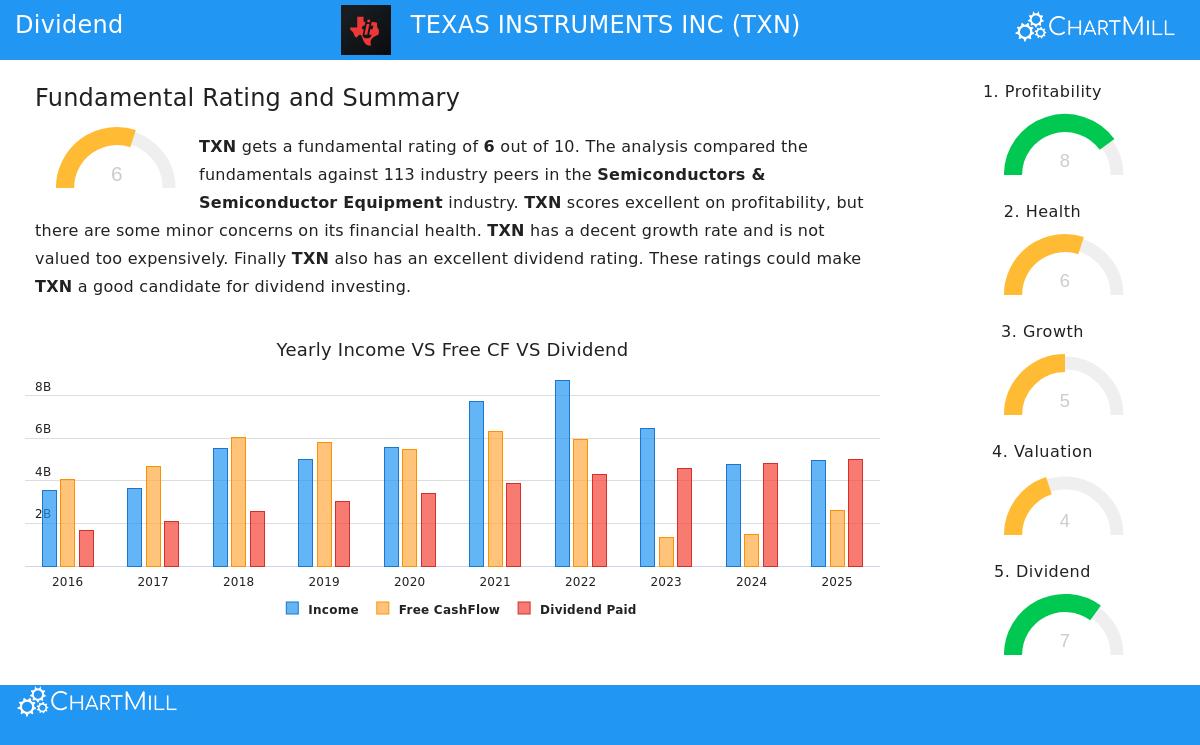
TEXAS INSTRUMENTS INC (NASDAQ:TXN) appears as a candidate from this kind of screening process. The semiconductor leader, a long-established company in analog and embedded processing chips, shows a profile that deserves more examination by income-oriented investors. Its selection comes from a firm ChartMill Dividend Rating of 7, aided by good Profitability and Health ratings of 8 and 6, in that order. This mix indicates a company that benefits shareholders while functioning from a place of basic soundness.
Dividend Profile: A Dependable History
The main attraction for dividend investors is in TXN's steady and increasing payments to shareholders. The company’s dividend history is marked by regularity and a dedication to giving back capital.
- Good and Higher-Than-Average Yield: With a yearly dividend yield of 2.63%, TXN provides a return that is satisfactory by itself. Notably, it is much higher than the average yield of other semiconductor companies (0.49%) and is also greater than the present S&P 500 average.
- Notable Growth History: TXN is not only a steady payer; it is a dividend raiser. The dividend has risen at a yearly rate of 8.24% over the last five years, showing management's belief in the business's ability to produce cash. This growth is a main part of total return for investors focused on the long term.
- Tested Dependability: The company has a dependable history, having paid and raised its dividend for at least ten straight years. This record of responsibility through different market periods offers assurance about the importance management gives to shareholder returns.
Profitability: The Source for Payments
A lasting dividend must be paid for by a profitable company. This is where the screening need for "adequate profitability" is important, and TXN does very well. Its high profitability rating of 8 is founded on outstanding margins and returns on capital, which are the real origins of dividend payments.
The company's operating margin of 34.72% and profit margin of 28.12% place it with the best in the competitive semiconductor equipment field. Also, its Return on Invested Capital (ROIC) of 17.15% shows very effective use of capital to create earnings. This strong earnings power supplies a wide buffer that helps make sure the company can keep financing its activities, spend for future needs, and still give significant cash to shareholders.
Financial Health: Supporting Lasting Power
While the dividend growth is positive, a point for care comes from the payout ratio, which is now above 100% of net income. This is the main element keeping the dividend rating from being higher and shows why the "adequate health" filter is necessary. A high payout ratio can indicate a dividend is in danger if earnings weaken. Still, TXN's overall financial health rating of 6 implies the company has the balance sheet fortitude to handle this for now.
Important health measures give background:
- Firm Liquidity: The company has plenty of short-term assets, with a Current Ratio of 4.35 and a Quick Ratio of 2.83, showing no trouble in meeting near-term debts.
- Controlled Debt: TXN's Debt/Equity ratio of 0.83 shows some use of debt financing, which is normal, but it is backed by a sound Altman-Z score of 10.10, pointing to a low immediate risk of financial trouble.
The lasting power question shown by the payout ratio is partly lessened by the company's firm free cash flow generation—a often better gauge of dividend coverage than earnings—and the belief that earnings growth will return. Analysts estimate EPS to grow by almost 20% in the next few years, which would normally bring the payout ratio down to a more sustainable level if the dividend growth continues at its past rate.
Valuation and Growth Setting
For a dividend investor with a long-term view, valuation is a factor for when to buy, but less important than the quality and lasting power of the income. TXN sells at a higher price than the wider market based on its P/E ratio, which is reasonable given its exceptional profitability, dependable dividend, and field-leading position. The company's growth profile is changing, with past EPS growth being low but future estimates pointing to a pickup, supported by estimated revenue growth. This expected growth is key as it would improve the dividend's lasting power.
A Candidate for More Study
TEXAS INSTRUMENTS INC presents a strong case for dividend investors using a multi-step screening method. It successfully fits the core needs: a high dividend rating aided by a good yield and growth history, very good profitability that pays for the distribution, and enough financial health to manage present industry pressures. The high payout ratio is an item to watch, but it is seen alongside firm cash flow and positive earnings growth projections. A full look at these basic elements can be seen in the complete ChartMill Fundamental Analysis report for TXN.
TXN is one of a number of stocks that pass this disciplined screen for quality dividend payers. Investors wishing to examine other companies that fit similar needs of high dividend ratings together with good profitability and health can see the full screen results here.
Disclaimer: This article is for informational purposes only and does not constitute financial advice, a recommendation, or an offer or solicitation to buy or sell any securities. The analysis is based on historical data and forward-looking estimates, which are not guarantees of future performance. Investors should conduct their own research and consult with a qualified financial advisor before making any investment decisions.