

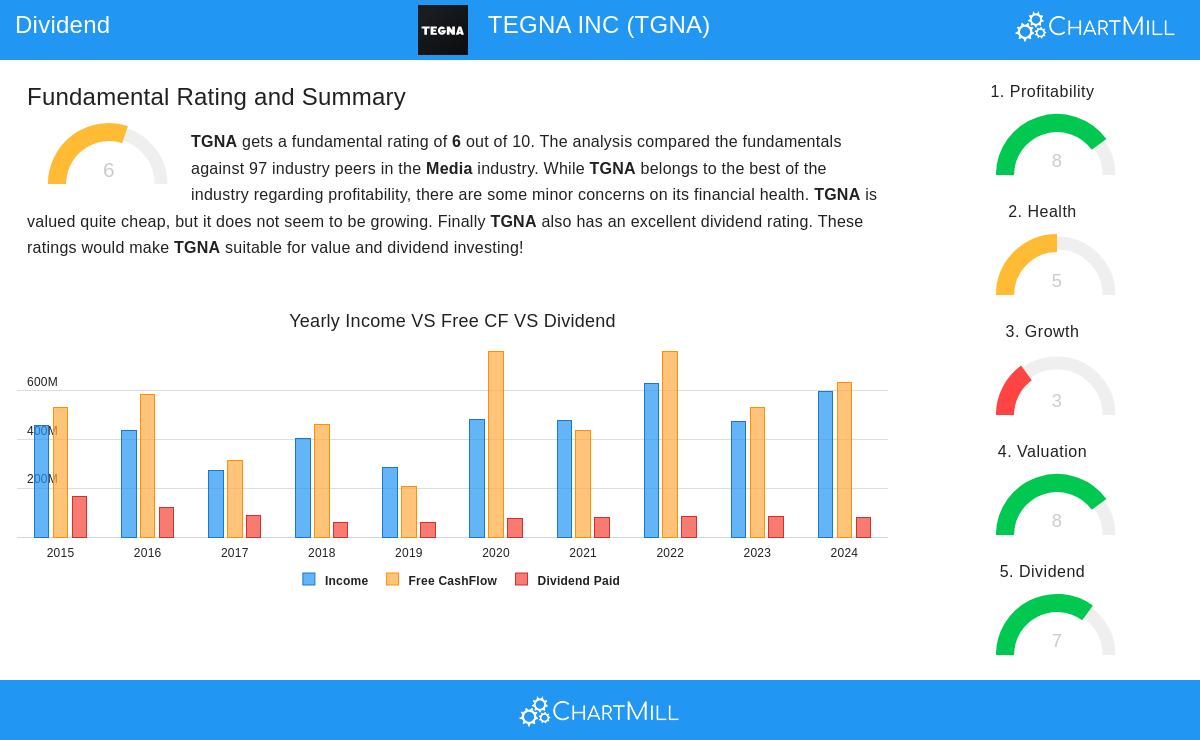
TEGNA INC (NYSE:TGNA) was identified by our Best Dividend Stocks screener as a candidate for income-focused investors. The company combines a solid dividend profile with decent profitability and financial health, making it an interesting option for those seeking reliable payouts.
Dividend Strengths
- Attractive Yield: TGNA offers a dividend yield of 2.87%, which is above the S&P 500 average of 2.35%. It also outperforms 80% of its peers in the media industry.
- Consistent Growth: The company has increased its dividend at an average annual rate of 11.34% over the past five years, demonstrating a commitment to rewarding shareholders.
- Reliable Track Record: TGNA has paid dividends for at least 10 years without reductions in the last five, indicating stability in its payout policy.
- Sustainable Payout Ratio: Only 17.48% of earnings are allocated to dividends, leaving ample room for reinvestment and future increases.
Profitability & Financial Health
- Strong Profit Margins: TGNA’s operating margin of 24.66% ranks in the top 3% of its industry, while its return on invested capital (9.33%) is also well above average.
- Reasonable Debt Levels: The company’s debt-to-equity ratio (0.83) is in line with industry norms, and its Altman-Z score (2.85) suggests manageable bankruptcy risk.
- Positive Cash Flow: TGNA has generated consistent operating cash flow over the past five years, supporting its ability to maintain dividends.
Valuation
TGNA trades at a P/E ratio of 5.73, significantly below both the industry average (44.01) and the S&P 500 (27.52). This suggests the stock is undervalued relative to its earnings.
For a deeper dive into TGNA’s financials, review the full fundamental report here.
Our Best Dividend Stocks screener provides more high-quality dividend ideas updated daily.
Disclaimer
This is not investing advice. The observations here are based on current data, but investors should conduct their own research before making decisions.