

For investors looking for chances in the market, a disciplined method often requires finding companies trading below their estimated true worth. This idea, called value investing, centers on locating stocks that seem priced too low by the market according to basic financial study. A typical filtering technique searches for companies with good valuation measures, suggesting they are inexpensive, while also holding fair ratings in financial condition, earnings ability, and expansion. This pairing tries to find possible discounts that are not just low-priced for a basic cause, but are operationally good businesses the market might have missed for now.
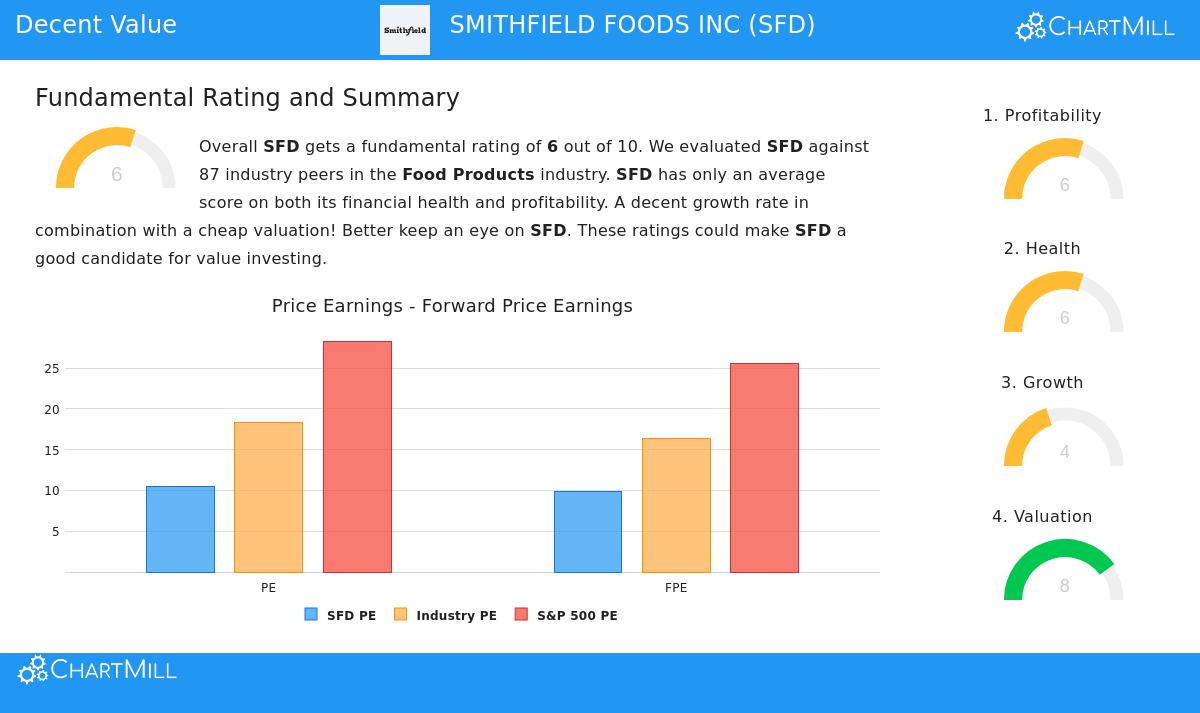
One stock that recently appeared from this "Decent Value" filter is Smithfield Foods Inc (NASDAQ:SFD). As a large meat-processing company with a set of recognized brands, it functions in a steady, necessary field. The filter's rules, which emphasize a high valuation grade together with acceptable ratings in other important areas, indicate SFD could merit more examination from investors using a value-focused plan.
Valuation: The Center of the Chance
The main draw for a value investor is a stock's price assessment, and this is where Smithfield Foods is most notable. The company's ChartMill Valuation Grade is a good 8 out of 10, meaning it is priced well compared to its finances and industry competitors.
- Price-to-Earnings (P/E) Ratio: At 10.53, SFD's P/E ratio is seen as fair. More significantly, it is less expensive than about 82% of similar companies in the Food Products field and is much lower than the present S&P 500 average of 28.30.
- Forward P/E Ratio: The future view stays positive, with a forward P/E of 9.92. This is less expensive than more than 93% of industry rivals and is also good compared to the wider market.
- Enterprise Value to EBITDA: This measure, which includes debt, also implies SFD is valued more affordably than almost 80% of its industry.
For a value plan, these numbers are vital. They form the numerical beginning, the finding of a possible difference between the market price and the company's basic profit ability. A low P/E in a steady field can indicate a chance if the core business is in good condition.
Financial Condition and Earnings Ability: Evaluating the Base
A low price assessment by itself can be misleading if the company is not financially stable. So, a value filter also sorts for fair financial condition and earnings ability. Smithfield Foods gets a 6 in both these groups, pointing to a steady, though not outstanding, operational foundation.
The company's financial condition is helped by a good cash position and acceptable debt amounts.
- Its Current Ratio of 3.10 shows enough ability to meet near-term bills, doing better than 85% of its industry.
- The Debt-to-Equity ratio of 0.31 shows the company is not too dependent on debt funding.
- An Altman-Z score of 3.52 indicates a low close-term chance of financial difficulty.
On the earnings ability side, Smithfield displays several positives that validate its operations and support the idea that it is a continuing business, not a failing one.
- Its Return on Invested Capital (ROIC) of 8.57% is higher than 85% of similar companies, showing effective use of capital.
- Profit and Operating Margins have displayed gains in recent years and are strong within the industry.
- These parts are important for value investors, as they help verify that the low price is not a sign of bad business quality or coming financial problems.
Expansion and Dividend: Providing Setting
While strict value choices may not show fast expansion, some positive movement can be a reason for the price difference to shrink. Smithfield's Expansion Grade is a 4. The last year saw a large rise in Earnings Per Share, though this comes after a time of falling sales. Looking ahead, experts anticipate small gains in both sales and EPS. This measured expansion view is normal for an established company in its sector and, when combined with a low price, can be interesting.
Also, the company gives a dividend yield of 4.21%, which is good compared to both its industry and the S&P 500 average. For value investors, a reliable dividend can supply income while waiting for the market to revalue the stock, and it frequently shows management's belief in the company's consistent cash flow.
Conclusion: A Possibility for Value Review
Smithfield Foods Inc shows a picture that matches several rules of value investing. It is priced low across several measures compared to its industry and the wider market, meeting the main need of searching for undervaluation. Importantly, this low price is combined with medium-to-good ratings in financial condition and earnings ability, which helps reduce the danger of a misleading cheap stock. The company works in a non-cyclical necessary field, produces a good dividend, and is predicted to grow slowly. This mix indicates the stock is not low-priced because it is damaged, but possibly because it is not noticed.
For investors using a disciplined value plan, SFD shows the kind of chance filters are made to locate: a basically good business trading at a price that may not completely show its steady profit ability and financial soundness. A complete look at the basic study behind these ratings can be seen in the full ChartMill Fundamental Report for SFD.
Find Other Possible Value Stocks The "Decent Value" filter that found Smithfield Foods is made to sort the market for similar chances. If you want to look at other stocks that meet these rules of good price assessment along with fair basic qualities, you can see the present filter results here.
Disclaimer: This article is for information only and is not financial advice, a suggestion, or a deal to buy or sell any securities. Investors should do their own study and talk with a qualified financial advisor before making any investment choices.