

For investors looking for chances where the market price may not completely show a company's basic strength, a methodical value method can be a helpful beginning. One technique involves filtering for companies that seem basically priced low by the market while still showing good operational condition, earnings, and growth outlook. This plan tries to find possible discounts, stocks trading at appealing prices not due to weak business results, but maybe because of wider sector feeling or short-term challenges. A recent filter using these ideas, concentrating on strong valuation numbers together with acceptable scores in other important basic areas, has pointed to Ryanair Holdings Plc-Sp ADR (NASDAQ:RYAAY) as a candidate worth more detailed review.
A Detailed View of Valuation
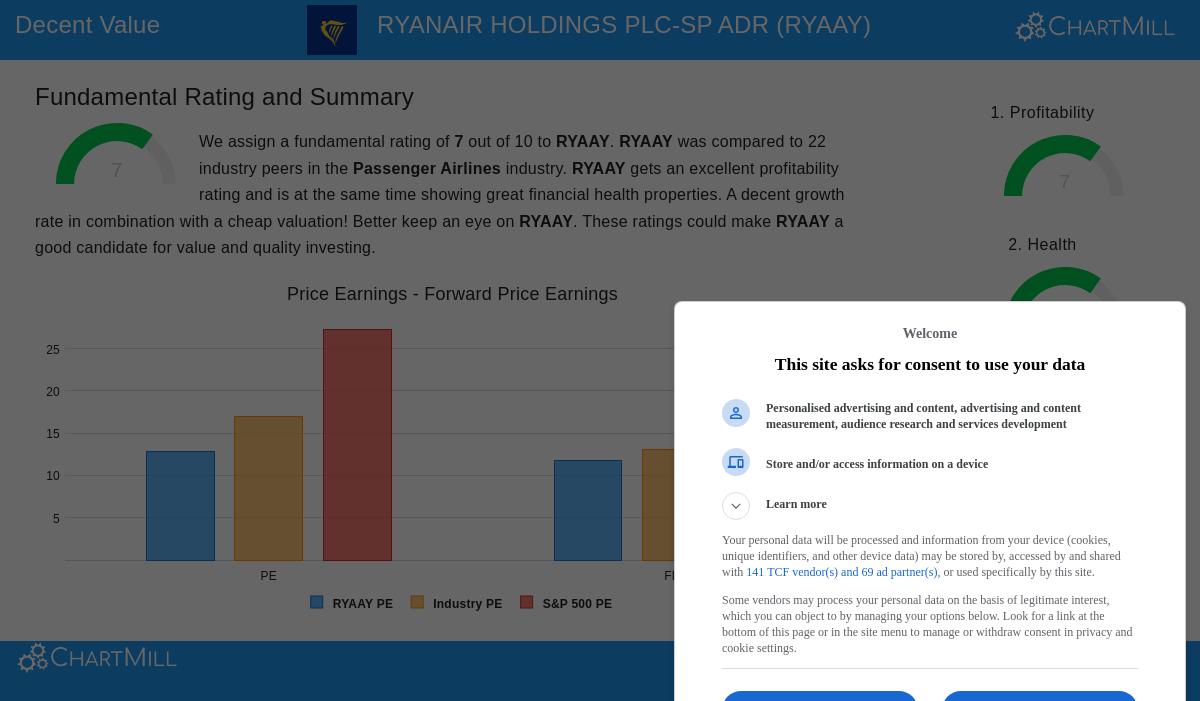
The central idea of value investing is buying a security for less than its real value. Ryanair's valuation numbers imply the market may be pricing the airline cautiously. According to ChartMill's fundamental analysis report, the stock gets a Valuation Rating of 7 out of 10, showing a relatively inexpensive profile compared to similar companies and the wider market.
- Appealing Earnings Multiples: Ryanair trades with a Price-to-Earnings (P/E) ratio of 12.88, which is less expensive than about 82% of its passenger airline industry peers. This ratio appears even more attractive when looking ahead, with a Price-to-Forward Earnings ratio of 11.75.
- Positive Market Comparison: Both the current and forward P/E ratios are notably lower than the current averages for the S&P 500, further highlighting the stock's valuation appeal.
- Growth Adjustment: The analysis mentions a low PEG ratio, which modifies the P/E for anticipated earnings growth. This implies the stock's price may not completely include its future growth possibility, a key point for value investors who look for a "margin of safety."
Evaluating Financial Condition and Earnings
A low valuation by itself can be misleading if the company is financially weak or not earning money. Real value chances are often discovered in companies that are both priced low and basically healthy. Ryanair scores a 7 for both Financial Health and Profitability, showing strength and effective operations.
Financial Condition Points:
- Good Solvency: The company shows very good solvency numbers. Its Debt-to-Equity ratio is a very small 0.03, doing better than 95% of the industry, showing very little dependence on debt funding.
- Value Generation: Ryanair's Return on Invested Capital (ROIC) is much higher than its cost of capital, meaning the company is successfully generating value for shareholders, a positive sign for long-term investors.
- Actions Favorable to Shareholders: The report mentions a decrease in shares outstanding over the past one and five years, which can indicate management's focus on increasing per-share value.
Earnings Advantages:
- Better Returns: Ryanair's earnings ratios are notable features. It has a Return on Invested Capital of 22.96% and a Return on Equity of 27.99%, performing better than most of its industry rivals.
- Good Margins: With a Profit Margin of 14.13%, the company is in the top group of its sector. Its Operating Margin, while having decreased lately, stays good at 14.36%.
Growth Path and Dividend
While strict value stocks occasionally show little growth, Ryanair presents a mixed profile. It has a Growth Rating of 6, supported by a good historical EPS growth rate of over 20% each year and expected future EPS growth averaging almost 15%. This growth helps support the investment idea, as it offers a way for the market to value the stock higher as earnings increase. Also, the company provides a dividend yield of 3.35%, which is above both the industry and S&P 500 averages, giving an income part while investors wait for possible price gains.
Why This Profile Matches a Value Plan
The mix of these elements fits a practical value investment method. The low valuation multiples give the initial margin of safety, the cushion between price and estimated value that Benjamin Graham stressed. The good health and earnings ratings help reduce the danger of a "value trap," as they show a business with a lasting competitive edge (in this case, a low-cost operational model) and a strong balance sheet that can manage industry cycles. The existence of growth and a dividend adds to the total return possibility, making it more than just a fixed, deep-value opportunity.
For investors wanting to examine other companies that share this profile of good basics paired with attractive valuations, more study can be done using the Decent Value Stocks screen on ChartMill.
Disclaimer: This article is for information only and does not make up financial guidance, a suggestion, or an offer to buy or sell any securities. The analysis is based on data and ratings given by ChartMill, and investors should do their own complete study and think about their personal money situation and risk willingness before making any investment choices.