

For investors looking for steady income, a systematic way to choose dividend-paying stocks is important. The method involves looking past only seeking high yields and concentrating on companies with lasting payouts supported by good finances. A typical filtering process looks for stocks that show a high dividend rating, a combined score assessing yield, growth, history, and payout security, while also holding fair ratings for profit and financial condition. This measured method tries to find companies not just dedicated to giving cash to shareholders but also fundamentally healthy enough to keep and possibly increase those payments over time.
One company that comes from such a strict filter is RPM INTERNATIONAL INC (NYSE:RPM), a maker of coatings, sealants, and building materials. The company's basic profile indicates it deserves more examination from income-oriented investors, as it seems to combine a reasonable dividend with business soundness.
Examining the Dividend Details
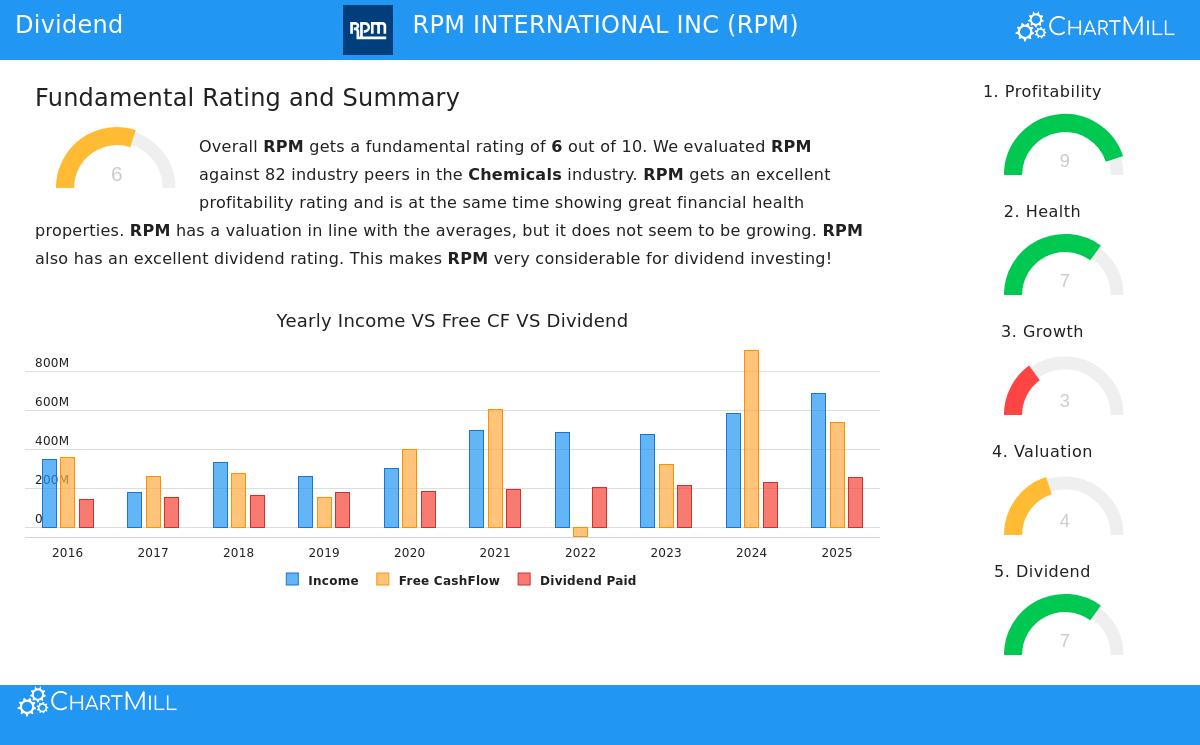
The center of the investment case for RPM is in its dividend traits, which are shown by its good ChartMill Dividend Rating of 7 out of 10. This rating brings together several important measures for dividend security.
- Yield and Growth: RPM provides a dividend yield of 1.92%, which is similar to both the industry average (2.28%) and the wider S&P 500 (about 1.82%). More notably, the company has regularly increased its payout, with an average yearly dividend growth rate of almost 7% over the last five years. This steady growth is a sign of a company that treats shareholders well.
- History of Dependability: RPM has built a reliable history, having paid and, importantly, raised its dividend for at least ten straight years. This record of dependability is a key screen for many dividend investors, as it shows management's dedication across different economic conditions.
- Secure Payout Ratio: Maybe the most important number for dividend security is the payout ratio. RPM uses about 40% of its earnings for dividend payments, which is seen as a low and very secure level. This gives plenty of space for the company to put money back into its business, handle slow periods, and keep increasing the dividend without stressing its finances. The basic report also states that earnings are increasing quicker than the dividend, further supporting the payout's security.
These elements together speak to a main risk in dividend investing: the threat of a high yield that lacks earnings support and is in danger of being reduced. RPM's profile highlights a growing, well-protected payout over a risky high yield.
Backed by Good Profit and Financial Condition
A lasting dividend needs to be backed by a profitable and financially stable business. This is why filtering for fair profit and condition ratings is key to the method—a company cannot generously distribute profits it does not make or keep up payouts if its finances are poor. RPM does well in these supporting areas.
The company receives a very good ChartMill Profitability Rating of 9. Main positives include:
- Strong return measures, with a Return on Equity of 21.22%, doing better than almost 94% of similar companies in the chemicals industry.
- Good and improving margins, including a Gross Margin over 41% and a Profit Margin of 8.76%, which are in the high range of its industry.
- A steady history of yearly profit and positive operating cash flow over the past five years.
Financially, RPM has a sound Condition Rating of 7. The balance sheet displays:
- Good liquidity, with a Current Ratio of 2.22 showing no problem meeting near-term bills.
- A reasonable debt amount, with a Debt-to-Equity ratio of 0.80 similar to industry peers. Its Altman-Z score of 4.03 indicates a very small chance of near-term bankruptcy.
This good profit and financial stability give the necessary base that makes RPM's dividend policy believable for the long run. The company produces more than enough profit to finance its payout and has the balance sheet soundness to maintain it during difficult times.
Value and Growth Points
While the dividend, profit, and condition measures are strong, a complete view needs setting on value and growth outlook. RPM's value is mostly similar to industry averages. Its Price-to-Earnings ratio of 21.26 is comparable to the industry but is lower than the present S&P 500 average, suggesting it is not overly costly relative to the market.
The area where RPM displays less force is in its growth rating. While past earnings per share (EPS) growth has been good, recent results have been unchanged, and future sales growth forecasts are moderate. This is a balance often observed with established, dividend-paying companies; they provide stability and income but may not give the fast growth of newer firms. For a dividend investor focusing on dependable income, this can be a suitable trade, especially when the company makes up for it with high profit and a safe payout.
Is RPM Suitable for a Dividend Portfolio?
RPM International shows an example of the kind of company a measured dividend filter tries to find. It joins a dependable and growing dividend, supported by a low payout ratio and a long history, with the basic force of high profit and a sound balance sheet. This match speaks to the central ideas of cautious dividend investing: looking for income that is secure, not just high.
For investors creating or adding to an income-producing portfolio, RPM stands as a candidate deserving more study. Its business model, centered on construction products and coatings, links it to industrial and consumer maintenance cycles, giving a level of durability. The company's shown dedication to giving capital to shareholders, backed by its fundamental financial force, makes it a notable option for those using a strict, quality-centered dividend method.
Find Other Dividend Options This review of RPM International came from a systematic filter for high-quality dividend payers. If you want to see other companies that fit similar standards for dividend force, profit, and financial condition, you can view the full filter results here.
Disclaimer: This article is for information only and does not make up financial advice, a suggestion, or an offer to buy or sell any security. Investors should do their own study and talk with a qualified financial advisor before making any investment choices. All investments carry risk, including the possible loss of principal.