

For investors aiming to build a portfolio that produces steady passive income, a methodical screening process is necessary. One useful strategy involves selecting for companies that provide a good dividend and are also established on a firm financial base. This method focuses on stocks with a high ChartMill Dividend Rating, which assesses yield, growth, and continuity, while also asking for satisfactory scores for earnings and financial soundness. This pairing aids in finding companies able to maintain and possibly increase their distributions over many years, instead of those with large yields that could be threatened by basic business problems.
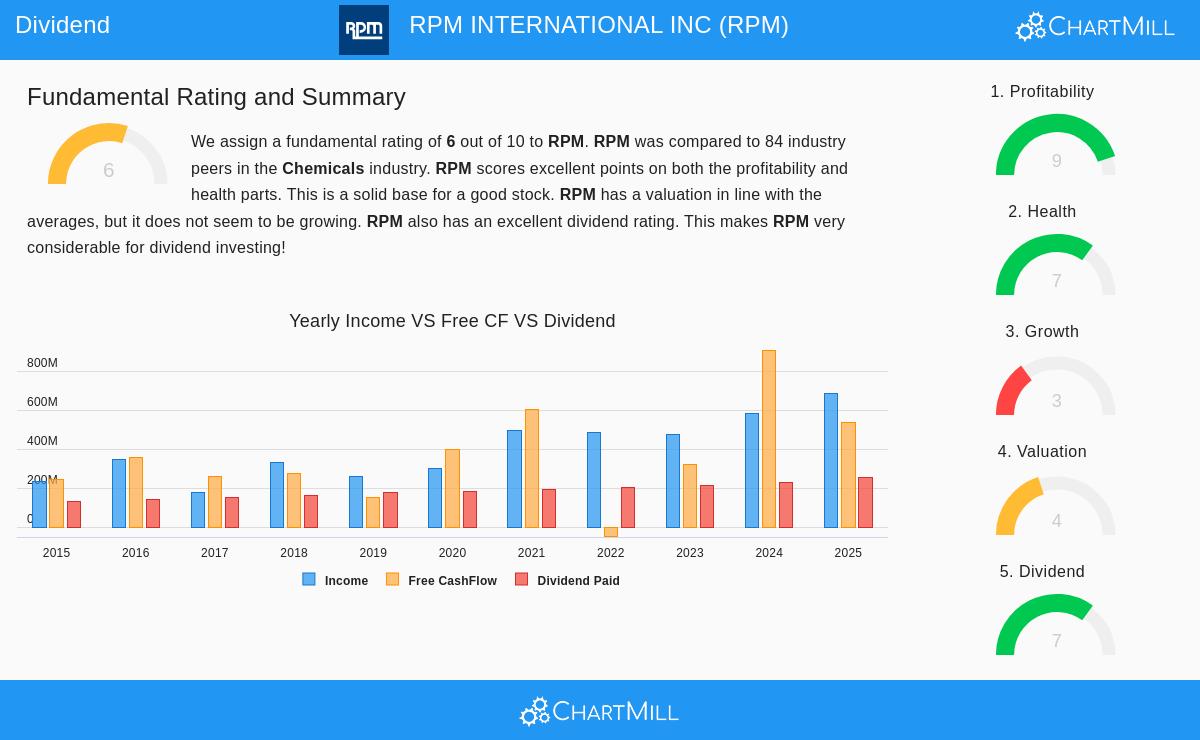
RPM INTERNATIONAL INC (NYSE:RPM), a producer of coatings, sealants, and construction materials, recently appeared from this kind of dividend-centered screen. The company's basic profile indicates it deserves further examination by income-focused investors. A detailed inspection of its finances shows a business that performs favorably on the main measures of dividend quality, earnings, and soundness.
Examining the Dividend Profile
The center of the screening method is a good dividend rating, and RPM meets this with a score of 7 out of 10. This rating is formed on several elements that dividend investors value:
- Dependable History: RPM has given a dividend for a minimum of 10 straight years and has not lowered its payment in that time. This record of consistency is a key sign of management's focus on giving capital back to shareholders.
- Maintainable Growth: The company's dividend has increased at a yearly rate of almost 7% over the last five years. Significantly, this growth is backed by profits that are rising at a quicker speed, implying the raises are maintainable and not pressuring the company's finances.
- Cautious Payout Ratio: RPM uses about 38% of its profits for dividend payments. This is a safely low ratio, offering a clear margin that lets the company put money back into the business, handle obligations, and keep the dividend during times of reduced earnings.
While its present yield of 2.02% is about equal to industry and market norms, the mix of a reliable history, steady growth, and a cautious payout policy makes RPM's dividend offer interesting for those concentrated on long-term income increase instead of highest current yield.
Supported by Good Earnings
A large-yielding dividend is only as strong as the business paying for it. This is why the screening process asks for satisfactory earnings, and RPM does well here with a high ChartMill Profitability Rating of 9. The company's capacity to produce profits is a direct supporter of its dividend policy.
- Good Margins: RPM has good margins overall. Its gross margin above 41% and operating margin over 12% are with the best in the chemicals sector, showing price strength and effective operations.
- Effective Capital Use: The company creates good returns on its assets and invested capital (ROIC of 11.27%), proving it uses shareholder capital well to make profits. These solid earnings measures supply the basic profit strength that protects the dividend.
A Base of Financial Soundness
The last part of the screening method is financial soundness, which makes sure the company has the balance sheet fortitude to handle economic changes without endangering its dividend. RPM receives a satisfactory Health Rating of 7, showing a mostly strong financial state.
- Stability and Cash Availability: The company has a strong Altman-Z score, pointing to a small short-term chance of financial trouble. Its current ratio of 2.26 shows more than enough near-term assets to meet coming costs.
- Obligation Points: While RPM holds a fair amount of obligations, with a Debt/Equity ratio of 0.87, its good free cash flow production means it would need just over five years to pay off all obligations from cash flow—a workable period next to many others. The recent decrease in shares outstanding is also a good indicator of shareholder-focused capital use.
Value and Growth Setting
It is necessary to see the dividend story inside the full investment view. RPM's value seems reasonable, with a forward P/E ratio a bit under the S&P 500 average. The company's primary test is growth; income fell notably last year, and while future profits are predicted to increase at a mid-single-digit speed, this growth rate is slowing. For a dividend investor, this highlights that RPM is mainly an income and capital protection story rather than a fast-growth investment. The company's very good earnings and soundness ratings help explain its value and support the argument for dividend steadiness even with slower top-line growth.
Interested in examining RPM's full basic analysis? You can find the complete report here.
RPM International shows an example in how a methodical screening process can find possible choices for a dividend portfolio. Its high dividend rating is supported by a long history, maintainable growth, and a cautious payout policy. These good dividend traits are strongly backed by very good earnings and satisfactory financial soundness, which are important for guaranteeing the duration of income payments. While investors should note its slower growth path, RPM seems to be a company made to dependably provide shareholders with an increasing dividend over time.
This review of RPM came from a systematic screen for quality dividend payers. If you want to do your own study, you can inspect the full list of stocks that meet like conditions through this Best Dividend Stocks screen.
Disclaimer: This article is for informational and educational purposes only and does not form investment advice, financial advice, or a suggestion to buy or sell any security. The analysis uses given data and shows the author's understanding. Investors should perform their own research and think about their personal financial situation before making any investment decisions.