

When selecting dividend stocks, investors often look beyond just high yields to find companies with sustainable payouts supported by strong financial health and profitability. A systematic approach involves filtering for stocks with high dividend ratings while ensuring acceptable scores in profitability and health metrics. This method helps identify companies able to maintain and possibly increase their dividends over time, rather than those with high yields that might indicate financial trouble. One stock that fits these requirements is RPM International Inc (NYSE:RPM).
Dividend Reliability and Growth
RPM International displays several traits that dividend investors usually want, especially regarding dividend consistency and growth potential. The company’s dividend profile shows a balance between yield, historical reliability, and sustainability.
- Dividend Yield: RPM provides a yearly dividend yield of 1.99%, which is fair though not very high. This yield is near the industry average of 4.05% and a bit under the S&P500 average of 2.39, making it a moderate income source instead of a high-yield option.
- Dividend Growth: The company has raised its dividend at an average yearly rate of 6.96% over recent years, showing a focus on giving more value to shareholders. This consistent growth is a good signal for investors seeking income that matches or beats inflation.
- Dividend History: RPM has paid dividends without interruption for at least 10 years and has not lowered its payout in that time. This history of reliability is important for income-focused investors, as it implies management's commitment to shareholder returns through different economic periods.
These dividend qualities are important for the screening method because they point to a company that not only pays dividends but does so reliably and with a history of growth, lessening the chance of sudden cuts that can happen with less stable payers.
Profitability Supporting Dividend Payments
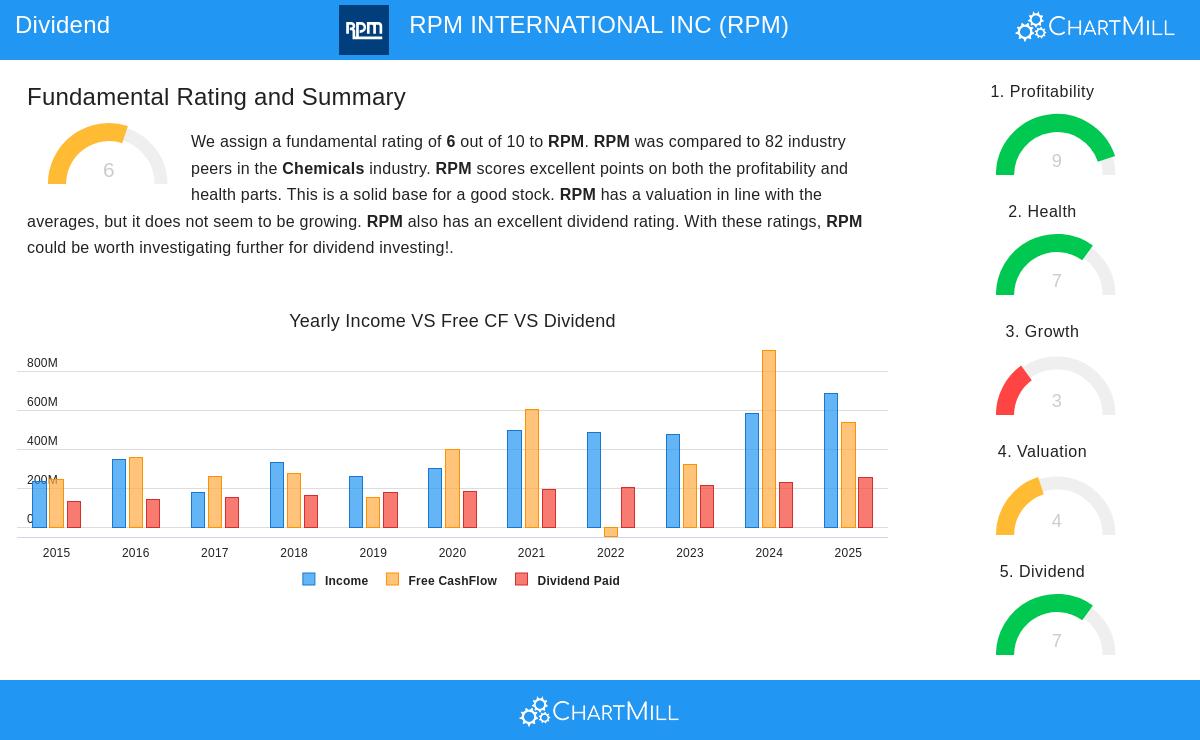
A company’s capacity to continue dividends depends on its profitability, and RPM performs well here with a ChartMill Profitability Rating of 9. Strong profitability makes sure that dividend payments are backed by real earnings instead of debt or temporary benefits.
- Margins and Returns: RPM’s profit margin is 9.12%, better than 85% of similar companies in the chemicals industry. Its return on equity is 22.45%, putting it in the top group of the industry, and its return on invested capital is 11.27%, also one of the best in its sector.
- Trends: The company has shown gains in key profitability measures over recent years, including rising operating and gross margins. This pattern indicates operational effectiveness and pricing strength, which are positive signs for future earnings stability.
Profitability is a fundamental part of the dividend screening process because it confirms that dividends are paid from continuing operations. A very profitable company like RPM is less likely to have earnings problems that could threaten its dividend payments.
Financial Health Ensuring Dividend Sustainability
RPM’s good financial health, shown by a ChartMill Health Rating of 7, gives extra confidence that the company can keep up its dividend through different economic periods. Health metrics assess liquidity and solvency, which are essential for surviving downturns without reducing shareholder payouts.
- Solvency: The company’s Altman-Z score of 3.88 shows a low chance of bankruptcy and is better than 88% of industry peers. Its debt levels, while existing, are controllable, with a debt-to-equity ratio of 0.87 that matches industry standards.
- Liquidity: RPM’s current ratio of 2.26 indicates strong short-term financial condition, meaning it can comfortably cover its near-term debts. This liquidity lowers the risk that the company would have to reduce dividends to save cash during short-term difficulties.
For dividend investing, financial health is essential; it makes sure a company has the strength to continue dividends even when encountering operational or broader economic challenges.
Valuation and Growth Considerations
While the main focus for dividend investors is frequently on yield and sustainability, valuation and growth prospects also contribute to total return potential. RPM’s valuation is fair, though its growth has been slow lately.
- Valuation: The stock’s price-to-earnings ratio of 20.14 is a little under the industry average, and its forward P/E of 16.98 is less expensive than the S&P500 average. This implies the stock is not highly priced compared to its earnings.
- Growth Challenges: RPM’s revenue fell by 19.20% over the last year, although its earnings per share are projected to increase by 8.72% per year in the next few years. The company’s growth rating of 3 shows that while it is not a fast-growth story, its profitability and health support its capacity to keep funding dividends.
For dividend investors, average growth is satisfactory if it comes with strong profitability and health, since the main objective is dependable income rather than quick price increases.
Finding More Dividend Opportunities
RPM International is only one instance from a wider group of dividend stocks that meet strict requirements for yield, growth, profitability, and health. Investors curious about finding similar options can review more results using the Best Dividend Stocks screen, which selects for high dividend ratings together with solid financial basics.
For a complete breakdown of RPM’s financial data, readers can see the full fundamental analysis report.
Disclaimer: This article is for informational purposes only and does not constitute investment advice. Investors should conduct their own research and consider their financial situation before making any investment decisions.