

Technical investors often look for stocks that mix solid momentum with clear entry points, and the Technical Breakout Setups method meets this need by filtering for securities showing both good technical condition and consolidation shapes. This method uses two specialized ChartMill indicators: the Technical Rating, which measures the strength and durability of a stock's trend, and the Setup Quality Rating, which checks for a clear consolidation base that might come before a possible breakout. Stocks with high scores on both measures are seen as leading choices, as they stand for companies with good technicals that are also forming patterns suitable for planned entry.
Technical Strength Assessment
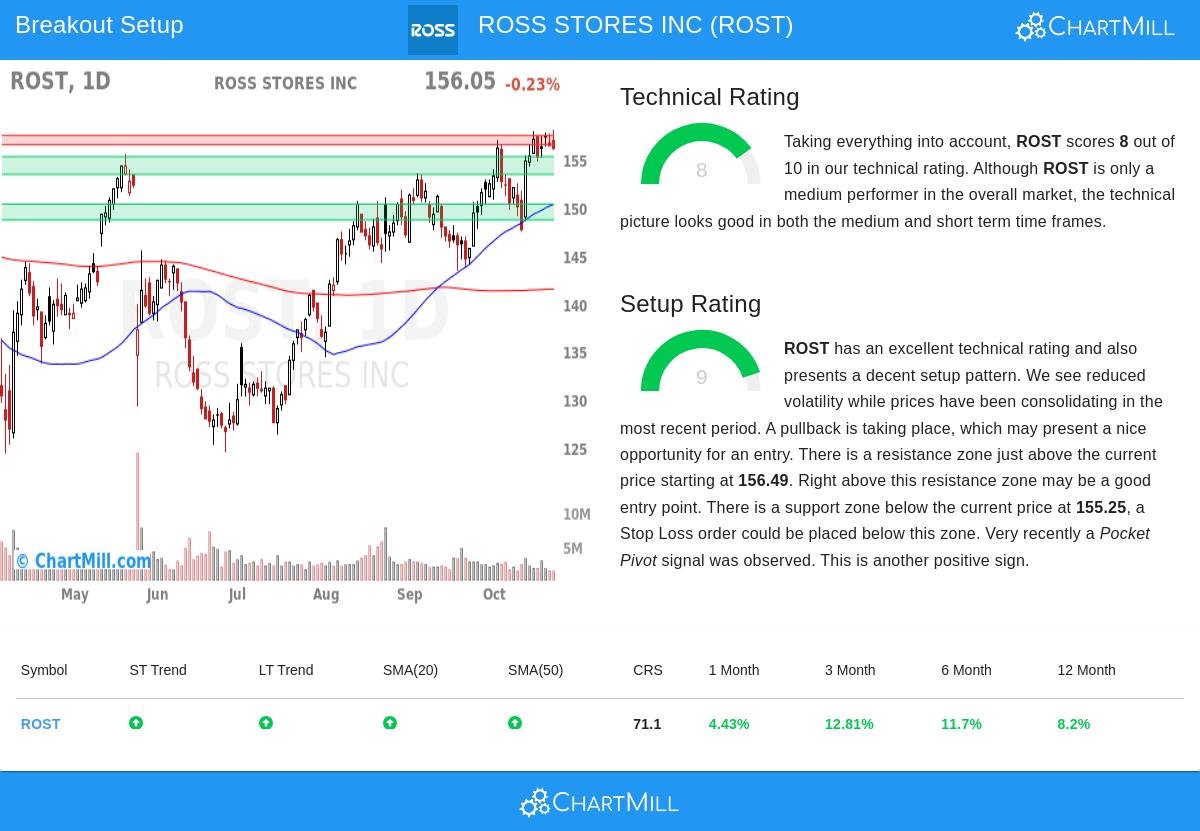
ROSS STORES INC (NASDAQ:ROST) shows a firm technical base, getting a Technical Rating of 8 out of 10. This score shows a good trend alignment over different periods, a key part for the breakout plan as it confirms the stock's basic momentum is positive. The detailed technical report points out several main strengths that add to this rating:
- The long-term and short-term trends are both seen as positive, showing continued buying pressure.
- The stock is trading close to its 52-week high of $158.69, a sign of firm investor belief.
- It is placed above all its main moving averages (20, 50, 100, and 200-day), confirming the upward trend structure.
- With a relative strength percentile of 71.1, ROST is doing better than most of the wider market, though its performance matches the general market which is also near highs.
This mix of factors indicates ROSS STORES INC is a market leader with a high level of technical soundness, making it a fitting choice for a breakout plan that depends on following set trends.
Setup Quality and Consolidation Pattern
Besides a solid trend, a good setup is needed for finding a lower-risk entry point. ROST does well here with a Setup Rating of 9, showing a clear consolidation phase. This rating is important for the method because it finds times when price movement has lessened and the stock is forming a base, often before the next notable price change.
The technical study shows a clear trading range has formed over the last month, between about $147.49 and $158.03. The stock is now trading near the top edge of this range. This coiling action lowers movement and makes a clear resistance level, which, if broken, could mark the start of a new upward move. Also, the setup is supported by:
- A recent "Pocket Pivot" signal, which is a price/volume pattern indicating accumulation by institutional investors.
- A clear support area just below the current price, around $153.40 to $155.25, giving a logical level for a protective stop-loss order.
- A set resistance area directly above, from $156.49 to $157.46, providing a specific breakout level for entry.
Potential Trading Setup
The combination of a high Technical Rating and a strong Setup Rating presents a specific possible trading situation. Based on the closest support and resistance levels, an automated study suggests a possible entry on a breakout above $157.47, with a stop-loss order placed below the support area at $153.39. This would cap the theoretical risk on the trade to about 2.59%. It is important to note that this is an illustrative example; investors should always do their own study to decide entry and exit points that fit their own risk tolerance and trading plan.
The presence of a high Setup Rating does not assure a winning breakout, but it does point out a time of consolidation inside a solid uptrend, which is exactly the situation the Technical Breakout Setups screen is made to find.
For investors looking for similar chances, new possible breakout choices are found daily. You can find the newest list by visiting the Technical Breakout Setups screen.
Disclaimer: This article is for informational purposes only and does not constitute investment advice of any kind. The examples and analysis presented are not a recommendation to buy or sell any security. All investing and trading involves risk, including the possible loss of principal. Always conduct your own due diligence and consult with a licensed financial advisor before making any investment decisions.