

For investors aiming to assemble a portfolio of durable, long-term holdings, the ideas of quality investing offer a useful framework. This method concentrates on finding companies with lasting competitive strengths, sound financial condition, and the capacity to produce steady, high-grade earnings through economic cycles. One organized way to find these companies is the "Caviar Cruise" stock screen, which selects for businesses showing better profitability, effective capital use, and maintainable expansion. The screen stresses important numerical measures, including a high return on invested capital, solid revenue and profit increase, controlled debt amounts, and a firm translation of accounting profits into free cash flow.
A recent use of this screen has pointed to The New York Times Co. (A) (NYSE:NYT) as a possible option deserving of further study by investors focused on quality. The company's financial picture matches several central ideas of the method, indicating a business constructed on a base of operational skill and financial control.
Financial Condition and Profitability
Central to quality investing is the search for companies that produce high gains on the capital given to them. The Caviar Cruise screen requires a Return on Invested Capital (leaving out cash, goodwill, and intangibles) over 15%. New York Times Co. not only reaches this level but greatly surpasses it, with a present ROICexgc of 33.7%. This outstanding number shows that management is very good at using capital in activities that create large profits, a main sign of a quality business with a possible protective barrier.
Also, the company shows a clean balance sheet, a key element for long-term strength. The screen employs a Debt-to-Free Cash Flow ratio below 5 as a standard for controlled borrowing. NYT is notable with a ratio of 0.0, showing a net cash position and no debt. This financial stronghold gives great ability to handle economic unpredictability, put money into expansion projects, and give capital to shareholders free from the weight of interest payments.
Maintainable Expansion and Earnings Grade
Quality investing looks for expansion, but expansion of a particular type: profitable, effective, and maintainable. The screen demands both 5-year revenue and EBIT (earnings before interest and taxes) compound annual growth rates (CAGR) to be over 5%, with EBIT increase exceeding revenue increase, a signal of gaining operational effectiveness and pricing ability.
- Revenue Increase (5Y CAGR): 6.8%
- EBIT Increase (5Y CAGR): 15.5%
NYT easily meets both requirements. More significantly, its EBIT increase is more than two times its revenue increase over the time. This shows the effective growth of its digital subscription model, where added revenue moves effectively to net income, pointing to operational leverage and a firming business model.
The grade of earnings is just as important. The screen chooses for a 5-year average Profit Quality, the translation of net income into free cash flow, above 75%. NYT's number is a strong 142.1%, showing it creates notably more cash flow than its accounting profits would indicate. This better cash creation pays for activities, investments, and shareholder returns without need for outside funding, a trademark of a financially independent company.
Fundamental Analysis Summary
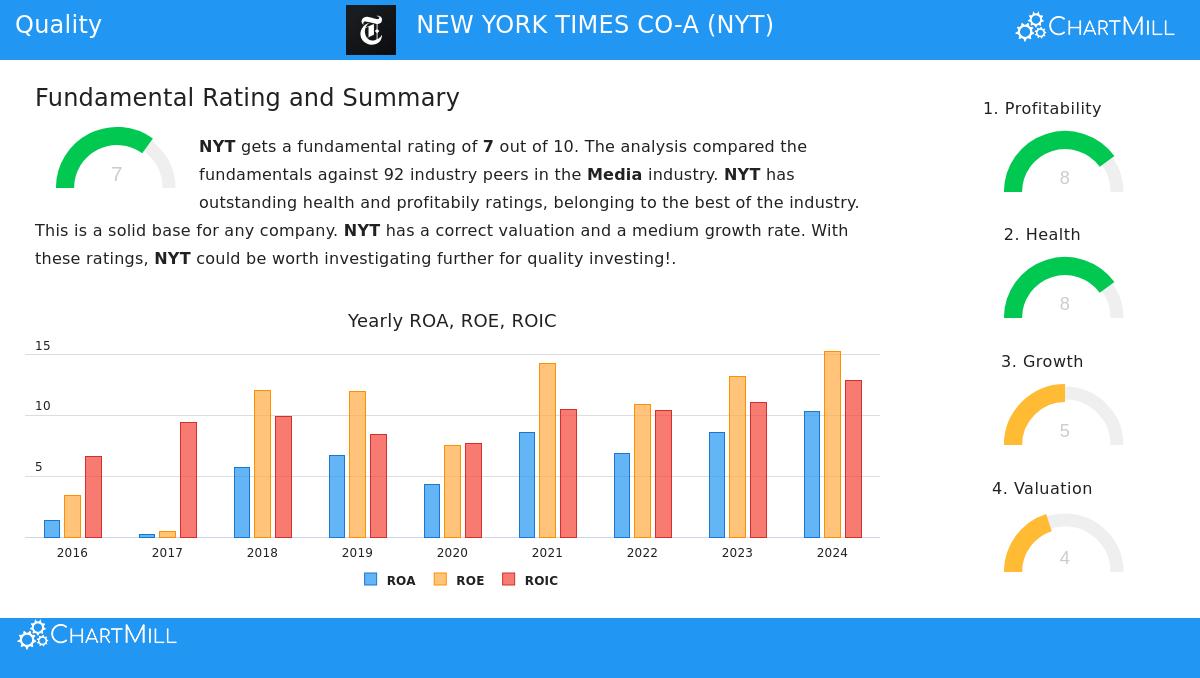
An inspection of NYT's combined fundamental analysis report supports the results from the quality screen. The report gives the company a total score of 7 out of 10, with specific force in the Profitability (8/10) and Financial Condition (8/10) groups.
Main points from the report are:
- Profitability: Steadily positive profits and cash flow over five years. Margins (Operating Margin of 16.1%, Profit Margin of 12.3%) place in the high group of the media business, and both have shown clear gain in recent years.
- Condition: An Altman-Z score of 10.54 shows almost no bankruptcy danger. The no-debt capital structure is noted as top-level.
- Expansion: The company shows firm past growth in Earnings Per Share (24.6% last year) and solid revenue growth.
- Valuation: This is the section where NYT shows a more varied image, scoring 4/10. While its Price-to-Earnings ratio is high compared to past averages, the report states this could be reasonable given its excellent profitability and anticipated earnings growth. The valuation is generally similar to the S&P 500 average.
Is NYT a Quality Investment Option?
Built on the numerical filters of the Caviar Cruise screen, The New York Times Co. makes a strong argument. It is strong in the central areas quality investors focus on: outstanding returns on capital, a very firm debt-free balance sheet, a pattern of profitable expansion with widening margins, and excellent translation of earnings into cash. These measures indicate a business with a competitive and scalable digital subscription model, careful management, and notable financial toughness.
Still, the quality investing view also thinks about less numerical elements. Investors must judge the lasting nature of the NYT's brand and journalism as a competitive edge, the long-term path of the digital news environment, and the abilities of its management group to keep advancing. The present market price also needs thought, as even the highest-grade company can be a bad investment if bought at a too high price.
For investors wanting to study other companies that meet similar strict quality filters, you can see the complete Caviar Cruise screen results here.
Disclaimer: This article is for information only and does not form financial guidance, a suggestion, or an offer to buy or sell any security. The study is built on data and a specific screening process; investors should do their own complete research and think about their personal financial situation before making any investment choices.