

For investors aiming to produce passive income, dividend investing stays a central method. However, only pursuing the largest yield can be a risky course, as a climbing yield frequently signals a falling stock price and possible business trouble. A more careful tactic involves searching for companies that provide a good dividend and also have the basic power to maintain and possibly increase those payments. This system values quality and lasting power over yield by itself.
One such search, the "Best Dividend Stocks" filter on ChartMill, uses this balanced thinking. It finds stocks by setting minimum levels for important basic health measures: a ChartMill Dividend Rating of 7 or more to confirm dividend quality, together with minimum Profitability and Health Ratings of 5 to verify the company is financially stable and producing enough earnings. This method finds companies where the dividend is held up by a strong business, not just a result of a low share price.
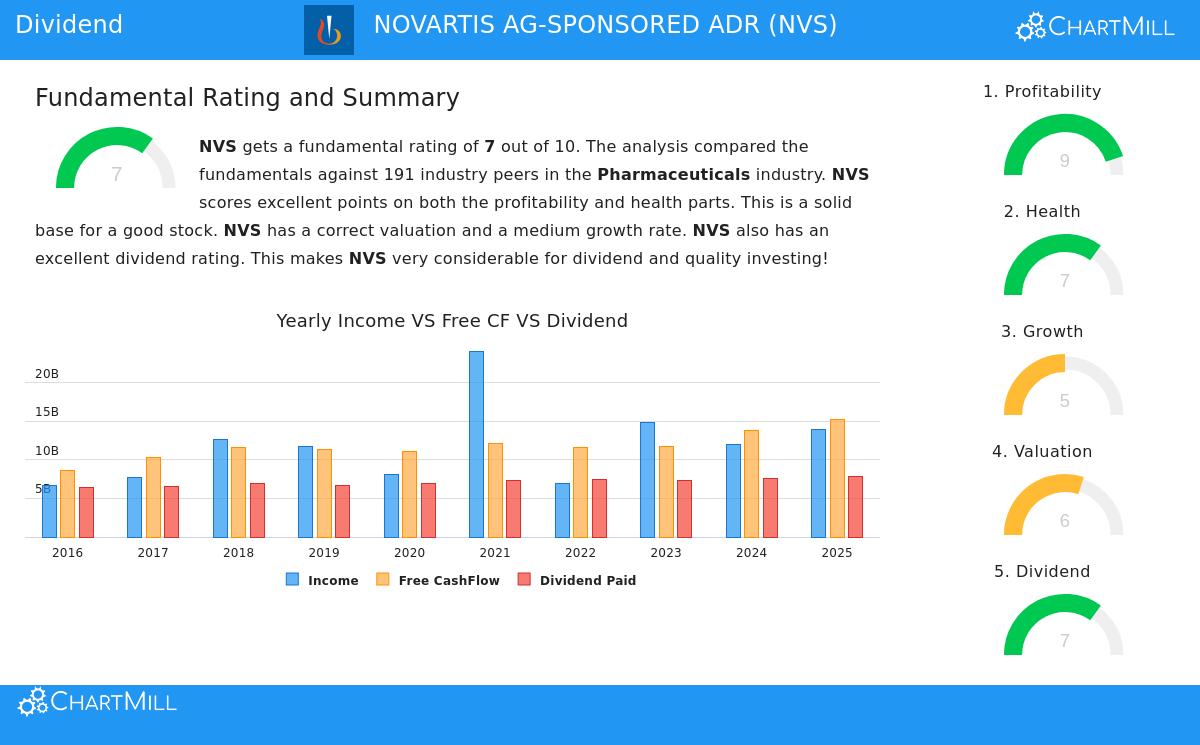
A clear example found by this search is Novartis AG-Sponsored ADR (NYSE:NVS), the Swiss pharmaceutical leader. The company's full basic report shows a profile that matches the search's rules, making it a strong option for dividend-centered portfolios.
Dividend Quality and Lasting Power
The center of the investment case for Novartis is in its dividend profile, which gets a 7 out of 10 on the ChartMill Dividend Rating. This rating combines several important parts dividend investors must examine.
- Yield and Comparison: NVS now gives a dividend yield of 2.99%. While not very high, this yield is fair and stacks up well against wider measures. It is much higher than the average for its pharmaceuticals industry (1.18%) and also exceeds the present S&P 500 average yield of about 1.85%.
- History and Increase: Steadiness is vital. Novartis has paid dividends for at least ten years and has not lowered its payout in the last five years, showing a dependable promise to shareholders. The dividend has increased at a yearly rate of 5.38% over this time, pointing to a management plan of giving back rising capital to investors.
- Payout Security: Lasting power is judged through the payout ratio, which shows what part of earnings is given as dividends. Novartis's ratio is 55.91%. This is on the higher end but is usually seen as workable, especially for an established, cash-producing company. Critically, the report states that the dividend is increasing at a rate nearly matching earnings growth, implying the present payout level can be maintained if this pattern holds.
This attention to a workable payout ratio and a history of dependable payments is exactly why the search method requires a high Dividend Rating. It shifts the study past a simple look at yield to a judgment of the dividend's staying power.
Basic Power: Profitability and Financial Soundness
A lasting dividend cannot exist without a profitable and financially safe company. This is why the search requires acceptable scores in Profitability and Health, rules where Novartis does very well. A sound core business is the source that pays for reliable dividend payments.
- Outstanding Profitability: Novartis receives a first-class Profitability Rating of 9. The company has very good margins, with an Operating Margin of 33.18% and a Profit Margin of 24.83%, putting it in the best group of its industry. Its Return on Invested Capital (ROIC) of 19.32% is much better than its cost of capital, confirming the company is effectively building shareholder value. High profitability supplies the needed cash flow to easily pay for the dividend.
- Firm Financial Soundness: With a Health Rating of 7, Novartis shows a stable financial base. The report notes a strong Altman-Z score, meaning a very small short-term chance of bankruptcy. While its current and quick liquidity ratios are mentioned as points of lesser strength next to similar companies, the study finds that the company's very good solvency and profitability measures reduce worries about instant liquidity problems. The debt level is also well-supported by the company's large free cash flow.
These good ratings in Profitability and Health are essential for the search plan. They work as a filter to make sure the good dividend is not an illusion hiding business softness or balance sheet danger. For Novartis, they confirm the company has the operational quality and financial strength to keep its shareholder returns through different economic conditions.
Valuation and Increase Setting
While the search is dividend-focused, a complete view includes valuation and increase outlook. Novartis gets a neutral Valuation Rating of 6. Its P/E ratio of 18.31 seems costly on its own but is actually low next to both its industry peers and the wider S&P 500. This suggests investors are not paying too much for its earnings and dividend stream.
The Growth Rating is a moderate 5. The company has provided good past earnings increase and is predicted to keep increasing at a modest speed. For dividend investors who value income steadiness and capital protection over fast growth, this even, predictable path can be a good point, as it supports the case for steady dividend raises.
An Option for More Study
Novartis AG-Sponsored ADR (NVS) shows the kind of security a quality dividend search intends to find. It provides a fair and well-supported yield, supported by a top-tier profitable business and a firm financial setup. The company’s long dividend history and dedication to slow growth in the payout further strengthen its attraction for income-focused investors.
For a complete look at all the basic parts behind these ratings, you can see the full ChartMill Fundamental Analysis Report for NVS.
Novartis is only one of the companies that fits the rules for lasting dividend investing. If you want to build a list of similar quality dividend payers, you can see the whole "Best Dividend Stocks" search and its present results here. The search gives a changing beginning point for investors to do their own additional careful study.
,
Disclaimer: This article is for informational purposes only and does not constitute financial advice, a recommendation, or an offer to buy or sell any securities. Investing involves risk, including the potential loss of principal. Readers should conduct their own research and consult with a qualified financial advisor before making any investment decisions.