

For investors aiming to build a portfolio that creates steady passive income, a disciplined screening process is important. One useful method involves selecting for companies that not only provide a good dividend now but also have the fundamental financial soundness to maintain and raise those payments. This approach frequently centers on stocks with high dividend ratings, which assess yield, growth, and sustainability, while also needing fair scores for profitability and financial soundness. This two-part aim helps sidestep the risk of high-yield stocks that could be hiding basic business problems with a payment that cannot last.
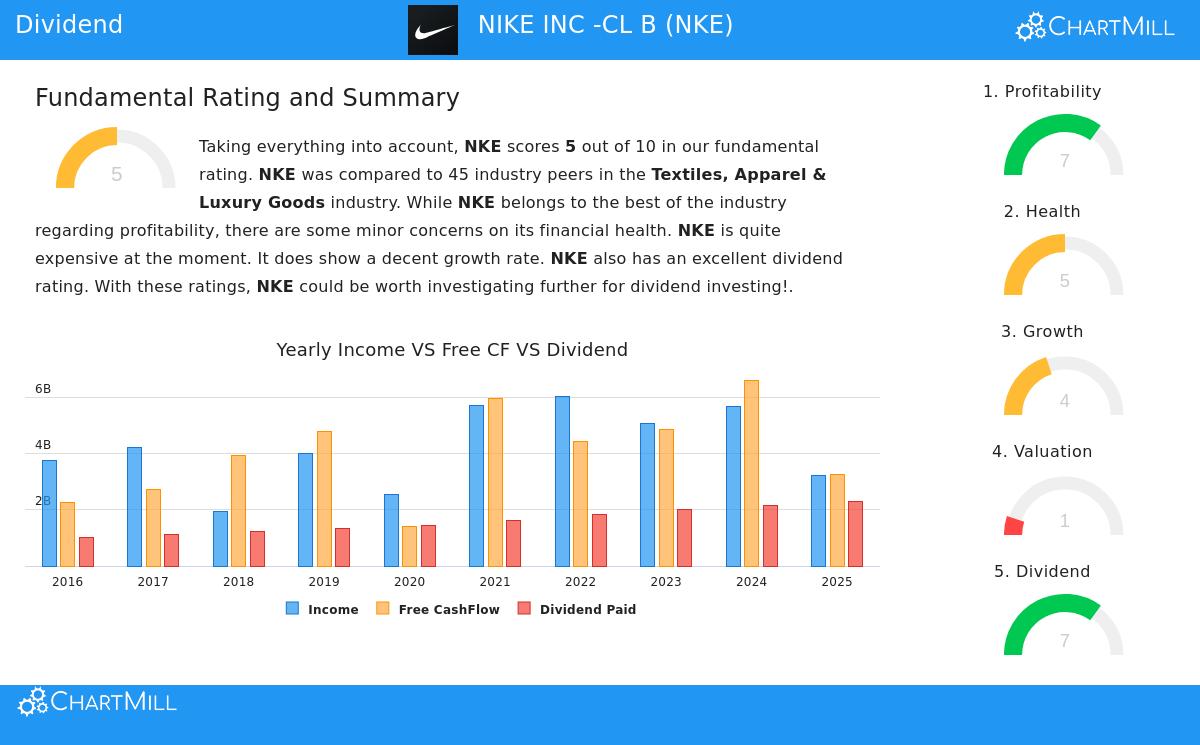
NIKE INC -CL B (NYSE:NKE) appears from such a screen as a candidate worth more study for dividend-oriented portfolios. The global athletic wear leader's inclusion comes from a solid ChartMill Dividend Rating of 7, backed by adequate Profitability (7) and Health (5) ratings. A more detailed view of the fundamental analysis report shows the particular advantages and points to weigh that support these scores.
Dividend Soundness and History
The main attraction for income investors is found in Nike's settled and increasing dividend characteristics. The company shows a dedication to giving capital back to shareholders, a key part of the dividend investment approach.
- Good and Higher-Than-Average Yield: Nike now has a dividend yield of 2.62%. This is higher than the average yield of similar companies (1.46%) and also above the present S&P 500 average of about 1.83%. For a company of Nike's size and brand strength, this gives a reliable income base.
- Notable Growth History: Possibly more important than the current yield is the dividend's growth path. Nike has raised its dividend at a notable yearly rate of 10.70% over the last five years. This steady increase is a sign of a company that treats shareholders well and directly meets the dividend investor's aim of making their passive income larger over time to offset inflation.
- Dependable Payment History: The company has given a dividend for at least ten years and has not cut it in that time. This long, steady history of payments increases investor trust in the income's dependability, which is critical for a plan built on expected cash flows.
Profitability Supports the Payment
A rising dividend can only continue if a profitable business backs it. This is why selecting for fair profitability is a required step in the method; a company cannot distribute profits it does not make. Nike's profitability measures, while indicating some recent strain, stay basically sound.
- Good Returns on Capital: Nike's Return on Equity (17.92%) and Return on Invested Capital (9.77%) are better than most of its industry peers. These numbers show the company is effective at creating profits from the money it uses, which is the final source of dividend funds.
- Firm Profit Margins: The company keeps a Profit Margin of 5.43%, placing it with the top in its competitive industry. This ability to set prices and operational effectiveness give a buffer that helps continued dividend payments even in harder economic times.
Financial Soundness: A Point for Care
The screening process also looks at financial health to make sure the company is not using too much debt, where loan repayments could risk the dividend. Nike's health rating of 5 points to a varied but acceptable situation.
- Firm Liquidity Position: Nike's liquidity is not a worry. A Current Ratio of 2.06 and a Quick Ratio of 1.40 show the company has more than enough short-term assets to meet its near-term debts, keeping operations running smoothly.
- Stability and Payment Longevity: This is the part needing the most careful look from dividend investors. Nike's Debt-to-Free-Cash-Flow ratio is a sound 3.24, meaning it could repay debt fairly fast. However, the present payout ratio—the part of earnings given as dividends—is at a very high 94.06%. This is a key area to watch, as it gives almost no room for problems if earnings fall. The report states that analyst forecasts expect earnings growth to be faster than dividend growth going forward, which would better this ratio, but it stays a number to check carefully.
Valuation and Growth Setting
It is key to see the dividend idea within the whole investment setting. Nike is now priced high on standard measures like Price-to-Earnings, trading above both its industry and the wider market. This shows its strong brand and market place but means investors pay more for quality. Also, the company is in a time of change, with recent year-over-year drops in revenue and earnings. Still, analyst forecasts indicate a return to mid-single-digit revenue growth and low-double-digit EPS growth in the next few years, which would support the idea for a lasting and rising dividend.
Nike offers a strong case for dividend investors who value growth and dependability of income over only a high yield. Its powerful brand, history of dividend raises, and basic profitability fit well with a plan looking for lasting income growth. The high payout ratio and high price are elements that require notice, indicating it may be better for investors with a longer-term view who trust in the company's growth recovery.
For investors wanting to look at other companies that meet similar strict dividend, profitability, and health filters, you can see the full screen results using this Best Dividend Stocks screener.
Disclaimer: This article is for information only and is not financial advice, a suggestion, or an offer or request to buy or sell any securities. The information given is based on supplied data and should not be the only reason for any investment choice. Investing has risk, including the possible loss of the original amount. You should do your own study and talk with a qualified financial advisor before making any investment choices.