

For investors looking for a disciplined, long-term way to build wealth, few strategies are as respected as Peter Lynch’s method. The famous manager of the Fidelity Magellan Fund supported investing in what you understand, concentrating on companies with clear operations, steady growth, and fair prices. His system is not about following the latest fads but about finding good companies that can be owned for many years. A central part is the "Growth at a Reasonable Price" (GARP) idea, which mixes the aim for growth with the care of value investing. This means looking for companies with good earnings growth, high profitability, stable finances, and a price that does not pay too much for that future promise.
One company that recently appeared from a filter set up on Lynch’s ideas is NEWMARKET CORP (NYSE:NEU). As a maker of petroleum additives and specialty chemicals for aerospace and defense, NewMarket works in necessary, if not very exciting, industrial areas. For Lynch, this is frequently a good trait, a "simple" business that is clear and supplies important products can be an ideal choice for long-term investment. Let's look at how NewMarket's financial picture matches the particular checks of a Peter Lynch-inspired filter.
Match with Peter Lynch Filtering Standards
The filter uses fixed rules to find companies that suit the GARP model. NewMarket Corp. passes these important tests:
- Steady EPS Growth: Lynch wanted companies increasing earnings per share (EPS) between 15% and 30% each year over five years, thinking growth outside this band was either too low or not maintainable. NewMarket shows a five-year EPS growth rate of 16.3%, putting it directly inside Lynch's target area for consistent, reliable increase.
- Fair Price via PEG Ratio: To prevent paying too much for growth, Lynch preferred a Price/Earnings to Growth (PEG) ratio of 1 or below. This measure checks the stock's P/E ratio against its growth rate. NewMarket's PEG ratio, using its past five-year growth, is 0.87. This shows the market is pricing its shares at a small reduction to its historical growth path, a good signal for price-aware investors.
- High Profitability (ROE): A strong Return on Equity (ROE) shows good use of shareholder money. Lynch usually searched for ROE above 15%. NewMarket is well above this with an ROE of 26.4%, proving notable profitability in its field.
- Cautious Financial Condition: Lynch favored companies with solid balance sheets. The filter demands a Debt-to-Equity ratio under 0.6 and a Current Ratio above 1. NewMarket does very well here, with a Debt/Equity ratio of 0.46 and a strong Current Ratio of 2.68. This points to a careful capital setup with enough cash to cover near-term needs, lowering money risk for long-term owners.
Basic Condition and Results Summary
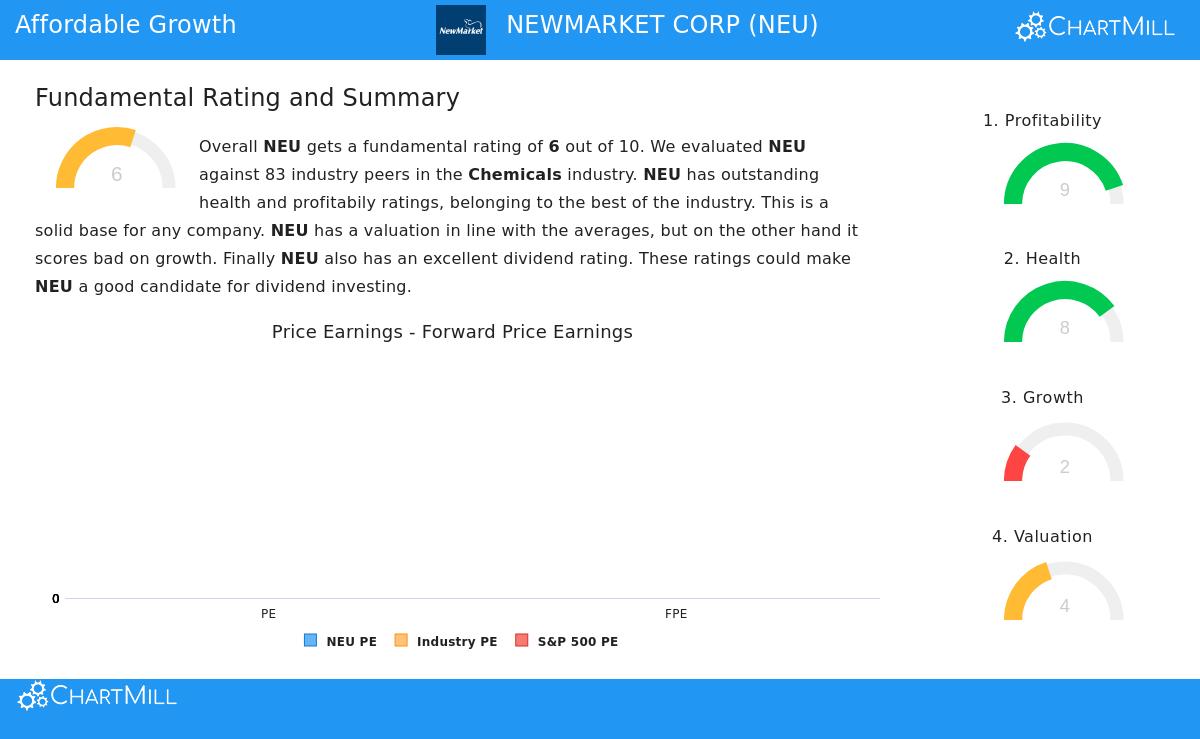
Outside the specific filter checks, a wider view of NewMarket's basic analysis report shows a company with clear strong points, especially in financial condition and profitability, which are central parts of Lynch's strategy.
The company receives a high total condition score, backed by a very good Altman-Z score hinting at low failure risk and a very easy debt load compared to its free cash flow. Its profitability numbers are excellent, with field-leading returns on assets, invested capital, and equity. Margins are high and have been getting better. While the company's sales growth has been slow lately, its skill at turning revenue into high profits stays notable.
From a price standpoint, NewMarket sells at a P/E ratio near 14, which is lower than both the wider S&P 500 and the normal for its chemicals industry. This, paired with its high profitability, implies the stock is not priced too high. Also, the company has a steady history of paying and raising its dividend, with a maintainable payout ratio, including an income part to the total return possibility.
You can see the complete, full basic analysis for NEWMARKET CORP (NYSE:NEU) here.
Is NewMarket a "Key Piece" for a Long-Term Portfolio?
For an investor following Peter Lynch's ideas, NewMarket Corp. makes a strong argument. It works in necessary, clear industries, petroleum additives and aerospace chemicals, that are not likely to disappear. It shows the sign of a Lynch-type investment: maintainable, double-digit earnings growth reached without high financial borrowing. The company is very profitable, cautiously run, and sells at a fair price when its growth and quality are weighed.
While the absence of analyst coverage and future guesses (a usual feature for smaller, less noticed firms Lynch liked) needs investors to complete their own study on the business's competitive edge and growth sources, the number-based base is sound. It represents the "growth at a reasonable price" belief, giving the chance for price gains together with a rising dividend.
Want to find other companies that fit this disciplined method? You can use the Peter Lynch strategy filter yourself and view the present outcomes here.
Disclaimer: This article is for information only and is not financial advice, a suggestion, or a deal to buy or sell any security. The study uses data and a particular investment strategy model; investors should do their own full research and think about their personal money situation before making any investment choices.