

The Caviar Cruise investment strategy focuses on identifying companies with exceptional quality characteristics that can deliver sustainable long-term growth. This approach, inspired by Belgian author Luc Kroeze's work, emphasizes fundamental strength over short-term price movements, seeking businesses with strong revenue and profit growth, high returns on invested capital, manageable debt levels, and consistent cash flow generation. Quality investors using this methodology typically employ a buy-and-hold strategy, becoming long-term owners of businesses that demonstrate operational excellence and competitive advantages.
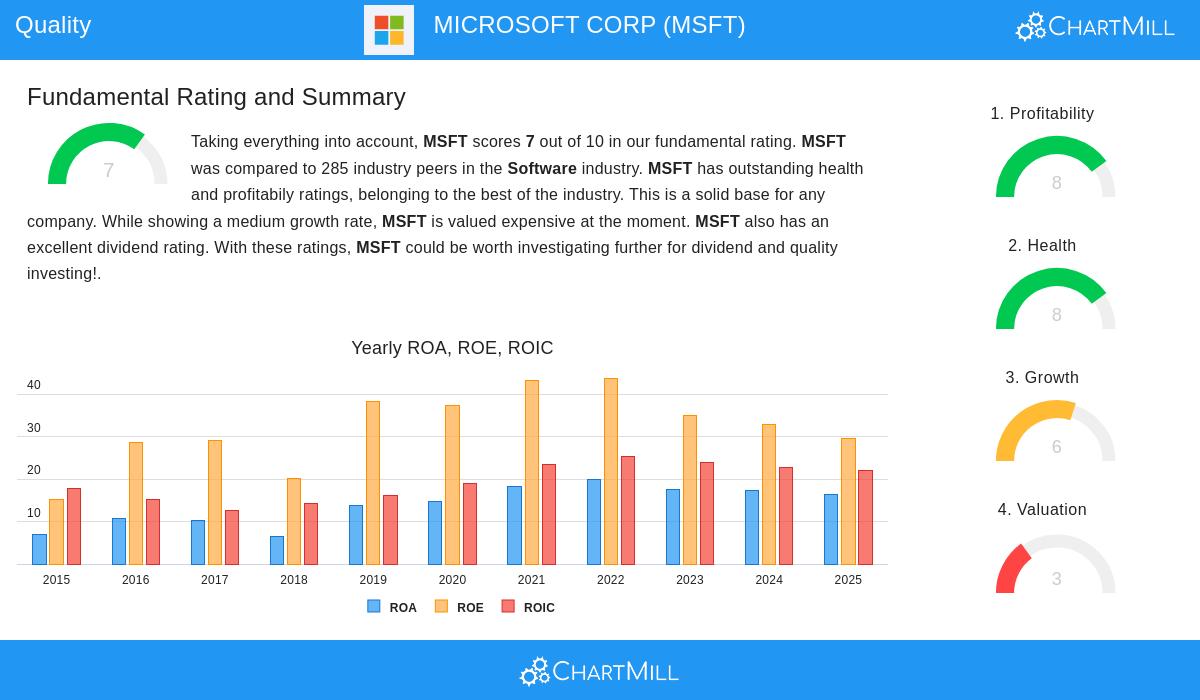
MICROSOFT CORP (NASDAQ:MSFT) appears as a strong candidate through the Caviar Cruise screening process, demonstrating multiple characteristics that align with quality investing principles. The technology giant's fundamental metrics reveal a company that not only meets but exceeds the strict criteria set by this investment methodology.
Growth Trajectory and Profitability
Microsoft demonstrates the consistent growth pattern that quality investors seek, with both revenue and operating profit increasing at notable rates over the past five years. The company's revenue has grown at a compound annual growth rate of 12.67%, comfortably exceeding the screen's 5% threshold. More importantly, Microsoft's EBIT growth of 19.40% annually significantly outpaces its revenue growth, indicating improving operational efficiency and pricing power.
Key growth metrics:
- 5-year revenue CAGR: 12.67% (versus requirement of >5%)
- 5-year EBIT CAGR: 19.40% (versus requirement of >5%)
- EBIT growth exceeds revenue growth by 6.73 percentage points
This EBIT growth superiority over revenue growth is particularly significant within the Caviar Cruise framework, as it suggests the company benefits from economies of scale and possesses pricing power, both hallmarks of quality businesses with sustainable competitive advantages.
Return on Invested Capital and Efficiency
Microsoft's exceptional return on invested capital stands out as a key strength, with the company achieving a notable 43.75% return on invested capital excluding cash, goodwill, and intangibles. This dramatically exceeds the screen's 15% requirement and places Microsoft among the top performers in its industry.
The importance of this metric for quality investors cannot be overstated, ROIC measures how effectively a company allocates capital to generate profits, and Microsoft's extraordinary performance indicates superior capital allocation decisions and operational efficiency. This high return rate suggests the company possesses durable competitive advantages that allow it to generate substantial profits from its investments.
Financial Health and Cash Flow Quality
Microsoft's balance sheet strength and cash flow characteristics align perfectly with quality investing principles. The company maintains a conservative debt profile, with a debt-to-free-cash-flow ratio of 1.25, well below the screen's maximum threshold of 5. This indicates Microsoft could theoretically repay all its outstanding debt in just over one year using current free cash flow generation.
Financial health indicators:
- Debt-to-Free-Cash-Flow: 1.25 (versus maximum threshold of 5)
- 5-year average Profit Quality: 83.54% (versus minimum requirement of 75%)
- Altman-Z score: 10.38 (indicating very low bankruptcy risk)
The company's profit quality score of 83.54% over the past five years demonstrates its ability to convert accounting profits into actual cash flow, a crucial consideration for quality investors who prioritize real economic value over accounting figures.
Complete Fundamental Assessment
Microsoft's complete fundamental analysis reveals a company performing well across multiple dimensions. The software giant earns an overall fundamental rating of 7 out of 10, with particularly strong showings in profitability (8/10) and financial health (8/10). The company's margins are exceptional, with operating margin of 45.62% and profit margin of 36.15%, both ranking in the top percentiles of the software industry.
While valuation appears stretched with a P/E ratio of 38.97, quality investors often accept premium valuations for exceptional businesses. The company's growth trajectory remains solid, with analysts projecting continued revenue growth above 12% and EPS growth above 15% in coming years. Microsoft's dividend program also shows quality characteristics, with a 10-year history of reliable and growing payments, though the current yield remains modest at 0.70%.
Quality Investing Considerations
Beyond the quantifiable metrics, Microsoft exhibits several qualitative characteristics that appeal to quality investors. The company benefits from multiple long-term growth trends including cloud computing, artificial intelligence, and digital transformation. Its competitive advantages are substantial, encompassing network effects, switching costs, and brand strength across enterprise and consumer markets.
Microsoft's global footprint, understandable business model, and demonstrated pricing power further reinforce its quality credentials. The company's strategic investment in OpenAI positions it at the forefront of AI development, potentially creating additional growth avenues. Management has consistently demonstrated capital allocation discipline, balancing reinvestment in growth with returning capital to shareholders through dividends and buybacks.
For investors interested in exploring other companies that meet the Caviar Cruise quality criteria, the complete screening results provide additional investment ideas that share these quality characteristics.
Disclaimer: This analysis is for informational purposes only and does not constitute investment advice, recommendation, or endorsement of any security. Investors should conduct their own research and consult with financial advisors before making investment decisions. Past performance does not guarantee future results.