

For investors aiming to construct a portfolio on value investing principles, the central task is finding companies whose market price is below their intrinsic value. This method, established by Benjamin Graham and used by Warren Buffett, needs a strict focus on financial basics to find possible opportunities. A useful beginning for this hunt is to filter for stocks that show good financial condition and earnings, but are valued at a level that implies the market might be missing their strength. This method helps to steer clear of "value traps", companies that are inexpensive for a cause, by confirming the core business is healthy.
Lantheus Holdings Inc. (NASDAQ:LNTH), a supplier of diagnostic imaging and nuclear medicine products, comes up as a possibility from this kind of filtering. The company's basic profile shows a notable mix of good operational measures and a pleasing price, making it a stock worth more study for value-focused investors.
Valuation: A Support of Value Investing
The heart of value investing is buying a dollar of assets for fifty cents. For LNTH, the price measures indicate the market might be giving such a chance, especially compared to its own field.
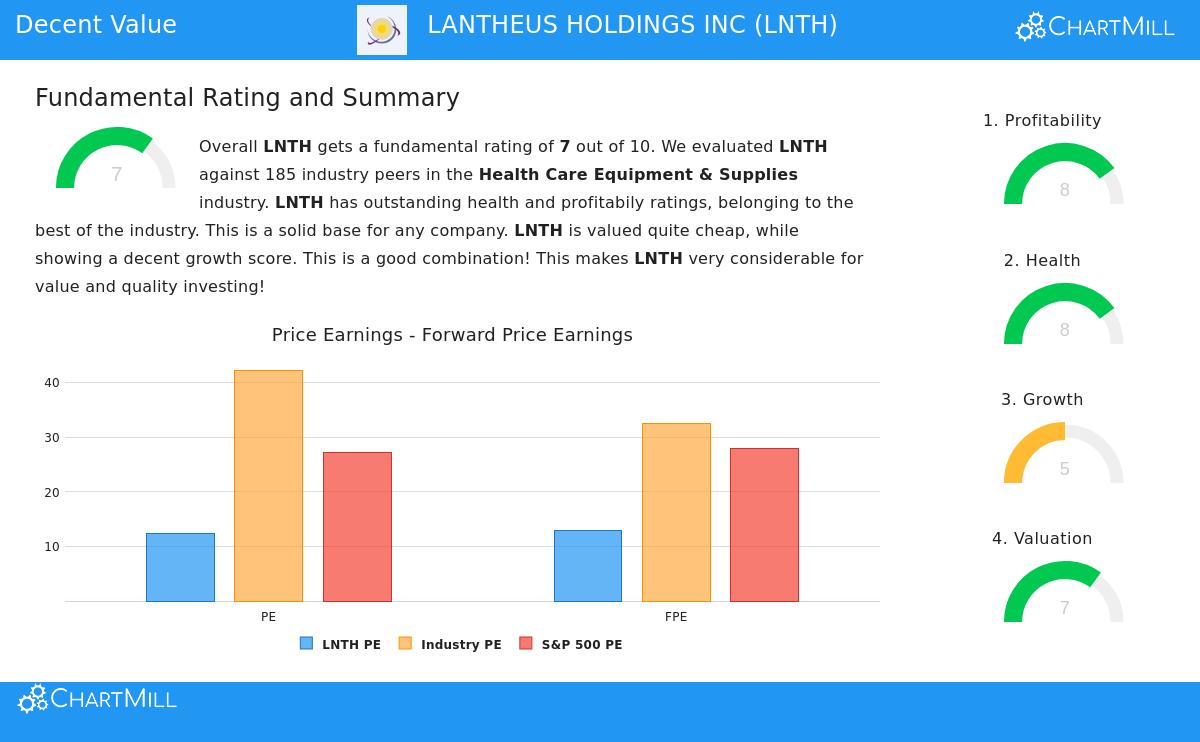
- Price-to-Earnings (P/E) Ratio: LNTH trades at a P/E ratio of 12.28, which is much less expensive than 93% of similar companies in the Health Care Equipment & Supplies field, where the average P/E is above 42.
- Forward P/E Ratio: Looking forward, the view stays alike. With a forward P/E of 12.95, LNTH is priced more cheaply than 91% of its field rivals.
- Price-to-Free Cash Flow: This is a notable measure. LNTH’s Price/FCF ratio is less expensive than almost 97% of the field, showing the company creates significant cash flow compared to its market value.
- Market Comparison: Both the trailing and forward P/E ratios are below half the present averages of the wider S&P 500 index, stressing its relative low price in the larger market.
These numbers are vital for a value investor because they are the first numerical sign of a possible difference between market price and intrinsic worth. A low price gives the essential "margin of safety" that guards investors from mistakes in calculation or unexpected business declines.
Financial Health: Confirming a Steady Base
An inexpensive stock is only a good buy if the company is financially strong enough to last and finally have its worth seen. LNTH gets an 8 out of 10 on ChartMill’s Financial Health score, pointing to a very firm balance sheet.
- Good Solvency: The company’s Altman-Z score of 4.38 indicates a very small short-term chance of financial trouble, doing better than 76% of the field.
- Controlled Debt: While the debt-to-equity ratio matches field averages, the more important measure is the Debt to Free Cash Flow ratio of 1.37. This very good number means LNTH could pay off all its debt with just over a year of its present free cash flow, doing better than almost 90% of similar companies.
- Sufficient Liquidity: With a Current Ratio of 2.67 and a Quick Ratio of 2.49, the company has more than enough short-term assets to meet its near-term debts, ensuring working adaptability.
For a value investor, excellent financial condition lowers the chance that a low-priced company will fail from a cash shortage or debt load before the market fixes its price. It gives the steadiness needed for a calm, long-term holding.
Profitability: The Driver of Intrinsic Value
A company's skill to create earnings is a direct source of its intrinsic worth. LNTH receives a high profitability score of 8, proving it is not only a steady business, but a very effective one.
- Better Returns: The company provides a Return on Invested Capital (ROIC) of 13.60%, exceeding 94% of its field. Its three-year average ROIC of 16.25% is almost two times the field average of 8.75%.
- Growing Margins: LNTH has firm and rising margins. Its Operating Margin of 22.63% places in the top 7% of the field, and both its Operating and Profit Margins have shown good increase in recent years.
This degree of profitability is critical. It verifies that the company has a competitive edge and is skilled at using capital to create income, key elements that support a greater intrinsic worth than the present market price may suggest.
Growth: The Way to Future Worth
While pure value stocks sometimes do not have increase, LNTH displays a fair and even growth profile with a score of 5. This adds a possible reason for the stock price to move toward a higher intrinsic worth over time.
- Firm Past Growth: Over the last several years, LNTH has reached a notable average yearly Revenue increase of 34.59% and EPS increase of 42.10%.
- Reasonable Future Outlook: Analysts forecast more limited forward increase, with yearly Revenue expected to rise by about 6.17% and EPS by 3.36%. While this shows a slowdown from the fast past increase, it still points to a business that is expected to grow, not shrink.
For the value investor, this growth setting is significant. It implies the company is in a rising market (diagnostic imaging and radiopharmaceuticals) and is not a still business fading. The change from high past increase to more maintainable forward estimates may partly clarify the present low price, giving a starting point if the market is too negative about the future.
Conclusion
Lantheus Holdings shows a basic profile that matches important value investing measures. It seems low-priced compared to both its field and the wider market, trades with a large margin of safety based on cash flow, and is supported by high profitability and financial condition. The company's firm past increase and place in the important healthcare field provide a base for future worth growth. Investors can examine the full basic study that backs this review here.
This study of LNTH came from a plan looking for "reasonable value" stocks, those with firm basics combined with a low price. For investors wanting to find other companies that fit this strict method, more filtering can be done using this set filter.
Disclaimer: This article is for information only and is not financial guidance, a suggestion, or a deal to buy or sell any security. Investing holds risk, including the possible loss of original funds. Readers should do their own study and talk with a registered financial consultant before making any investment choices.