

For investors looking for opportunities where the market price may not fully show a company's basic strength, a disciplined screening method can be a helpful beginning. One such approach involves looking for equities that join an attractive valuation with good basic measures. This method looks for stocks that seem inexpensive based on standard valuation ratios but are not "value traps", companies that are inexpensive for a cause. Instead, the attention is on firms that also show good financial condition, steady earnings, and at least average growth potential. This mix tries to find possibly underpriced securities supported by a lasting business, matching key ideas of value investing where a safety buffer is wanted together with quality.
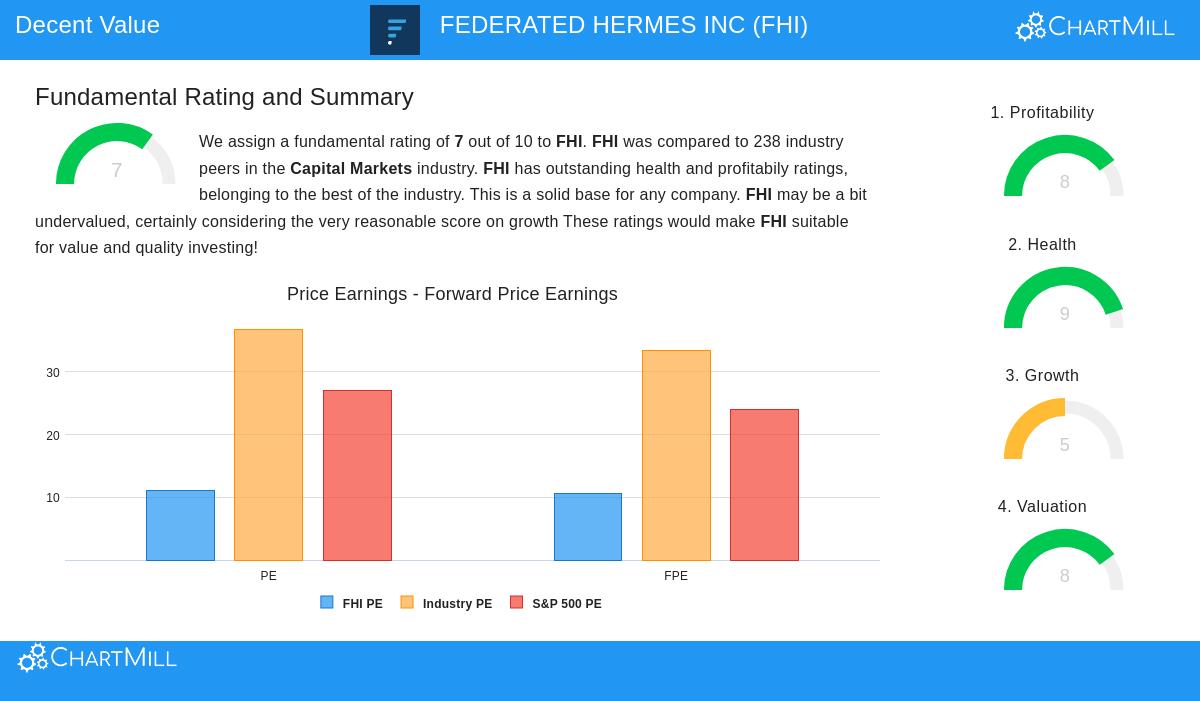
FEDERATED HERMES INC (NYSE:FHI), a Pittsburgh-based investment management firm, recently came from a screen made to find such "acceptable value" chances. The screen selected for stocks with high valuation ratings, showing they trade at appealing multiples, while also needing acceptable scores in earnings, financial condition, and growth. FHI's basic report indicates it deserves more examination under this structure.
Valuation: The Basis of Chance
The main draw for a value-focused screen is a stock's valuation, and FHI rates highly here with a score of 8 out of 10. The measures show a company trading at a large markdown to both wider market and industry norms.
- Price-to-Earnings (P/E): FHI's P/E ratio is 11.14, which is much less than the S&P 500 average of 26.94 and the Capital Markets industry average of 36.81.
- Forward P/E: Looking forward, the valuation stays attractive with a forward P/E of 10.56, compared to a 23.94 average for the S&P 500.
- Enterprise Value to EBITDA: This ratio, which includes debt, is noted as being less expensive than 92% of industry rivals, further highlighting the stock's relative discount position.
For a value investor, these ratios are the first sign of a possible difference between market price and inherent worth. The low P/E and forward P/E indicate the market is using a cautious multiple on FHI's earnings, which may not fully consider the company's other positive attributes.
Financial Health: A Base of Steadiness
An inexpensive valuation loses its attraction if the company's balance sheet is weak. FHI does very well in this part, getting a top-level condition score of 9. This shows a financially sound company with a good ability to meet its duties and handle economic declines.
- Good Solvency: The company has an Altman-Z score of 5.28, showing a very small near-term chance of financial difficulty and doing better than 86% of its industry. Its debt-to-equity ratio of 0.29 shows little dependence on debt funding.
- Very Good Liquidity: With both a Current Ratio and Quick Ratio of 3.13, FHI has enough liquid assets to cover near-term debts, doing better than over 81% of industry rivals.
- Debt Handling: Maybe most notably, FHI's Debt to Free Cash Flow ratio is 1.34, meaning it could in theory pay off all its debt with just over a year's worth of free cash flow.
This very good financial condition gives the important "safety buffer" that value investors focus on. It means the company is not just numerically inexpensive but is built on a steady base, lowering the chance that its low valuation is a sign of coming financial problems.
Profitability: Good Business at a Markdown
A value stock gets more appealing when it is not only inexpensive and sound but also very profitable. FHI's earnings score of 8 confirms it is a basically profitable business.
- High Returns on Capital: The company makes notable returns, with a Return on Invested Capital (ROIC) of 18.60% and a Return on Equity (ROE) of 30.66%, both putting it in the top 5% of its industry.
- Good Margins: FHI keeps a gross margin of 95.56%, among the best in its field. Its operating margin is steady at 28.35%, about average for the industry.
These measures are key because they show that the company is effectively using its capital to create earnings. For an investor, high and steady earnings supports the idea that the business has a lasting competitive edge, making its low valuation multiple possibly unusual rather than reasonable.
Growth and Dividend: Helpful Elements
While the screen looked for "acceptable" growth, FHI's profile here is blended but shows positive movement where it matters most for shareholders. Its growth score is a neutral 5.
- Earnings Movement: Past EPS grew by a notable 54% last year, and analysts predict good future EPS growth of 15.10% each year. This increase is a positive indicator.
- Revenue Issues: It is key to note that revenue fell by 12.36% over the past year, though the long-term trend stays one of small growth.
- Dependable Income: Adding to the value case is a dividend yield of 2.55%, which is more than the S&P 500 average. The dividend has grown at a yearly rate of over 15% and has been paid reliably for at least ten years, backed by a maintainable payout ratio.
The focused strength in earnings growth, along with a dependable and growing dividend, adds another part to the investment case. It indicates shareholders are being rewarded to wait for any possible market re-evaluation of the stock's worth.
Conclusion
Federated Hermes Inc. shows a profile that matches closely with a disciplined value-looking method. It trades at a noticeable discount to the market and its rivals, as shown by its low earnings multiples. Importantly, this low valuation is joined with very good financial condition and high earnings, lessening the main dangers often linked with inexpensive stocks. The company's good balance sheet and excellent returns on capital indicate quality, while its earnings growth path and shareholder-friendly dividend policy give extra support.
In summary, FHI seems to be a case where the market may be missing the strength of the basic business when setting its price, creating a possible chance for investors who focus on basics over feeling.
You can see the full basic examination for FHI here.
This article is based on a specific basic screening method. If you are interested in looking at other stocks that meet similar "acceptable value" rules, you can use this screen yourself.
Disclaimer: This article is for information only and does not make up financial guidance, a suggestion, or an offer to buy or sell any security. Investing includes risk, including the possible loss of original investment. You should do your own study and talk with a qualified financial consultant before making any investment choices.