

For investors aiming to construct a portfolio on value investing principles, the central task is finding companies priced below their inherent value. This established method, created by Benjamin Graham and used notably by Warren Buffett, requires a systematic hunt for securities the market has priced incorrectly. The aim is not to follow popular fads, but to discover good businesses with sound basics that are offered at a lower price. A useful method for this hunt is applying organized filters that sort for important financial strength measures combined with good prices, providing a safety buffer. One stock that recently appeared using such a "Decent Value" filter, which emphasizes a good price rating together with firm scores for earnings, financial strength, and expansion, is Federated Hermes Inc (NYSE:FHI).
A Look at the Basic Argument
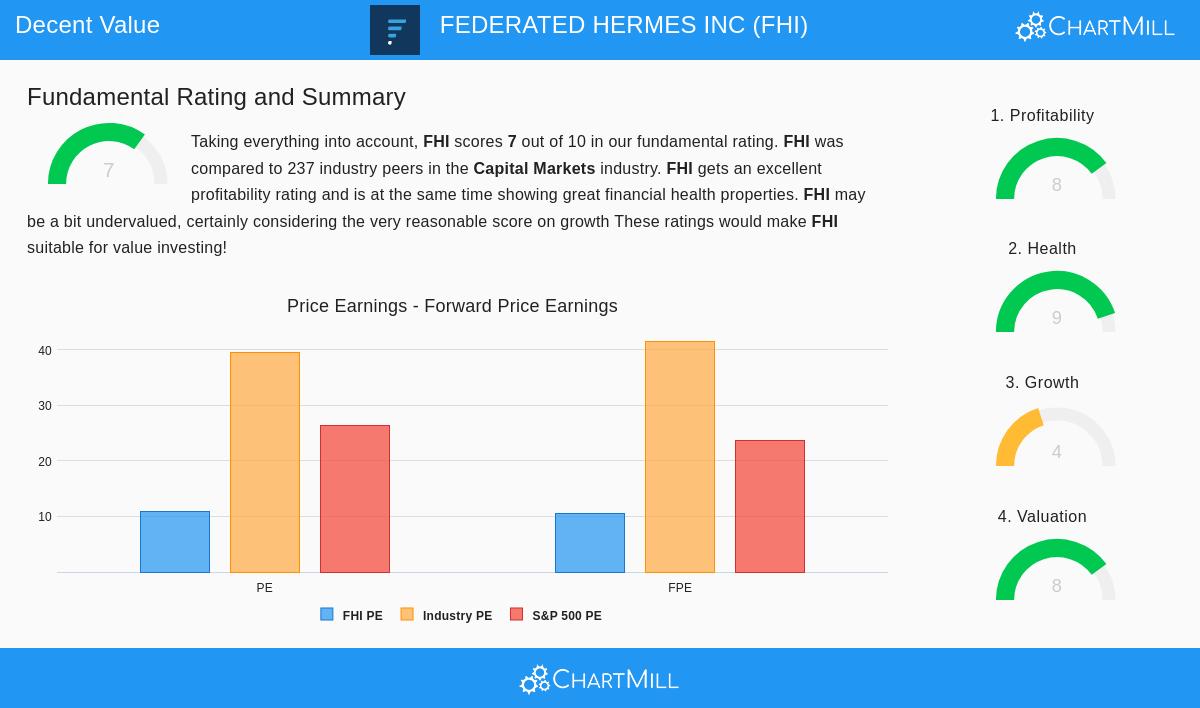
Federated Hermes works in the capital markets field as a seller of investment management products and financial services. According to ChartMill's detailed fundamental analysis report, FHI receives a total fundamental rating of 7 out of 10. This number comes from an assessment across five key sections, each important for a value investor's review. The details show an interesting profile where notable advantages in some sections may balance adequate scores elsewhere, all while the stock sells at what seems a fair price.
Price: The Basis of the Chance
For a value investor, price is the starting place. A stock must be low compared to its basics to offer that needed safety buffer. FHI's price rating is a firm 8 out of 10, signaling the market may be valuing it cautiously.
- Price-to-Earnings (P/E): FHI sells at a P/E ratio of 10.88, which is sensible alone and is also lower than about 65% of similar companies. Compared to the S&P 500 average P/E of 26.43, the stock seems notably low.
- Forward P/E and Enterprise Value: The forward P/E of 10.49 shows a similar picture, being lower than almost 69% of the field. Also, based on the Enterprise Value to EBITDA ratio, more than 91% of companies in the capital markets field are priced higher than FHI.
- Growth Consideration: The low PEG ratio, which modifies the P/E for projected earnings expansion, indicates the current price may not completely account for the company's future possibility, a typical marker of a value chance.
Financial Strength: A Base of Steadiness
Benjamin Graham stressed the need for a company's financial soundness to endure economic declines. A value investor requires assurance that a low-priced company is not a "value trap" with payment problems. Here, FHI does very well with a close to ideal strength rating of 9.
- Firm Solvency: The company's Altman-Z score of 5.23 shows no immediate bankruptcy danger and does better than 86% of the field. Its low debt-to-equity ratio of 0.29 shows little dependence on debt.
- Notable Liquidity: With current and quick ratios both at 3.13, FHI has strong liquidity to cover its near-term debts, scoring higher than 81% of similar companies. The debt-to-free-cash-flow ratio of 1.34 is especially good, meaning the company could pay off all debt in just over a year from its cash.
Earnings: The Driver of Inherent Value
A low-priced stock is only a sound investment if the company is basically profitable and can produce returns for shareholders. FHI's earnings rating of 8 confirms it is a good business.
- High Returns: The company creates strong returns on its assets and capital. Its Return on Invested Capital (ROIC) of 18.60% and Return on Equity (ROE) of 30.66% each put it in the best 5% of its field.
- Firm Margins: While the profit margin matches the field, FHI has a notable gross margin of 95.56%, doing better than 95% of rivals. This signals a very efficient operation with firm pricing control or a good cost setup.
Expansion and Dividend: Future Outlook and Income
While strict value investing can include flat companies, mixing value with adequate expansion outlook can be a strong driver. FHI's expansion rating is a modest 4, but it displays positive movement in key areas.
- Earnings Movement: The company reported firm EPS expansion of 54% over the last year. Although revenue fell lately, the long-term pattern and future projections indicate steady, single-digit expansion in both revenue and earnings.
- Dependable Income Source: With a dividend yield of 2.59%, above the S&P 500 average, and a 10-year history of consistently paying and increasing its dividend (at a yearly rate over 15%), FHI provides an income element value investors often like. The payout ratio of 28.5% is maintainable, leaving lots of room for reinvestment and future increases.
Final Thoughts: A Pick for the Value Portfolio
Federated Hermes Inc presents an argument that fits several value investing ideas. It sells at a lower price than both the wider market and its own field based on normal price measures. This possible low price is supported by a very firm balance sheet with high liquidity and solvency, and strong earnings shown by notable returns on capital. While its expansion is not rapid, it is steady and joined with a dependable and rising dividend. For an investor filtering for decent value, companies that are low-priced but not weak, FHI justifies more study as a pick that provides a safety buffer through its financial soundness and a fair price for a profitable business.
This review of FHI was prompted by a "Decent Value" stock filter. Investors curious about finding other companies that fit similar standards of good price, earnings, strength, and expansion can look for more possible chances using the Decent Value Stocks filter on ChartMill.
Disclaimer: This article is for information only and does not form financial guidance, a suggestion, or an offer to buy or sell any security. Investing holds risk, including the possible loss of original funds. You should do your own study and talk with a qualified financial advisor before making any investment choices.