

For investors looking for a systematic method to build wealth over time, few plans are as respected as the one made famous by Peter Lynch. The famous leader of the Fidelity Magellan Fund supported a "growth at a reasonable price" (GARP) idea, concentrating on companies with lasting earnings growth, good financial condition, and prices that do not overvalue that future promise. His system, explained in One Up on Wall Street, stresses basic examination and a buy-and-keep perspective, avoiding attempts to time the market. A central belief is putting money into comprehensible companies, and an important numerical filter involves finding firms with steady earnings per share (EPS) growth between 15% and 30%, a PEG ratio at or under 1, a good return on equity (ROE), and a careful balance sheet.
A Peter Lynch Candidate: Enphase Energy Inc (NASDAQ:ENPH)
Enphase Energy Inc (ENPH) designs and makes integrated home energy systems, which include microinverters, batteries, and software for solar power creation and storage. As a company that allows homeowners to create, store, and control their own electricity, it works in the increasing cleantech field, a contemporary area that, while technically sophisticated, offers a physical product and service becoming more common and clear to the regular buyer.
Checking Against Lynch's Main Rules
The Peter Lynch filter finds companies that show a particular mix of growth, earnings, and price. Enphase Energy seems to match a number of these important numerical checks, which are made to find lasting compounders.
- Lasting Earnings Growth: Lynch preferred companies increasing at a "steady" rate, not an extreme speed that is often hard to keep up. Enphase states a 5-year average EPS growth rate of 16.99%. This fits directly inside Lynch's aimed range of 15% to 30%, pointing to a record of solid but possibly continued increase.
- Fair Price (The PEG Ratio): Maybe the most important Lynch number is the Price/Earnings to Growth (PEG) ratio, which tries to see if you are paying a fair amount for that growth. A PEG of 1 or less is seen as good. Enphase has a PEG ratio (using the past 5-year growth) of 0.86, meaning the market may not be completely valuing its past growth path, so meeting Lynch's price rule.
- Earnings and Effectiveness (ROE): Return on Equity checks how well a company creates profit from shareholders' equity. Lynch wanted high ROE as a signal of a lasting competitive edge and effective leadership. Enphase's ROE of 15.84% is more than the 15% line often linked with high-grade businesses, fitting with this rule.
- Financial Condition (Current Ratio & Debt): Financial strength is key for long-term owned assets. The Current Ratio checks short-term cash availability, and Lynch wanted a ratio above 1. Enphase's ratio of 2.07 shows a good ability to handle upcoming bills. On debt, Lynch was careful, favoring low Debt/Equity ratios. Enphase's D/E ratio of 0.53 is under the filter's limit of 0.6, though it should be mentioned that Lynch's own choice was for a stricter level under 0.25.
A Look at the Basic Health
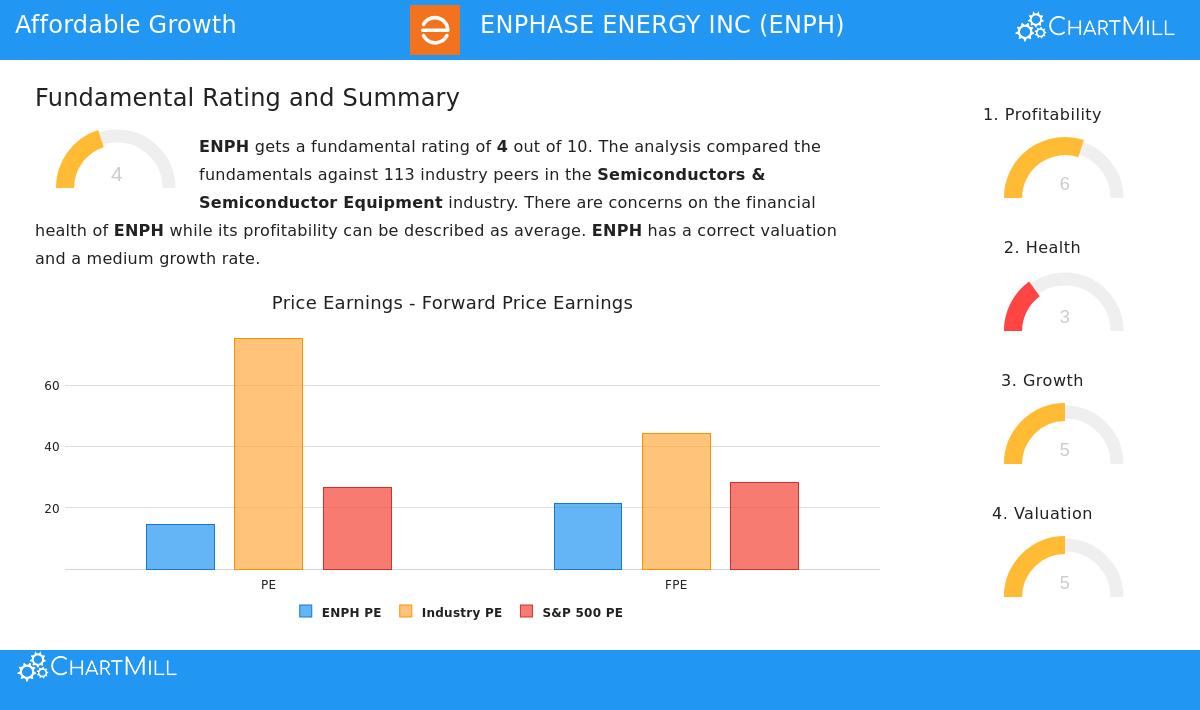
A wider view of Enphase's basic health shows a varied but interesting picture, matching a company in a competitive and changing field. According to a detailed basic examination report, Enphase gets a total score of 4 out of 10.
- Earnings (Score: 6/10): The company shows solid earnings numbers, with its ROE and Return on Invested Capital (ROIC) doing better than a large part of its semiconductor equipment industry equals. However, experts point to a recent drop in both profit and operating margins, a matter for more study.
- Financial Condition (Score: 3/10): This is the area of biggest worry. While cash availability is strong (as shown in the Current Ratio), the company holds an amount of debt that is more than many industry rivals. The report states that its Debt-to-Free-Cash-Flow ratio is high, and its Return on Invested Capital is now under its cost of capital, pointing to difficulties in making shareholder value from recent investments.
- Price (Score: 5/10): Price signals are neutral to positive. The normal P/E ratio of 14.59 seems low compared to both the industry and the wider S&P 500. However, the expected P/E ratio is higher, and the market seems to be valuing a large reduction in future growth.
- Growth (Score: 5/10): The company has a very good history of past growth in both sales and EPS. The key point for a Lynch-type investor is the ability to continue that growth. Here, the view becomes less strong; expert guesses predict a noticeable slowing in both sales and EPS growth over the next years, which matches the more careful expected price multiples.
Is Enphase a Match for the Long-Term GARP Investor?
Enphase Energy offers an interesting example for the Peter Lynch system. It meets the first numerical filter with its past growth rate, good PEG ratio, strong ROE, and enough cash availability. For an investor who understands and has faith in the long-term use path of home energy control, the company works in a sensible, increasing area.
However, the Lynch plan needs thorough checking beyond the filter. The weaker future growth guesses, higher debt amounts, and margin pressures noted in the basic report are important cautions. A true Lynch follower would need to examine if the present difficulties are short-term industry challenges or signals of a weakening competitive edge. The filter finds a candidate; the investor must now choose if Enphase has the lasting qualities to be a long-term owned asset.
Find Other Possible Assets
The Peter Lynch plan is made to create a varied collection of companies that meet these strict rules. Enphase Energy is only one example that came from this systematic filter. If you want to look at other companies that now match this "growth at a reasonable price" description, you can see the complete list of results using the Peter Lynch Strategy stock filter.
Disclaimer: This article is for information only and is not financial guidance, a suggestion, or an offer to buy or sell any security. Putting money at risk involves possible loss, including the chance to lose the original amount. You should do your own examination and talk with a qualified financial consultant before making any investment choices.