

For investors looking for reliable income, a methodical screening process can help find companies that provide more than a high stated yield. A sound dividend strategy frequently searches for stocks that pair a solid and increasing payout with good core business operations. This method usually includes sorting for companies with high dividend ratings, which measure yield, increase, and the ability to last, while also checking they keep acceptable scores for earnings and financial condition. This process tries to steer clear of "yield traps"—companies with payouts too high to keep, often due to a falling stock price—and instead concentrates on businesses able to sustain and raise their dividends over time.
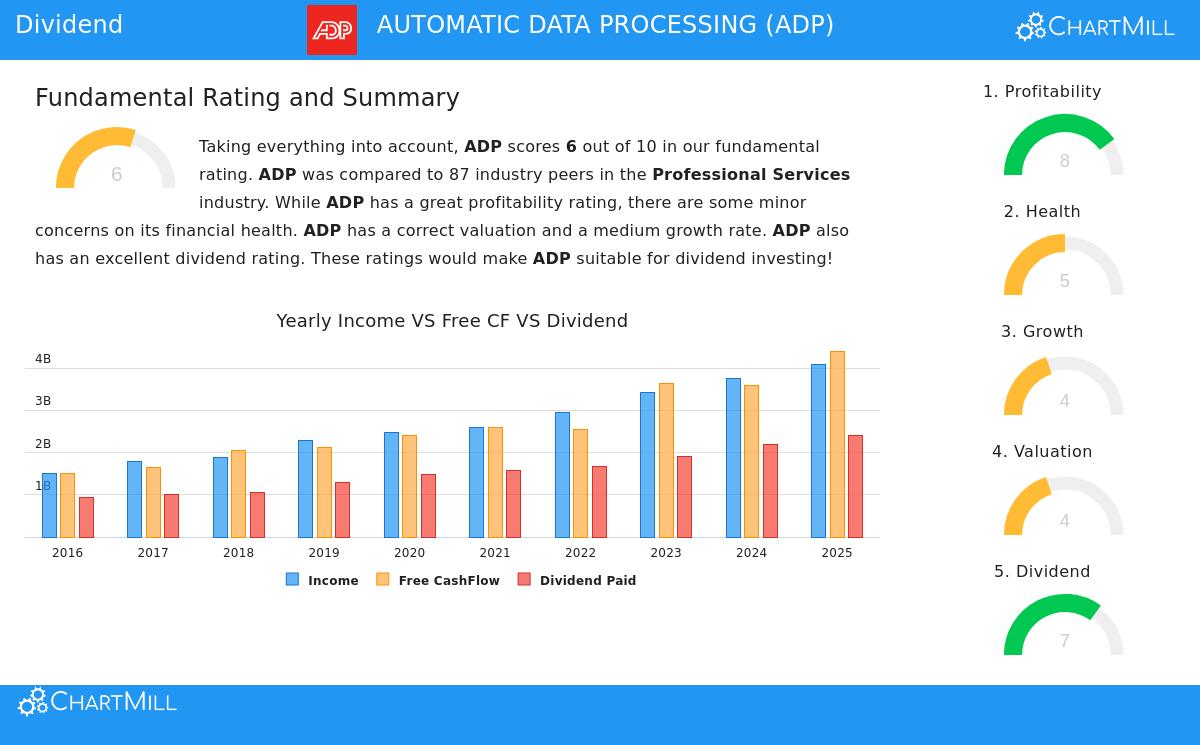
One company that comes up from such a methodical screen is Automatic Data Processing (NASDAQ:ADP), a top worldwide provider of human capital management services. The company’s presence on a "Best Dividend" screen indicates it deserves more attention from investors focused on income. By looking at its fundamental report, we can see why ADP fits the requirements of high dividend quality combined with business strength.
Dividend Profile: A Dependable and Increasing Payout
ADP’s attraction for dividend investors is based on its strong dividend rating, which judges the size, past consistency, and future viability of the payout.
- Appealing and Competitive Yield: ADP now provides a dividend yield of 2.76%. This is higher than the industry average of 1.45% and also exceeds the present S&P 500 average yield of about 1.82%. For investors, this means the stock delivers an above-average income compared to both similar companies and the wider market.
- Notable History of Increase: Dependability is important in dividend investing, and ADP has a proven record. The company has not only paid but also regularly raised its dividend for at least ten years in a row. The dividend has increased at a notable yearly rate of 11.62% over the last five years, showing a solid dedication to giving capital back to shareholders.
- Viability Factors: The report states that ADP pays out about 59% of its income as dividends. While this is above average, it normally stays within a workable range for an established, cash-producing business. However, a point for investors to note is the report's comment that recent profit increase has been lower than the dividend increase rate, which could strain viability if it persists. This shows the value of the next part: core earnings.
Supported by Solid Earnings
A high dividend is only as reliable as the company’s skill to pay for it. This is why sorting for acceptable earnings is a key partner to dividend measures. ADP performs well here, receiving a high earnings rating.
- Superior Returns: The company produces excellent returns on capital. Its Return on Invested Capital (ROIC) of 34.42% and Return on Equity (ROE) of 66.25% are with the best in its field, doing much better than most peers. This shows very efficient use of shareholder capital.
- Good and Widening Margins: ADP works with solid margins, including a Profit Margin of nearly 20% and an Operating Margin above 26%. These margins have displayed positive movement, getting better over recent years. Solid and widening margins supply the profit strength needed to back ongoing dividend payments and raises.
Judging Financial Condition
The last filter in the screening method—acceptable financial condition—serves as a protection. It makes sure the company is not using too much debt and can handle economic slowdowns without putting its dividend at risk. ADP’s condition rating shows a varied but overall workable view.
- Effective Debt Handling: A key plus is ADP’s solid free cash flow, which easily pays for its debt. The report says it would take under one year of free cash flow to settle all existing debt, a situation better than more than 80% of its industry rivals.
- Points to Watch: The analysis mentions two cautions. First, the Altman-Z score, a gauge of bankruptcy risk, is in an area that implies some financial risk, though this is partly linked to the industry setup. Second, liquidity ratios (Current and Quick Ratios) are lower than many peers. However, the report explains this by noting the company’s low total debt amount and strong cash flow coverage, which lessen these worries for an established business. For dividend investors, the main idea is that while the balance sheet is not perfect, the company’s exceptional cash production gives a major cushion.
Value and Increase Background
For a dividend stock meant for a long-term portfolio, value and increase outlook give background for total return possibility. ADP is not valued as a deep bargain stock; its P/E ratio matches its industry. However, its Price-to-Free-Cash-Flow ratio is more attractive, priced lower than many peers. Increase is stable, with mid-single-digit revenue increase and high-single-digit EPS increase expected, which supports the argument for continued, if possibly more moderate, dividend increase matching profits.
Conclusion
Automatic Data Processing (ADP) shows the kind of company a methodical dividend screen tries to find. It matches an appealing, well-supported, and increasing yield with the basic strengths of high earnings and sufficient financial condition. The company’s leading market place and consistent cash flows create the base of its shareholder returns. While investors should note the mentioned points on payout viability and balance sheet measures, ADP’s overall picture makes it a strong option for investors creating a durable dividend portfolio.
You can examine the complete, detailed fundamental analysis for ADP here.
This review of ADP came from a systematic screening process. If you want to investigate other companies that fit similar standards for solid dividends, good earnings, and reasonable financial condition, you can locate and adjust the "Best Dividend Stocks" screen yourself using this link: Explore the Best Dividend Stocks Screen.
Disclaimer: This article is for information only and does not make up financial advice, a suggestion to buy or sell any security, or a support of any investment plan. Investors should do their own study and think about their personal money situation and risk comfort before making any investment choices.