

For long-term investors aiming to build wealth through a disciplined, fundamental method, few strategies are as respected as Peter Lynch’s. As the famous manager of the Fidelity Magellan Fund, Lynch supported a philosophy of investing in what you understand, concentrating on companies with clear operations, maintainable growth, and fair prices. His method, often called Growth at a Reasonable Price (GARP), stays away from speculative trends by looking for firms that are profitable, financially sound, and priced in a way that does not overestimate their future. This strategy focuses on lasting competitive strengths and consistent development over temporary, excessive excitement.
A recent filter using Lynch’s main rules has found ADOBE INC (NASDAQ:ADBE) as a possible option for more study. The software leader, recognized for its Creative Cloud, Document Cloud, and Experience Cloud services, seems to match several important parts of the Lynch philosophy. We can look at how Adobe’s financial picture compares to the specific filters made to find good growth at a sensible price.
Match with Peter Lynch Rules
Peter Lynch’s filter looks for companies with a particular financial picture: strong but not extreme growth, high profitability, good financial condition, and a pleasing price when growth is accounted for. Adobe’s present measurements show a good match across these areas.
- Maintainable Earnings Growth: Lynch preferred companies with a steady history, usually seeking a 5-year earnings per share (EPS) growth rate between 15% and 30%. Growth above 30% was often seen as hard to maintain. Adobe’s 5-year EPS growth rate of 18.7% fits well within this range, showing a past of solid, controlled increase.
- Price Justified by Growth (PEG Ratio): A key part of the GARP method is the Price/Earnings to Growth (PEG) ratio. Lynch looked for companies with a PEG of 1 or below, indicating the market price is fair compared to the firm’s growth rate. Adobe’s PEG ratio, using past growth, is about 0.90, suggesting the stock could be priced low when its historical earnings growth is included.
- High Profitability (ROE): Strong return on equity (ROE) shows efficient use of shareholder money. Lynch’s filter usually needs an ROE above 15%. Adobe greatly passes this with an ROE of 59.1%, putting it with the best in its field and showing a very effective profit-making operation.
- Financial Condition Tests: The strategy focuses on balance sheet soundness. Two important filters are a Debt-to-Equity ratio below 0.6 and a Current Ratio of at least 1.0. Adobe fits both:
- Its Debt/Equity ratio of 0.53 shows a fair amount of debt, which is acceptable given its large cash flows.
- Its Current Ratio of 1.02 means it has enough short-term assets to meet its short-term debts.
Fundamental Condition and Price Summary
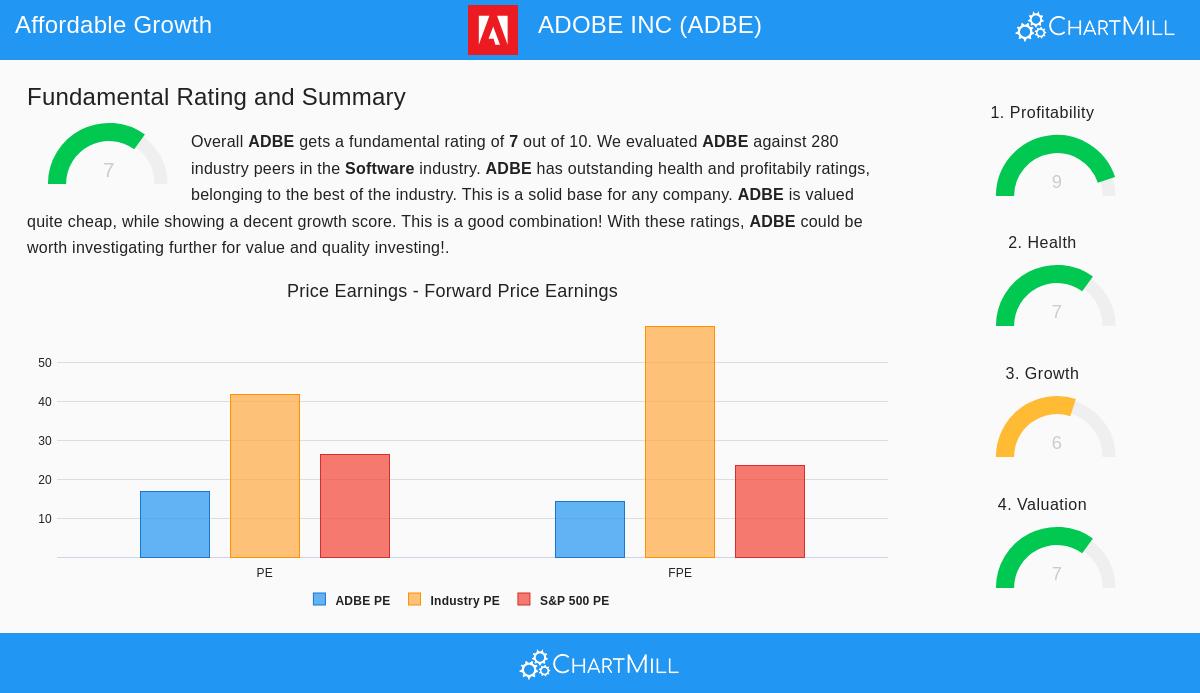
A wider view of Adobe’s fundamental analysis report supports the image from the Lynch filter. The company gets a high total score, with specific high points in profitability and financial condition.
Profitability is a clear high point. Adobe scores a 9 out of 10 here, having field-leading margins and returns. Its operating margin is over 36%, and its return on invested capital (ROIC) of more than 34% shows great skill in using capital to create profits.
Financial Condition is good. With a score of 7 out of 10, the company’s stability is very good, shown by a strong Altman-Z score and a low debt-to-free-cash-flow ratio. While its current and quick ratios are average next to some others, its overall profitability and cash flow strength lessen common liquidity worries.
Price seems fair. Scoring a 7, Adobe sells at a P/E ratio of 16.7, which is lower than both the wider S&P 500 and the average for the software field. Most of its price measurements, including Price/Free Cash Flow and Enterprise Value/EBITDA, are less expensive than most of its field competitors.
Growth is still positive, though slowing. The company has produced strong past growth in revenue and EPS. While future growth expectations are good, they forecast a more measured speed, which matches Lynch’s liking for maintainable, rather than very fast, increase.
You can see the full fundamental analysis for ADOBE INC (NASDAQ:ADBE) here.
An Option for the Long-Term Investor
For an investor following Peter Lynch’s ideas, Adobe offers a strong example. It works in an area many users know directly, creative and digital experience software, and has built a leading, subscription-based market place. The financial measurements show a company that is not only increasing but doing so with high profitability and careful financial handling. The price, especially when seen through the PEG ratio, does not seem to ask for a high cost for ideal conditions, instead giving what looks like a fair price for a high-quality operation.
It is key to note that a filter result is a beginning for more study, not a suggestion to buy. Lynch himself highlighted the need to understand the operation behind the figures. Investors should think about competitive risks, the addition of generative AI in its products, and the company’s capacity to keep its growth path in a developing market.
Want to look at other companies that pass the Peter Lynch filter? You can find the complete list and adjust the filter settings yourself using the Peter Lynch Strategy stock screener.
Disclaimer: This article is for information only and is not financial advice, a suggestion, or an offer to buy or sell any security. Investing has risk, including the possible loss of principal. You should do your own study and talk with a qualified financial advisor before making any investment choices.